Last updated: July 6, 2026
Gold has preserved purchasing power across centuries of wars, currency collapses, and economic crises. For U.S. investors, gold investing serves a specific purpose inside a portfolio: it tends to hold value — and sometimes gain value — during periods when equities, currencies, or confidence in financial systems come under pressure. That combination of durability and independence from corporate earnings makes gold a recurring topic in disciplined portfolio construction.
Why Gold Holds Value When Other Assets Fall
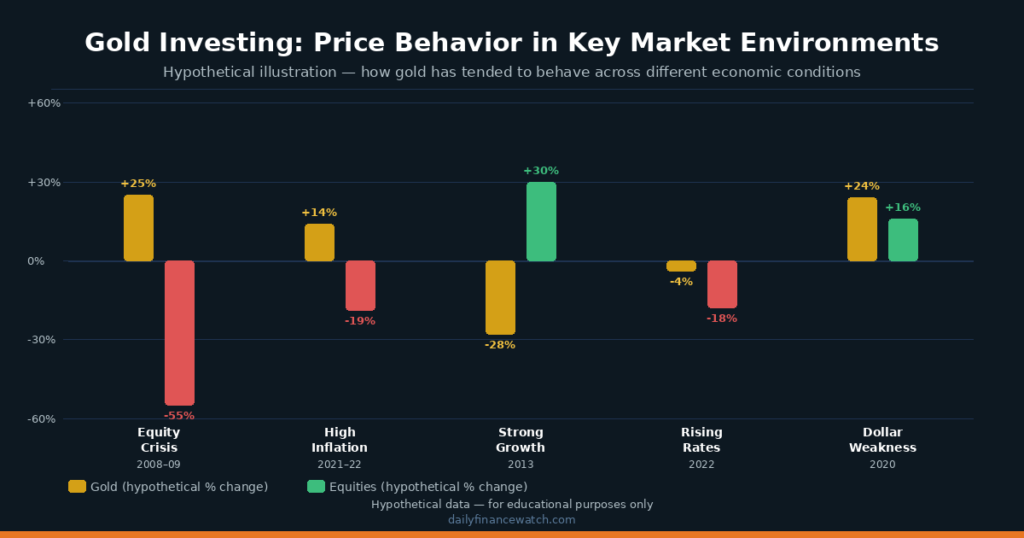
Caption: Gold prices have historically risen during equity drawdowns and high-inflation periods, though past performance does not guarantee future results.
Gold carries no counterparty risk. A share of stock depends on a company’s management, revenue, and solvency. A bond depends on the issuer’s ability to repay. Gold depends on nothing except its own scarcity and the collective recognition of its value. This structural independence is why central banks, sovereign wealth funds, and institutional investors hold gold alongside traditional financial assets.
The metal’s scarcity is real and measurable. The World Gold Council estimates that all the gold ever mined would fill roughly 3.5 Olympic-sized swimming pools — a finite supply that contrasts sharply with the elastic supply of paper money. When governments expand their money supply faster than economic output grows, the purchasing power of that currency tends to fall. Gold, which cannot be printed, has historically maintained its real value during such periods.
Gold as an Inflation Hedge — What the Data Shows
Gold’s reputation as an inflation hedge is well-established but nuanced. Over long time horizons — measured in decades — gold has broadly tracked the loss of purchasing power in the U.S. dollar. However, over shorter periods of one to five years, the relationship between gold prices and consumer price inflation can diverge significantly. Investors who expect an immediate or precise hedge against every inflationary episode may be disappointed.
The more consistent pattern is gold’s response to real interest rates — interest rates adjusted for inflation. When real rates are negative (meaning inflation exceeds nominal interest rates), gold tends to perform well because the opportunity cost of holding a non-yielding asset like gold falls. When real rates are strongly positive, gold faces more competition from yield-bearing instruments. The Federal Reserve’s H.15 release provides current nominal rate data that investors can compare against published inflation figures.
| Scenario | Real Interest Rate | Gold Tendency | Reason |
|---|---|---|---|
| High inflation, low rates | Negative | Favorable | Holding gold costs less relative to cash |
| Low inflation, rising rates | Positive | Unfavorable | Cash and bonds offer real yield competition |
| Financial crisis / stress | Mixed | Often favorable | Safe-haven demand rises regardless of rates |
| Strong dollar, stable growth | Positive | Unfavorable | Risk appetite flows to equities |
How Investors Access Gold in a Portfolio
Physical gold — bullion bars and coins — is the most direct form of ownership. However, storage costs, insurance, and liquidity limitations make physical gold impractical for most retail investors beyond a small allocation. Most investors gain gold exposure through financial instruments instead.
Gold ETFs (exchange-traded funds) track the price of gold and trade on major stock exchanges like any share of stock. The SPDR Gold Shares ETF (ticker: GLD) and the iShares Gold Trust (IAU) are among the largest and most liquid vehicles in the U.S. market. These funds hold physical gold in vaults on behalf of investors. ETF risk here includes the fund’s expense ratio — a small annual cost that slightly reduces returns relative to spot gold prices — and the fact that ETF ownership does not grant direct rights to the underlying metal.
Gold Mining Stocks and Leveraged Exposure
Gold mining companies offer a different risk profile. When gold prices rise, mining company revenues often increase faster than costs, expanding profit margins and potentially amplifying returns relative to gold itself. This is called operating leverage. However, mining stocks carry company-specific risks — management decisions, geopolitical exposure, production costs, and hedging programs — that physical gold or gold ETFs do not.
For example, consider a hypothetical mining company whose all-in sustaining cost (the total cost to produce one ounce of gold) is $1,200 per ounce. If gold trades at $1,800, the margin is $600. If gold rises to $2,100, the margin grows to $900 — a 50% margin expansion on a roughly 17% price move. This leverage works in reverse during gold price declines. A disciplined investor may compare the margin expansion potential against the added volatility before allocating to miners over physical gold exposure.
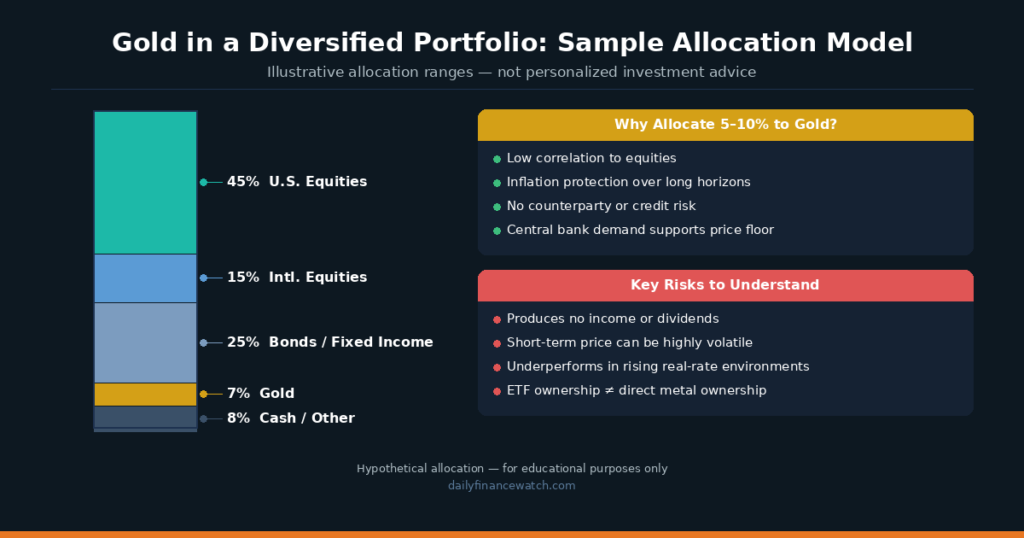
Caption: A small gold allocation — often cited between 5% and 10% — can reduce overall portfolio volatility without significantly reducing long-term expected returns.
Risks and Limitations of Owning Gold
Gold produces no income. It pays no dividend and generates no earnings. For an investor with a long time horizon and a primary goal of wealth accumulation through compounding, a large gold allocation can reduce total returns by replacing income-generating assets with a store-of-value asset. This opportunity cost is a real and recurring criticism of heavy gold allocations.
Gold prices can also be volatile in the short term. During the 2008 financial crisis, gold initially sold off sharply alongside equities as investors liquidated assets to meet margin calls — before recovering and rallying strongly into 2011. During rapid equity recoveries, gold often underperforms. Furthermore, the gold market can be influenced by currency movements, central bank buying and selling programs, and speculative positioning in futures markets that have little to do with fundamental supply and demand.
Common Mistakes Investors Make with Gold
Investor psychology creates predictable errors in gold allocation. Recency bias — the tendency to assume recent trends will continue — can drive investors to buy gold after a major rally, purchasing near a price peak rather than during periods of lower institutional interest. FOMO (fear of missing out) during gold’s strong performance periods in 2020 and 2022 led some investors to overweight the metal at elevated prices.
Anchoring is another risk. An investor who bought gold at $1,000 per ounce may anchor their expectations to that price and hold too long without reassessing whether the conditions that drove the original thesis — negative real rates, currency stress, systemic risk — still apply.
What Disciplined Investors Watch Before Buying Gold
Smart money flow into gold often reflects broader macro signals rather than short-term price action. Institutional investors and central banks tend to increase gold exposure when they observe a combination of rising fiscal deficits, currency debasement risk, falling real interest rates, and declining confidence in sovereign debt markets. Central bank gold demand has reached historically elevated levels in recent years, according to World Gold Council data, as emerging market central banks diversify reserves away from U.S. dollar holdings.
A disciplined investor may evaluate gold as a portfolio component by examining real interest rate trends, the U.S. dollar index, and the ratio of gold to the S&P 500 over time. This does not guarantee future performance, but it provides a framework grounded in structural monetary dynamics rather than short-term price momentum.
FAQ
What percentage of a portfolio should be in gold?
Most portfolio models suggest allocating between 5% and 10% of a portfolio to gold as a diversification tool. Some institutional frameworks go as low as 2% and as high as 15% depending on an investor’s risk tolerance, time horizon, and view on inflation. Higher allocations may reduce long-term compounding because gold generates no income. The appropriate level depends on individual financial circumstances. This content is educational, not personalized advice.
Why does gold rise when the dollar weakens?
Gold is priced in U.S. dollars globally. When the dollar loses purchasing power against other currencies, it takes more dollars to buy the same ounce of gold — so the dollar price of gold rises. Furthermore, a weakening dollar often reflects loose monetary policy or rising inflation expectations, both of which independently drive demand for gold as a store of value. The two forces — currency weakness and inflation risk — frequently appear together and reinforce gold demand.
Should investors own physical gold or a gold ETF?
Physical gold offers direct ownership with no counterparty risk and no annual fees, but requires secure storage and insurance, and can be illiquid for large amounts. Gold ETFs such as GLD or IAU are easy to buy, highly liquid, and low-cost, but carry a small expense ratio and do not give investors direct access to the metal. For most retail investors, a gold ETF is the more practical option. Physical gold may suit investors who want tangible ownership outside the financial system.
This content is for educational purposes only and does not constitute personalized financial advice. All investing involves risk, including the possible loss of principal.