Last updated: June 29, 2026
When the U.S. Dollar Index (DXY) — a measure of the dollar’s value against a basket of six major currencies — rises sharply, gold prices tend to fall. When the dollar weakens, gold tends to climb. This inverse relationship between dollar strength and gold is one of the most consistent patterns in global financial markets, and understanding why it exists gives investors a useful lens for reading macro conditions and managing portfolio risk.
Why Dollar Strength and Gold Move in Opposite Directions
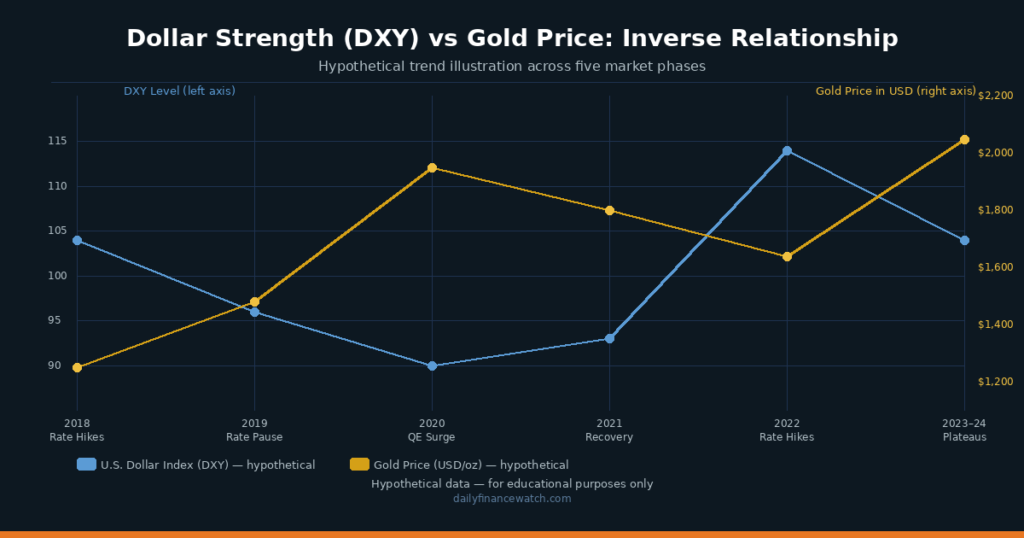
Caption: The DXY and gold price have historically moved in opposite directions across multiple market cycles, though short-term divergences do occur.
Gold is priced globally in U.S. dollars. This single fact explains most of the relationship. When the dollar strengthens against other currencies, it takes fewer dollars to buy one ounce of gold — so the dollar price of gold falls, even if gold’s value in euros, yen, or other currencies remains unchanged. The reverse is equally true. A weaker dollar makes gold cheaper in foreign currencies, which increases global demand and pushes the dollar price higher.
This mechanism operates through purchasing power, not just perception. A foreign investor holding euros who wants to buy gold must first convert euros into dollars. When dollar strength rises, that conversion becomes more expensive relative to the euro’s purchasing power, reducing effective demand from non-U.S. buyers. Consequently, global gold demand softens and prices adjust downward to reflect that reduced buying pressure.
When the Inverse Relationship Breaks Down
The dollar-gold inverse relationship is a tendency, not a law. During acute financial crises — such as the early weeks of March 2020 — both the dollar and gold can rise simultaneously. This happens because a severe liquidity shock prompts investors worldwide to sell everything, including gold, and convert the proceeds into dollars, the world’s reserve currency. Dollar demand spikes not because confidence in the dollar is strong, but because dollars are needed to meet immediate obligations.
Similarly, in environments where inflation fears dominate over currency strength concerns, gold can rise alongside a relatively stable dollar. Investors often watch real interest rates — nominal rates minus inflation expectations — rather than the nominal dollar level alone, because real rates more directly capture the true opportunity cost of holding gold over yield-bearing instruments.
| Market Environment | Dollar Trend | Gold Tendency | Key Driver |
|---|---|---|---|
| Fed rate hike cycle | Strengthening | Declining | Higher real yields reduce gold appeal |
| Fiscal deficit expansion | Weakening | Rising | Currency debasement risk increases |
| Global liquidity crisis | Spiking | Initially falls, then recovers | Emergency dollar demand dominates |
| Stagflation (high inflation + slow growth) | Mixed / Weakening | Rising | Inflation fear outweighs rate pressure |
| Strong U.S. growth, stable rates | Strengthening | Flat to declining | Risk appetite shifts to equities |
How the U.S. Dollar Index Works and Why It Matters
The DXY measures the dollar against a weighted basket of six currencies: the euro (57.6% weight), Japanese yen (13.6%), British pound (11.9%), Canadian dollar (9.1%), Swedish krona (4.2%), and Swiss franc (3.6%). Because the euro carries the largest single weight, movements in euro/dollar exchange rates drive much of the DXY’s daily fluctuation.
Investors track the DXY because it provides a single, liquid reference point for dollar conditions across global markets. The Intercontinental Exchange (ICE) publishes real-time DXY data, and futures contracts on the DXY trade on the ICE Futures U.S. exchange. A reading above 100 on the DXY indicates the dollar is stronger than its 1985 baseline. A reading below 100 indicates relative weakness.
The Federal Reserve’s Role in Driving Both Assets
The Federal Reserve is the most important single institution shaping the relationship between dollar strength and gold. When the Fed raises interest rates, U.S. Treasury yields rise, making dollar-denominated assets more attractive to global capital. Foreign investors buy dollars to purchase Treasuries, which pushes the DXY higher. Simultaneously, the rising opportunity cost of holding non-yielding gold reduces its appeal, pulling gold prices lower.
When the Fed cuts rates or expands its balance sheet through asset purchases, the opposite dynamic unfolds. Lower yields reduce the incentive to hold dollars, the DXY softens, and gold becomes relatively more attractive. The 2018–2019 Fed rate pause and the 2020 quantitative easing program both illustrate this mechanism. You can monitor current Fed policy decisions and statements through the Federal Reserve’s official website.
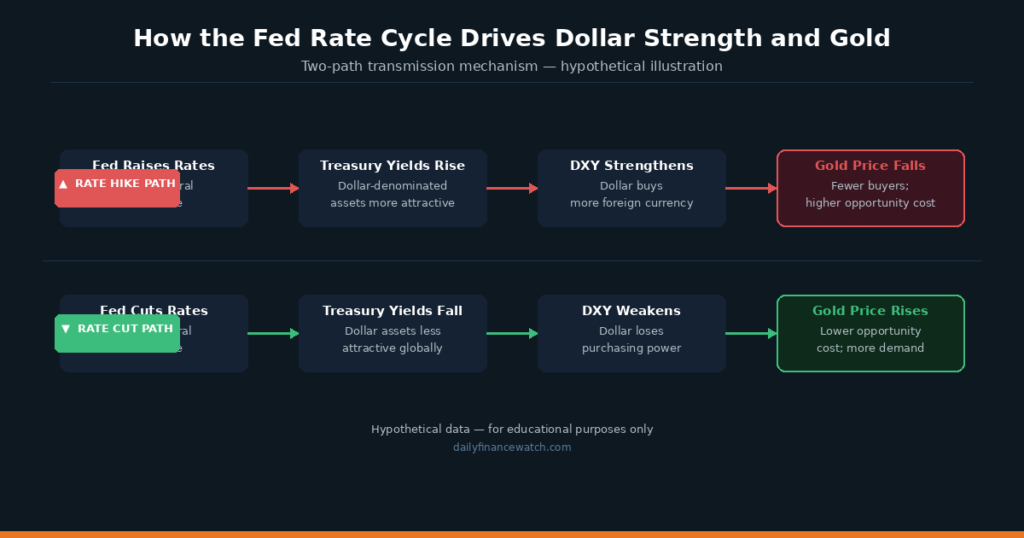
Caption: Fed rate decisions set off a chain reaction through Treasury yields, dollar demand, and gold pricing that disciplined investors track as a leading macro signal.
What Happens to Gold When the Dollar Loses Reserve Status Risk
Beyond day-to-day trading dynamics, a longer-term structural debate surrounds the dollar’s role as the world’s primary reserve currency. Central banks worldwide hold approximately 58% of their foreign exchange reserves in dollars, according to International Monetary Fund data. This reserve demand creates a structural floor under dollar strength that competes with gold as a store of sovereign value.
When confidence in any reserve currency weakens — because of sustained fiscal deficits, political instability, or loss of military and economic dominance — central banks historically diversify into gold. World Gold Council data shows that central bank net gold purchases reached multi-decade highs in 2022 and 2023, driven in part by emerging market central banks reducing dollar concentration after geopolitical disruptions froze Russian dollar reserves. This structural buying provides long-term demand support for gold that operates independently of the short-term dollar trading relationship.
For a U.S.-based investor, this distinction matters. Short-term dollar-gold movements are useful for tactical timing signals. Long-term structural shifts in reserve currency composition are a separate, slower-moving force that can sustain gold demand even during periods of moderate dollar strength.
How Disciplined Investors Use the Dollar-Gold Relationship
Smart money analysis of the dollar-gold dynamic typically focuses on real interest rates and the DXY trend together rather than either indicator alone. A rising DXY alongside falling real rates — which can occur when inflation rises faster than nominal yields — may suggest that gold remains supported despite nominal dollar strength. A rising DXY accompanied by rising real rates typically presents a more challenging environment for gold.
A disciplined investor may also track gold’s performance in non-dollar currencies as a cross-check. If gold is rising in euros, yen, and Australian dollars simultaneously — not just in U.S. dollar terms — it suggests that demand is driven by global factors beyond currency translation effects alone. This multi-currency lens can help distinguish genuine gold demand from simple dollar weakness.
Investor psychology adds another layer of complexity. Recency bias — the tendency to assume recent trends will continue — can cause investors to avoid gold during extended periods of dollar strength, even when structural conditions for eventual dollar weakness are building. Confirmation bias — seeking information that supports an existing view — can push investors to overweight dollar-negative headlines while dismissing signs of dollar resilience. A disciplined macro framework, reviewed at set intervals rather than reacting to daily price moves, reduces the behavioral risk of mistiming either asset.
For investors building on these concepts, why investors buy gold and how central banks move money flow provide the foundational context that connects currency dynamics to practical portfolio decisions.
FAQ
What does a strong dollar mean for gold prices?
A strong dollar typically puts downward pressure on gold prices. Because gold is priced globally in U.S. dollars, a stronger dollar makes gold more expensive for foreign buyers, reducing international demand. Additionally, dollar strength often reflects higher U.S. interest rates, which increase the opportunity cost of holding non-yielding gold relative to Treasuries or cash. However, this relationship can break down during inflation spikes or financial crises when gold demand rises for reasons unrelated to currency movements.
Why do central banks hold both dollars and gold?
Central banks hold dollars because the U.S. dollar remains the world’s dominant reserve currency, widely used in global trade and debt contracts. They hold gold because it carries no counterparty risk — unlike dollars, which depend on the creditworthiness of the U.S. government. Gold also cannot be frozen or sanctioned. Following the 2022 freeze of Russian dollar reserves, many emerging market central banks accelerated gold purchases to reduce dependence on any single nation’s currency as a reserve asset.
How can investors track the dollar-gold relationship themselves?
Investors can monitor the U.S. Dollar Index (DXY) through financial data platforms or the ICE exchange website and compare it against spot gold prices, available through major brokerage platforms or the World Gold Council. Plotting both on the same chart over a one- to five-year period reveals the general inverse trend and periods of divergence. Watching real interest rates — available through the Federal Reserve’s FRED database as the 10-year TIPS yield — adds a third variable that sharpens the analysis considerably.
This content is for educational purposes only and does not constitute personalized financial advice. All investing involves risk, including the possible loss of principal.