Last updated: July 1, 2026
Most long-term investing guides rank five beginner strategies as if they were equal levers. In reality, one of them — cost discipline — silently governs whether the other four actually work. On January 1, 2008, Warren Buffett bet $1 million on exactly that idea. He picked a low-cost S&P 500 index fund against a basket of hedge funds. Ten years later, he had won by a wide margin. Time in market, diversification, dollar-cost averaging, low costs, and an early start all describe one principle from different angles. Consequently, the beginner who understands that hierarchy holds an edge most strategy lists never mention.
Long-Term Investing Starts With Time in the Market
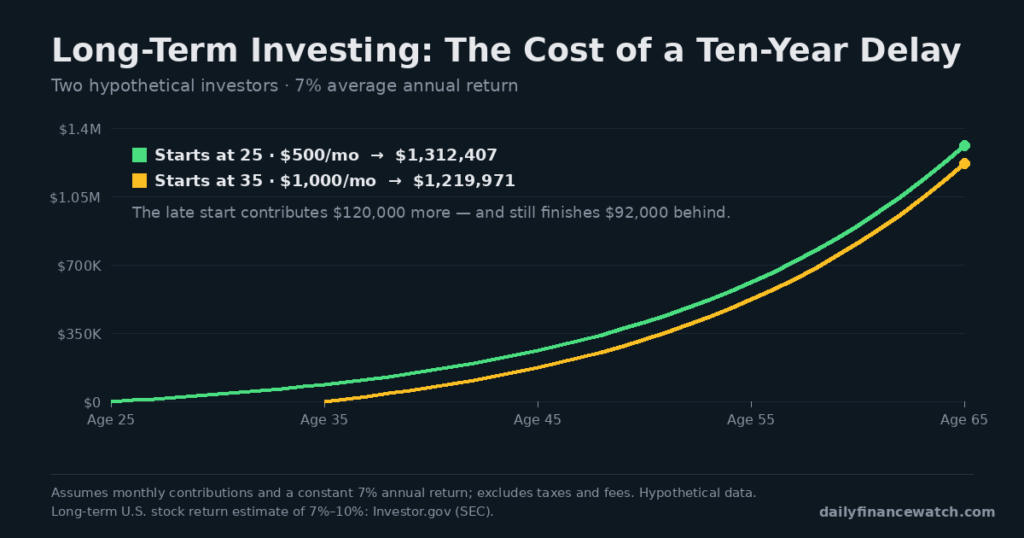
Ten fewer years cost more than doubling the monthly contribution ever recovers.
Compound growth is why the first strategy is time in market rather than timing the market. According to the SEC’s Investor.gov, a 7% to 10% annual return is a common long-term estimate for diversified U.S. stocks. That number matters less than what happens after it. However, the compounding process only works while the money stays invested. Missing even a few of the market’s best days changes the outcome dramatically. Most gains cluster in short, unpredictable rallies. In reality, this is the mathematical case against attempted market timing. A beginner does not need to identify the best days — only to be present for them.
Why Long-Term Investing Rewards the Early Start
The math is straightforward but easy to underweight. A dollar invested at 7% doubles roughly every ten years. Consequently, an investor who starts at 25 gets one extra doubling by retirement compared to one who starts at 35. That gap holds even when the older investor contributes twice as much. In particular, the extra doubling is not intuition — it is arithmetic. Furthermore, most beginner regret over “starting late” is really regret over losing that final doubling. Long-term investing rewards early, small, and consistent contributions more than late, large, and irregular ones.
Two Habits That Remove Guesswork: Diversification and Dollar-Cost Averaging
Two strategies remove the need to predict the market: diversification and dollar-cost averaging. Diversification is what an index fund provides automatically. A single S&P 500 fund holds 500 companies weighted by market capitalization. Because of that, a beginner buying one index fund gets more diversification than most hand-picked portfolios. Twenty to thirty individually chosen stocks rarely match a single index fund’s spread. Furthermore, the SEC’s Investor.gov describes diversification as spreading investments across different asset types to lower overall portfolio risk.
Dollar-cost averaging is the second automatic habit. Investing a fixed dollar amount on a set schedule buys more shares when prices are lower. It buys fewer shares when prices are higher. For example, many beginners invest $500 monthly into an S&P 500 ETF such as SPY. In addition, this pattern removes the timing decision entirely. Over time, the average price paid tends to sit below the average market price during the period. A beginner who has already opened a brokerage account can automate this with one setting. Setting up an automatic monthly transfer turns dollar-cost averaging into a background process.
A common piece of advice for beginners is to hold many different stocks to reduce risk. However, that framing confuses the mechanism. In reality, a broad index fund already holds hundreds of stocks and captures diversification more cheaply than any hand-picked portfolio. Institutional investors reserve individual stock selection for concentrated bets on specific research — not as their default diversification tool. For a beginner, spreading capital across 20 or 30 selected names typically creates the illusion of diversification. This approach adds trading friction and lower risk-adjusted returns.
The Buffett Bet: Why Cost Discipline Rules Long-Term Investing
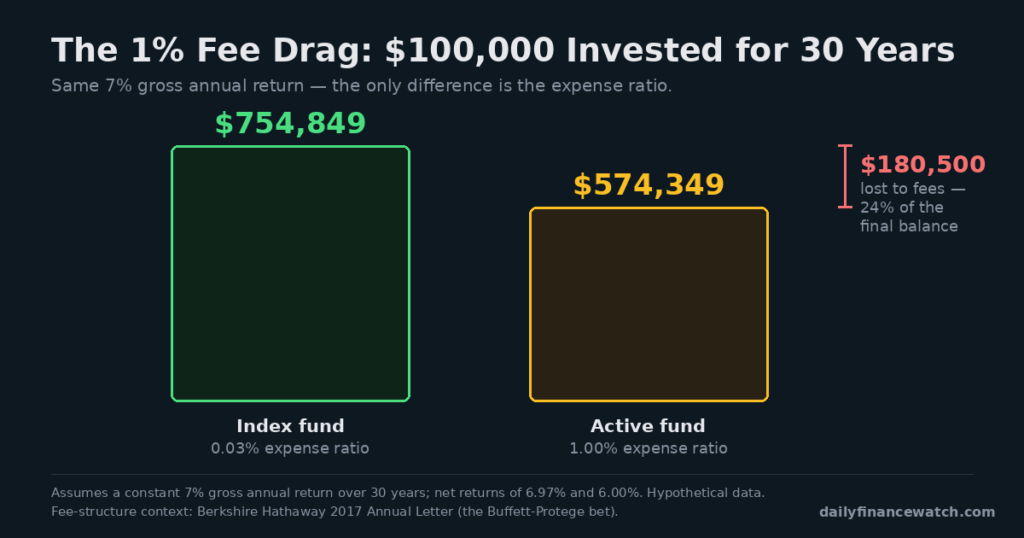
The quieter number on the fee line decides a quarter of the outcome.
The clearest historical evidence for cost discipline is Warren Buffett’s ten-year bet. The wager ran from January 1, 2008, to December 31, 2017. According to his 2017 Berkshire Hathaway annual letter, Buffett reported the results. The low-cost S&P 500 index fund returned 8.5% annualized. Meanwhile, the five funds-of-funds selected by Protégé Partners returned between 0.3% and 6.5% annualized. One of the five even liquidated before the bet ended. The performance gap did not come from bad stock picking. It came from layered fees.
| Investment | Annualized Return (2008–2017) | Outcome |
|---|---|---|
| S&P 500 index fund | 8.5% | Won the bet |
| Five funds-of-funds (Protégé Partners) | 0.3% – 6.5% | All five trailed; one liquidated |
Source: Berkshire Hathaway 2017 Annual Letter, Warren Buffett (February 2018).
Cost differences look small in isolation but compound over long horizons. Consider two investors who each start with $100,000 and earn a 7% gross annual return for 30 years. However, one holds a low-cost index fund charging 0.03% per year in expense ratios. The other holds an actively managed mutual fund charging 1.00% per year. By comparison, at 6.97% net, the first investor ends with about $755,000. At 6.00% net, the second investor ends with about $574,000. In particular, the 1% cost differential silently claims roughly $180,000, or nearly a quarter of the final balance. Consequently, this drag operates every year, whether the market goes up or down.
The Behavior Layer: Why Psychology Breaks Good Strategies
Even the correct strategies fail when behavior overrides them. Loss aversion is the tendency to feel losses about twice as strongly as equivalent gains. This bias pushes beginners to sell during declines and freeze during recoveries. Meanwhile, recency bias makes the last twelve months feel like the next twelve. In addition, herd behavior turns social-media commentary into perceived market signals. For example, the SEC has warned that short-term trading driven by social-media discussion carries significant risk. However, none of these behaviors are personal failings. They are default cognitive settings that show up in every generation of investors.
The corrective is not to eliminate emotion but to remove decisions. Automatic monthly contributions, index-fund allocations, and pre-committed rebalancing rules operate independently of how the reader feels about markets that month. Because of that, they neutralize the most expensive behavioral traps. Consequently, the practical goal is fewer discretionary moments per year, not more informed ones.
The five strategies beginner articles rank as separate levers describe one principle from different vantage points. However, they are not equally weighted. In particular, time in market amplifies whatever return the underlying investments deliver. Diversification and dollar-cost averaging automate away timing decisions. In addition, behavioral automation prevents the same decisions from being unmade in a panic. Cost discipline, meanwhile, is the multiplier that determines what is left after the market delivers. Long-term investing that ignores fees looks identical to an approach that respects them at first. Over time, compounding makes the gap permanent. For most beginners, the practical first move is simple. Pair a broad index fund with automatic monthly contributions, and leave it undisturbed.
For related reading: What Is an Expense Ratio? and Best ETFs for Beginners.
Frequently Asked Questions
How much do fund fees affect returns over 30 years?
Over 30 years, a 0.03% index fund and a 1% actively managed fund produce dramatically different final balances. The cost differential silently claims about a quarter of the wealth. That drag operates every year, regardless of market direction. However, no fund manager can reliably promise a stock-picking edge that overcomes it. In addition, the Buffett bet showed that even sophisticated managers failed. Their 2%+ fee structure could not overcome a low-cost index fund over ten years.
What is dollar-cost averaging and how does it work?
Dollar-cost averaging means investing a fixed dollar amount on a set schedule — typically monthly. The investor buys more shares when prices are lower and fewer when prices are higher. Over time, the average price paid tends to fall below the average market price. In addition, the pattern removes the timing decision, which is where most beginner mistakes cluster. A common structure automates $200 to $500 monthly, from a checking account into an index fund.
Can a beginner start with just one index fund?
Yes, and many financial educators consider a single broad-market index fund the cleanest starting portfolio for a new investor. A total U.S. stock market fund or an S&P 500 fund provides exposure to hundreds of companies weighted by size. Furthermore, adding a second or third fund often introduces overlapping holdings without meaningful diversification improvement. In reality, complexity enters the portfolio only when it must. That trigger is usually a specific time-horizon, tax, or income-source requirement.
This content is for educational purposes only and is not personalized financial advice. Investing involves risk, including possible loss of principal.
© 2026 Daily Finance Watch. Excerpts under 50 words with attribution and a link back are permitted. Full-article reproduction requires written permission.