Last updated: July 5, 2026
Buying an S&P 500 index fund sounds like instant diversification across 500 companies. Actually, AI-driven mega-cap growth has concentrated that index far more than most investors realize.
What “AI Stocks” Actually Means
Specifically, AI stocks refers to companies whose business ties closely to artificial intelligence. Also, this includes chipmakers, cloud infrastructure providers, and software companies building AI features. According to Investor.gov, diversification means spreading money among different investments to reduce risk. You can review the official guide at investor.gov. However, a single sector trend can undermine that diversification. This can happen even inside a broad-market fund.
The Thesis: Why “500 Companies” Overstates Your Diversification
Here is the mechanism behind the thesis. Notably, the S&P 500 is not weighted equally across its 500 members. Instead, it uses float-adjusted market-capitalization weighting. According to S&P Dow Jones Indices, larger companies receive proportionally larger index weights. As a result, a handful of mega-cap AI-exposed companies can dominate index composition.
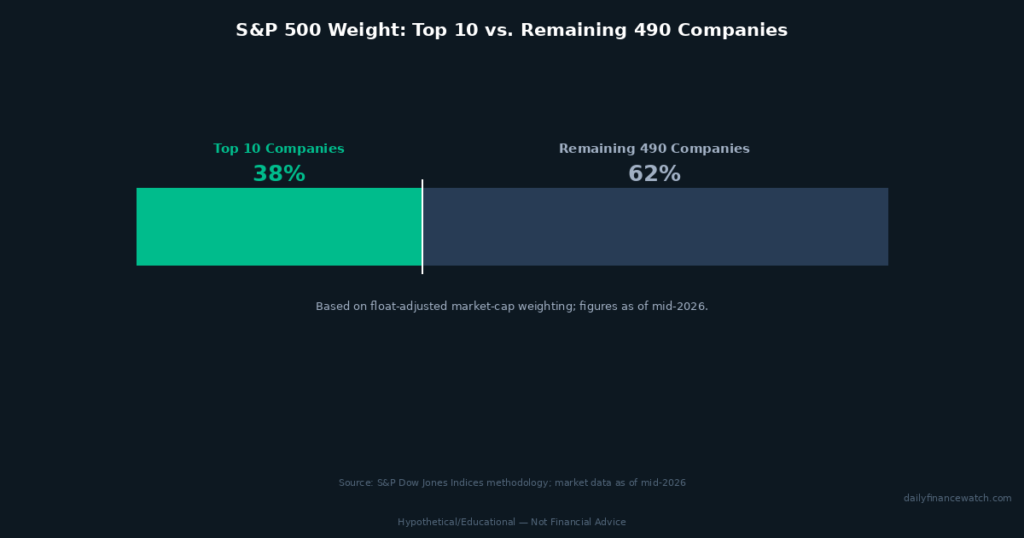
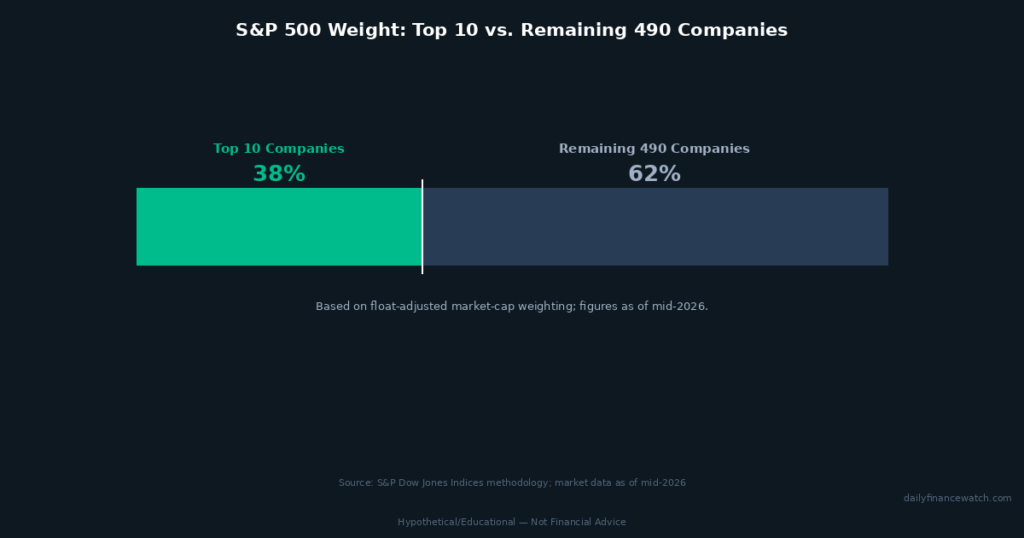
A stacked bar showing the top 10 S&P 500 companies’ combined weight versus the remaining 490.
The Concentration Has Grown Historically Large
As of mid-2026, the picture looks stark. The 10 largest S&P 500 companies account for roughly 38% of the index’s total value. Notably, this concentration nearly doubled from around 20% in 2015. Historically, average top-10 concentration has run closer to 24%. Before the recent AI-driven run-up, the previous high point was 28%, reached back in 1970.
The Experience Anchor: What Sits Inside That Top 10
Several of today’s largest companies derive substantial value from AI infrastructure. This includes chips and software tied to AI development. Specifically, Nvidia alone represented over 7% of the index by mid-2026. This reflects heavy demand for AI data center hardware. When investors buy a standard S&P 500 fund, they automatically inherit this concentrated exposure. Notably, this happens regardless of whether they intended to invest heavily in AI.
Earnings Concentration Tells a Related Story
Notably, the top 10 companies do not just dominate market value. Also, they generate a disproportionate share of index earnings. Recent data shows the top 10 accounted for roughly 31% of S&P 500 earnings. This represents a smaller share than their 38% market-value weight. This gap suggests something important. Valuations for these companies have run somewhat ahead of their current profit contribution.
A bar chart showing S&P 500 top-10 concentration percentages across five decades.
How to Actually Evaluate an AI Stock
Notably, traditional valuation metrics require adjustment for AI-focused companies. Specifically, many are spending heavily on research and infrastructure before generating proportional revenue. Notably, comparing revenue growth trends often reveals more than current profit margins alone. Additionally, checking what percentage of total revenue actually comes from AI products matters. Some companies market AI capabilities prominently. However, their AI-specific revenue remains a small fraction of total business.
Watch for Overstated AI Claims
Notably, regulators have taken action against companies exaggerating AI capabilities. This mirrors the greenwashing pattern discussed in our guide on ESG investing. In both cases, marketing language outpaced what a company’s actual practices could support. Instead, reading specific disclosures about AI revenue provides a clearer picture. This matters more than relying on press releases alone.
Concentration Risk Cuts Both Ways
Notably, high concentration in dominant companies is not automatically bad. Specifically, these companies currently generate substantial cash flow. They also hold genuine competitive advantages in their markets. However, concentration carries a specific risk. A downturn in AI sentiment could disproportionately affect a “diversified” index fund. This holds true even if only a handful of companies disappoint on earnings. Instead, some investors manage this exposure through equal-weighted alternatives. These distribute risk more evenly across all 500 constituents, rather than weighting by size.
The Anti-Advice Reminder
Several factors determine whether concentrated AI exposure fits your portfolio. These include your risk tolerance, time horizon, and your understanding of actual fund composition. Notably, no index fund guarantees protection from sector-specific downturns. This holds true regardless of how many total companies it holds. Before assuming broad diversification, review your fund’s actual top holdings. Also, consider their combined weight relative to the total fund. Consulting a financial professional can help you decide whether additional diversification makes sense.
An S&P 500 index fund technically holds 500 companies. However, its performance increasingly depends on a small group of AI-exposed giants. Ultimately, understanding that concentration matters more than assuming the number “500” guarantees broad diversification.
This article is for educational purposes only. It does not constitute financial advice. Market concentration levels and company weightings change frequently.
© 2026 Daily Finance Watch. All rights reserved.