When you buy a single share of Apple, you own a small piece of a real company. That share gives you a legal claim on its assets and future profits. Understanding what is a stock begins with this simple idea of ownership. A stock is a unit of ownership in a public corporation. Investors buy shares because they want a portion of the company’s growth. However, prices move up and down daily, so losses remain a real possibility.
What Is a Stock? The Foundation of Share Ownership
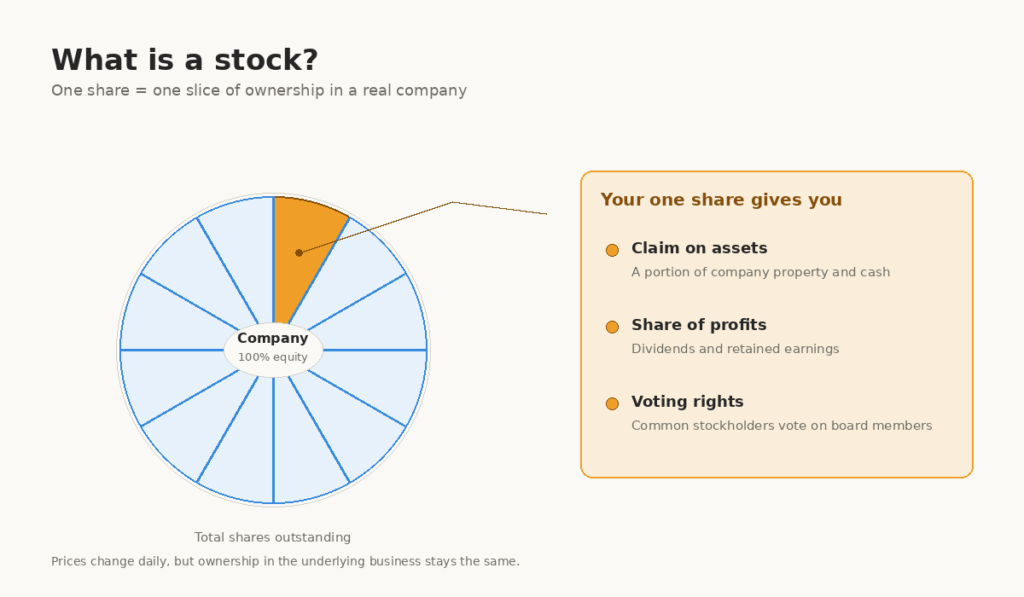
A stock, also called a share or equity, represents partial ownership in a corporation. Equity simply means an ownership stake in a business. When a company sells shares to the public, it raises money to expand. In return, each shareholder owns a small fraction of that company.
Companies issue two main kinds of shares. Common stock gives holders voting rights and variable dividends. A dividend is a cash payment made from company profits. Preferred stock pays fixed dividends but usually carries no voting power. For example, preferred holders receive payments before common holders during financial trouble.
| Feature | Common Stock | Preferred Stock |
|---|---|---|
| Voting rights | Yes | Usually none |
| Dividend type | Variable, not guaranteed | Fixed, paid first |
| Growth potential | Higher | Lower |
| Payout priority in bankruptcy | Last | Before common stock |
This structure explains why most beginners start with common stock. Therefore, your returns depend mainly on long-term business performance, not short-term price swings.
How Stocks Work and Why Prices Move
Public companies list their shares on exchanges such as the New York Stock Exchange and Nasdaq. Buyers and sellers meet there and agree on a price. As a result, a stock price reflects what investors will pay at that moment. This price changes constantly during trading hours.
Several forces move share prices over time. Earnings reports, interest rates, and economic news all matter. In addition, investor psychology pushes prices beyond what the numbers justify. Because emotion drives short-term trading, prices often swing more than fundamentals suggest.
The U.S. Securities and Exchange Commission explains how trades are matched and executed. You can review the basics through the SEC’s guide on how stock markets work. This source helps beginners understand orders and exchanges clearly.
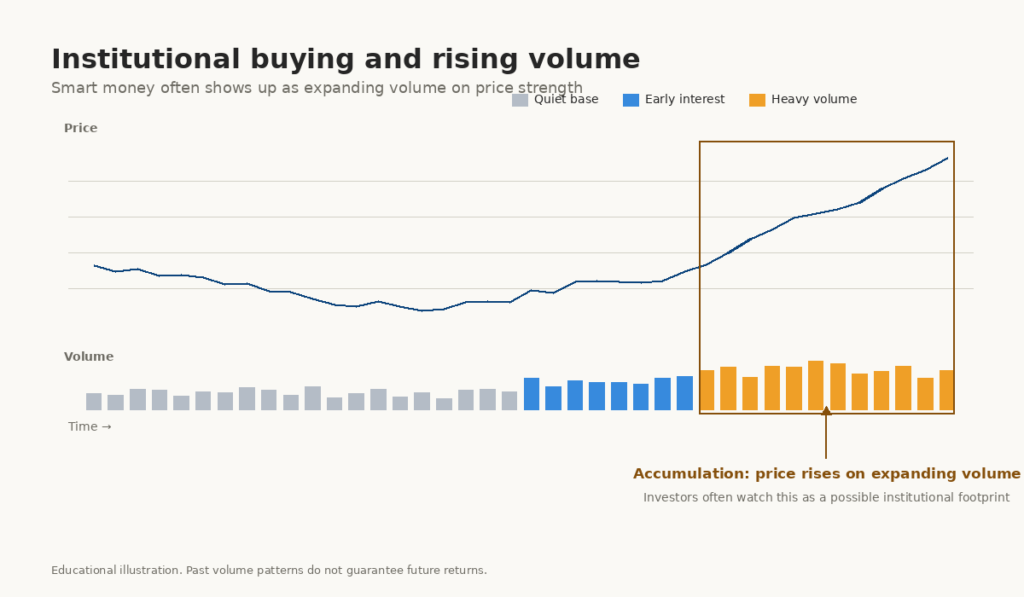
Disciplined investors watch more than the daily price. Institutional buying, rising trading volume, and relative strength can signal growing interest. Relative strength measures how a stock performs against the broader market. This may suggest accumulation, but it does not guarantee future returns.
The Real Advantages and Risks of Owning Stocks
Stocks offer one major advantage: long-term growth potential. Over long periods, U.S. stocks have historically rewarded patient investors. According to the SEC, large-company stocks have still lost money in roughly one of every three years. Therefore, knowing what is a stock means accepting real risk alongside potential reward.
| Advantages | Risks |
|---|---|
| Long-term growth potential | Prices can fall sharply |
| Ownership and voting rights | No guaranteed dividends |
| Liquidity and easy trading | Emotional decisions hurt returns |
| Dividend income from some firms | Companies can fail entirely |
A Simple Example With Microsoft
Imagine you buy 10 shares of Microsoft at a hypothetical price of $400 each. Your total investment equals $4,000. If the price rises to $440, your shares are worth $4,400. However, if it falls to $360, your value drops to $3,600. This example shows how gains and losses both depend on price movement.
Many investors connect stock selection to long-term megatrends. Artificial intelligence, semiconductors, and cloud computing now drive growth across the market. For instance, demand for AI infrastructure has lifted interest in chipmakers. A disciplined investor may compare valuation against this growth instead of chasing price. Our overview of reading stock valuation ratios can help with that step.
Common Beginner Mistakes and Smart Money Habits
Common Mistakes Beginners Make
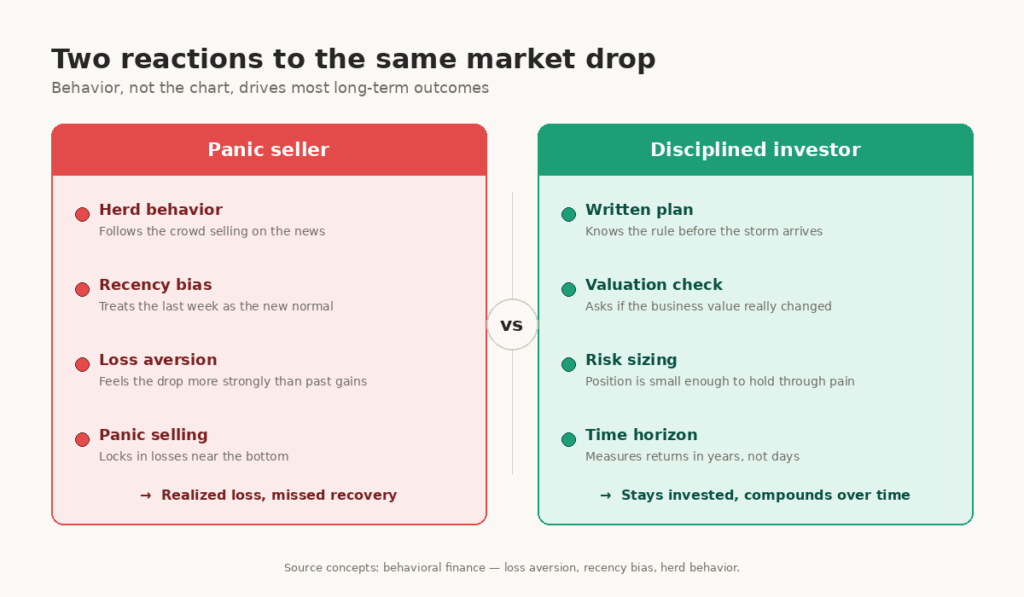
New investors often repeat the same errors. Many chase stocks only after large price gains. This reflects FOMO, the fear of missing out that drives late buying. Others sell during normal declines. Panic selling locks in losses that patience might have avoided.
Smart Money Best Practices
Experienced investors follow a steady process instead of emotion. They study balance sheet strength, free cash flow, and consistent earnings. Free cash flow is the cash a company keeps after expenses and investments. In contrast, beginners often focus only on recent price action. This means a clear plan matters more than any single trade.
Behavioral finance explains why people act against their own interest. Loss aversion means investors feel losses more strongly than equal gains. Recency bias makes recent events feel more important than they truly are. Because these biases distort judgment, awareness becomes a real advantage. You can also review investor protections on the SEC’s stocks information page.
A stock gives you ownership, growth potential, and real risk at the same time. Smart investors respect all three together. Therefore, learning the basics protects you before you commit any capital. Start small, stay patient, and let understanding guide each decision.
For further reading, explore these related guides:
What is the difference between a stock and a bond?
A stock represents ownership in a company, while a bond represents a loan to a company or government. Stockholders share in profits and losses through price changes and dividends. Bondholders instead receive fixed interest and repayment at maturity. Therefore, stocks offer higher growth potential but usually carry greater risk than most bonds.
How much money do I need to start buying stocks?
You can start with a small amount today because many brokers offer fractional shares. A fractional share lets you buy part of one full share. For example, you could invest twenty dollars in a high-priced stock. However, start only with money you can leave invested for years, since prices fluctuate in the short term.
Should beginners buy individual stocks or index funds?
Beginners often reduce risk by starting with broad index funds before picking individual stocks. An index fund holds many companies at once, which spreads risk widely. Individual stocks can grow faster, but they can also fall harder. As a result, many disciplined investors combine both. Your choice should match your goals, time horizon, and comfort with risk.