On any given Monday morning, billions of dollars trade hands within the first hour of trading at the New York Stock Exchange. Each transaction represents a real buyer and a real seller agreeing on a price for one company. Understanding what is the stock market starts with this simple idea of an organized marketplace where shares change hands. The stock market is the network of exchanges and trading venues where shares of public companies are bought and sold. It serves individual investors and large institutions every business day. However, the system carries genuine risk, so learning how it works matters before you commit any money.
What Is the Stock Market and Why It Exists
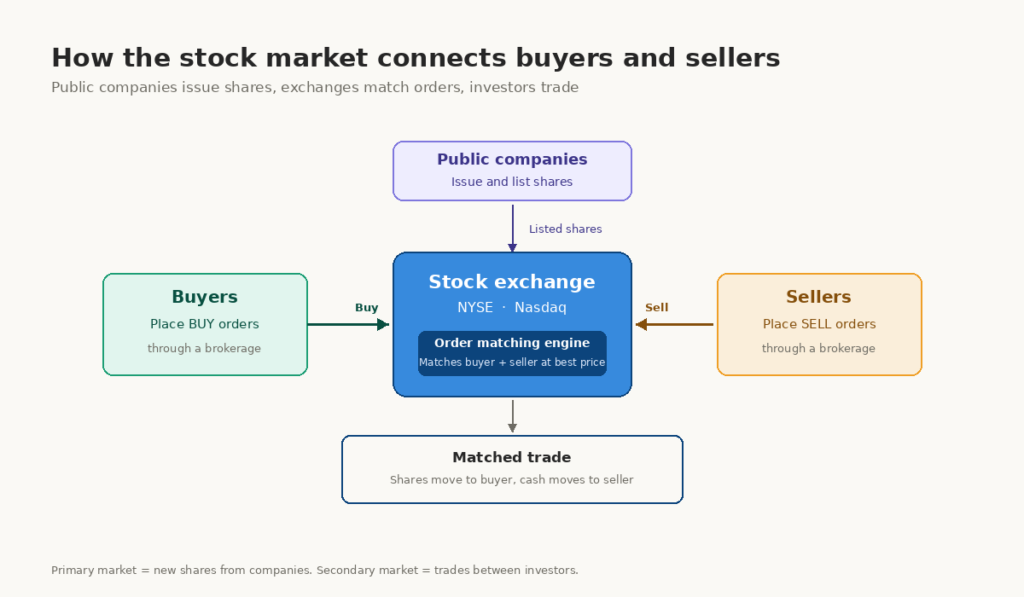
The stock market is a coordinated network of exchanges where shares of public companies trade. A share represents a small ownership stake in a real business. Investors place orders through regulated brokerage accounts during set trading hours. Therefore, the market acts as a price discovery system that runs throughout each business day.
This system actually has two related parts. The primary market is where companies issue new shares directly to investors. For example, an initial public offering, or IPO, happens in the primary market. In contrast, the secondary market is where investors trade existing shares with each other. Most daily activity takes place in the secondary market.
| Market type | What happens there | Main benefit |
|---|---|---|
| Primary market | Company issues new shares | Business raises capital |
| Secondary market | Investors trade existing shares | Investors gain liquidity |
| Over-the-counter | Trades happen off main exchanges | Smaller or foreign companies |
Companies use this system to raise capital for growth, hiring, and new projects. As a result, the market connects savers who hold capital with businesses that need it. Our guide on what a single share actually represents explains the ownership side in more detail.
How Stock Exchanges Match Buyers and Sellers
The two largest U.S. exchanges are the New York Stock Exchange and Nasdaq. Both match buyers and sellers through computer systems, though their structures differ. The NYSE still uses designated market makers on a physical trading floor. Meanwhile, Nasdaq operates as a fully electronic market with competing market makers.
A typical trade follows a clear path. First, an investor places an order through a regulated brokerage. Next, the broker routes the order to an exchange or other trading venue. The exchange then matches the order with a willing counterparty at the best available price. Furthermore, this entire process now finishes in fractions of a second.
Orders fall into two main types every investor should know. A market order executes immediately at the current best available price. In contrast, a limit order executes only at a specific price or better. Because limit orders give you direct price control, many disciplined investors prefer them in volatile market conditions.
Major Indexes That Track the Stock Market
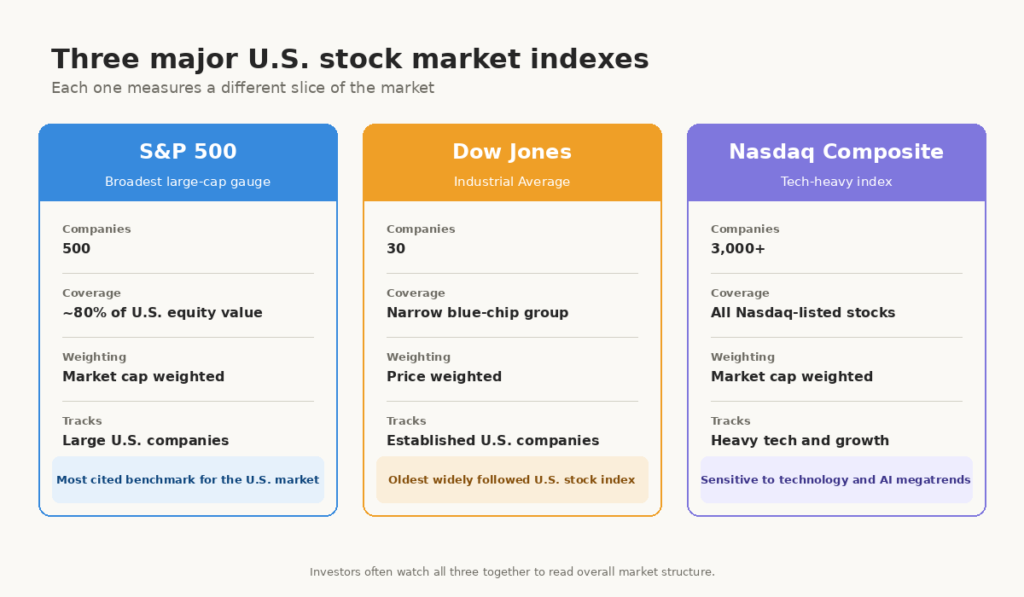
Investors measure overall performance through indexes. An index calculates the combined value of a chosen group of stocks. The three best-known U.S. indexes are the S&P 500, the Dow Jones Industrial Average, and the Nasdaq Composite.
Each index measures a different slice of the market. The S&P 500 tracks 500 large U.S. companies and represents roughly 80% of total U.S. equity market value. The Dow tracks 30 large blue-chip companies using a price-weighted formula. Meanwhile, the Nasdaq Composite tracks thousands of companies listed on the Nasdaq exchange, including most major technology names.
You can review additional details through the SEC’s investor education guide on stock markets. This resource explains how exchanges and indexes work in plain language.
For instance, when news reports say “the market closed up 1% today,” they usually mean the S&P 500 or the Dow. However, these indexes do not always move together. Technology stocks can rise while industrial stocks fall on the same day. As a result, watching only one index can miss important market structure shifts.
What Smart Investors Watch in the Stock Market
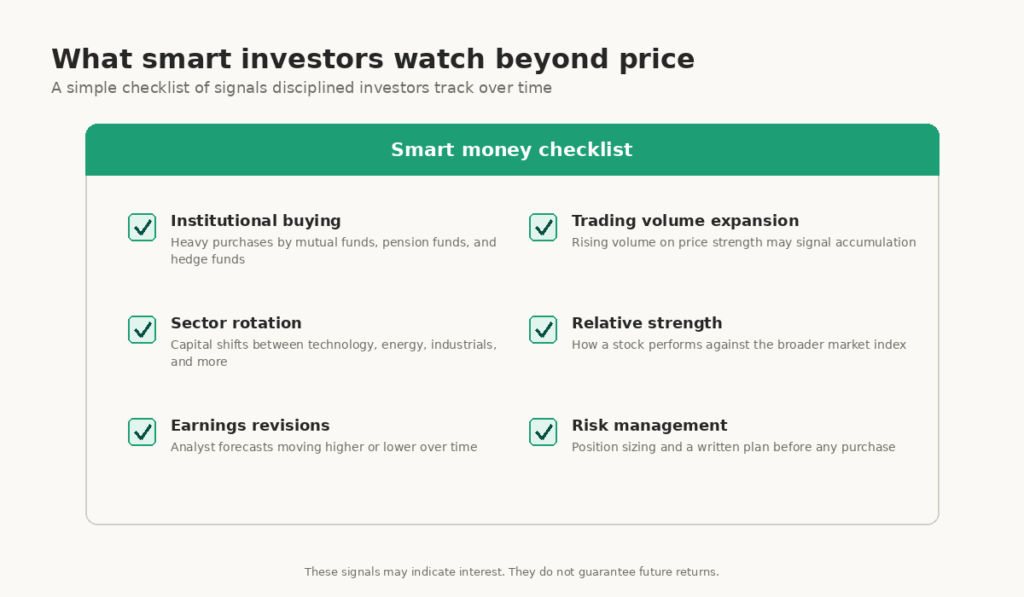
Disciplined investors look beyond daily price moves when they study what is the stock market signaling on any given day. They watch institutional buying, sector rotation, and trading volume. Institutional buying means heavy purchases by mutual funds, pension funds, and hedge funds. Rising volume on price strength may suggest accumulation, but this does not guarantee future returns.
Common Beginner Mistakes
New investors often confuse a rising index with their own portfolio performance. They feel happy on green days and stressed on red days. This is recency bias, which means giving too much weight to the most recent events. Furthermore, many beginners chase whatever sector rose last month, ignoring valuation completely.
Smart Practices
Experienced investors define their plan before they buy. They consider time horizon, position size, and risk management. Risk management means controlling how much capital you can lose on any single trade. For instance, a long-term investor might hold a low-cost S&P 500 index ETF while studying individual stocks separately. An index ETF is a fund that tracks a market index and trades like a single stock.
Investor psychology often decides who keeps gains through volatility. Therefore, calm decisions made with a clear written plan tend to outperform emotional reactions over time. Patience and process beat prediction in nearly every market cycle.
For further reading, explore these related guides:
What is the difference between the stock market and a stock exchange?
The stock market is the broader system that includes all exchanges and trading venues. A stock exchange is one specific organized marketplace within that system. For example, the New York Stock Exchange and Nasdaq are exchanges. Meanwhile, the stock market as a whole includes both of them, plus over-the-counter trading and other electronic networks where shares change hands daily.
Why does the stock market generally rise over long periods?
Over long periods, the stock market tends to rise because public companies grow earnings, expand operations, and reinvest profits. Population growth, productivity gains, and inflation also push prices higher. However, the path is uneven and includes regular corrections and occasional bear markets. Historically, large U.S. stocks have still lost money in about one of every three years.
How can a beginner start participating in the stock market?
A beginner can start by opening a brokerage account at a regulated U.S. broker. Many platforms allow small deposits and offer fractional shares. A fractional share is a portion of one full share. After funding the account, you can buy individual stocks or low-cost index funds. Start small, invest regularly, and only commit money you do not need for short-term expenses.