Every time you look up a stock on your brokerage platform, two prices appear side by side — a slightly lower number and a slightly higher one. Most beginners assume the stock has one price. Understanding bid and ask price reveals why two prices always exist and why that gap matters every time you place a trade. The term “bid” refers to the highest price a buyer will pay to buy a specified number of shares of a stock at any given time. The term “ask” refers to the lowest price at which a seller will sell the stock. The bid price will almost always be lower than the ask price. The difference between the bid price and the ask price is called the “spread.” That spread is not a glitch. It is the real cost of executing a trade. Investor.gov
What Bid and Ask Price Mean in Plain Terms
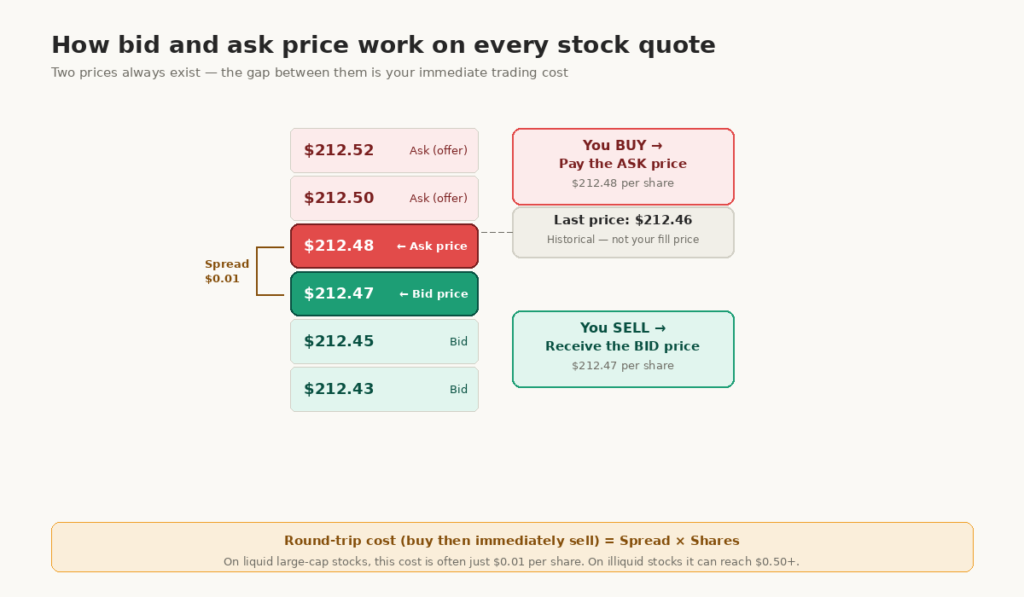
Think of the stock market as a continuous negotiation between millions of buyers and sellers. Buyers post the highest price they are willing to pay — the bid. Sellers post the lowest price they are willing to accept — the ask. No trade happens until a buyer agrees to pay the ask price or a seller agrees to accept the bid price. The current stock price shown on most platforms is the price of the last completed trade — a historical price. The bid and ask are the prices that buyers and sellers are currently willing to trade at. Corporate Finance Institute
A simple example makes this concrete. Suppose Apple shows a bid of $212.45 and an ask of $212.47. The spread is $0.02. When you place a market order to buy, your trade fills at the ask price of $212.47 — not at $212.45 and not at the “current price” shown on the screen. When you sell using a market order, your trade fills at the bid price of $212.45. This two-cent difference is your immediate cost of entering and exiting the position.
| Term | Definition | Who sets it |
|---|---|---|
| Bid price | Highest price a buyer will currently pay | Buyers in the market |
| Ask price | Lowest price a seller will currently accept | Sellers in the market |
| Bid-ask spread | Difference between ask and bid | Market conditions and liquidity |
| Last price | Price of the most recently completed trade | Historical record only |
| Mid price | Midpoint between bid and ask | Neither buyer nor seller |
Bid and ask prices show the current market supply and demand for a security. The bid price represents demand for a security; the ask price represents supply. When demand for a stock rises sharply, buyers push their bids higher to attract willing sellers. Consequently, both the bid and ask prices move upward together. When selling pressure dominates, the reverse happens. SoFi
You can review the SEC’s official definition of bid and ask prices at Investor.gov for the regulatory perspective on how these quotes function.
How the Bid-Ask Spread Affects Your Trading Costs
Narrow Spreads vs Wide Spreads
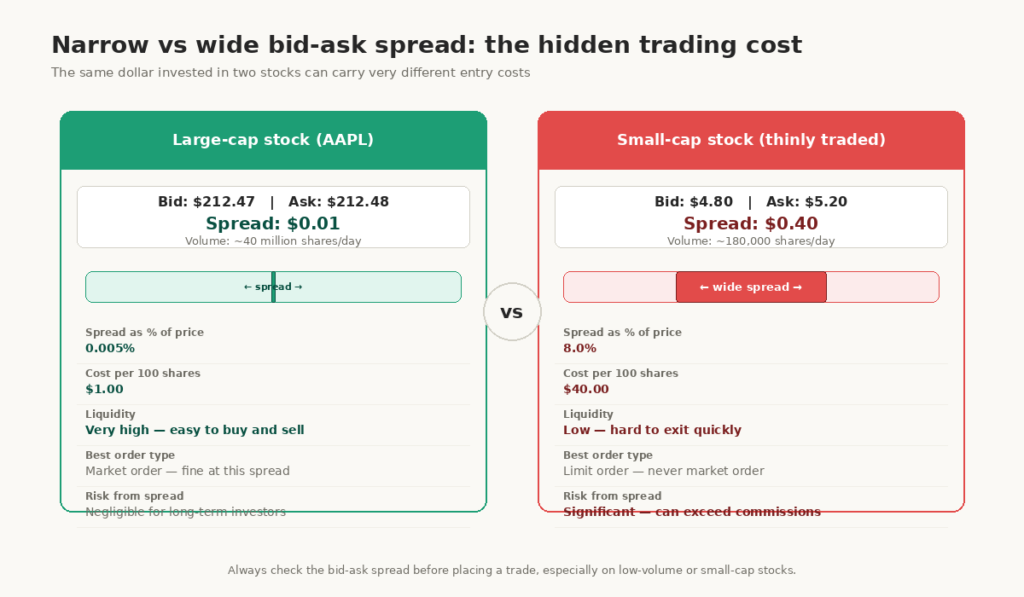
The size of the bid-ask spread directly determines how much you pay simply to participate in a trade. Popular stocks like Apple or Microsoft trade millions of shares daily and tend to have very tight spreads. Thinly traded small-cap stocks often have wider spreads. When prices move fast, market makers take more risk, so spreads usually widen. Gotrade
Consider two stocks side by side. Stock A is a large-cap technology company trading 40 million shares per day with a spread of $0.01. Stock B is a small-cap company trading 200,000 shares per day with a spread of $0.30. A trader who buys and then immediately sells Stock A loses $0.01 per share to the spread. The same round trip in Stock B costs $0.30 per share — thirty times more expensive before any price movement occurs.
| Stock type | Typical spread | Liquidity level | Trading cost impact |
|---|---|---|---|
| S&P 500 large-cap (e.g. AAPL) | $0.01 | Very high | Negligible for long-term holders |
| Mid-cap stock | $0.05–$0.15 | Moderate | Small but noticeable for active traders |
| Small-cap stock | $0.20–$1.00+ | Low | Significant — can exceed commissions |
| Extended-hours trading | Widens considerably | Reduced | Higher cost and uncertainty |
When Spreads Widen
Spreads do not stay constant throughout the trading day. Spreads are often widest near the open, near the close, and in extended hours. Mid-session trading can be cheaper in spread terms. During earnings releases or major economic announcements, even normally tight spreads on large-cap stocks can widen temporarily as market makers face increased uncertainty. Furthermore, any stock with low average daily volume carries a structurally wider spread throughout the entire session. Gotrade
Our guide on how to read a stock quote explains where to find the bid and ask prices on any standard brokerage quote page.
The Role of Market Makers in Setting the Spread
What Market Makers Do
Market makers are firms — typically large financial institutions — that continuously post both a bid price and an ask price for specific stocks throughout the trading day. Market makers help keep stock markets liquid, meaning it is relatively easy and inexpensive to enter and exit the market and to ensure there are plenty of offers available. In stock markets, market makers act as “wholesalers” — they buy in bulk at the bid price and sell at the ask price, earning the spread as compensation for providing liquidity. Chase
Without market makers, buyers and sellers would need to find each other independently. Waiting for a matching counterparty would slow every trade and create unpredictable price gaps. Market makers eliminate this problem by standing ready to buy or sell at any moment during market hours. Their profit is the spread itself. Competition between multiple market makers on actively traded stocks pushes spreads extremely tight — sometimes to a single penny.
How Market Makers Manage Risk
Market makers take on risk every time they quote prices. A market maker who buys shares at the bid price faces the possibility that the price falls before finding a seller at the ask. To compensate for this risk, market makers widen their spread during volatile conditions. In less liquid or more volatile markets, spreads widen to reflect higher risk. Small-cap stocks that have much less information surrounding them carry more inherent risk, so market makers demand bigger spreads to make it worth their while to provide liquidity. Saxo
This is why smart investors treat widening spreads as a signal worth watching. A sudden spread expansion on a normally tight stock may indicate that market makers are hedging against an imminent news event or unusual order flow. This does not guarantee future price movement, but disciplined investors note these changes before acting.
How to Use Bid and Ask Price as an Investor
Market Orders vs Limit Orders
When you place a market order to buy, you pay the ask price — always. When you place a market order to sell, you receive the bid price — always. Many beginner investors place market orders without realizing they are accepting the less favorable side of the spread each time.
Limit orders give you control over which price you are willing to pay. A buy limit order set at the bid price or between the bid and the ask may fill at a better price than a market order, but carries no guarantee of execution. For beginners, a simple rule is: use market orders only when the spread looks tight and the stock is very liquid. Otherwise, use limit orders to stay in control of the price you pay or receive. Gotrade
Common Beginner Mistakes With Bid and Ask
Many beginners confuse the last traded price with the price they will actually pay. The last price is historical. Your execution price will be the current ask price if you are buying or the current bid price if you are selling. Furthermore, some investors trade small-cap or penny stocks without checking the spread first. A $0.50 spread on a $3.00 stock represents a 16.7% immediate loss on entry and exit combined — a hidden cost that overwhelms any short-term price movement.
Herd behavior leads retail investors to buy stocks with recent sharp gains, often during periods when spreads have already widened due to increased volatility. Loss aversion then prevents those same investors from selling at a loss, even when the spread has compressed their effective entry price further than the current quote suggests. Awareness of how bid and ask price mechanics work reduces both of these behavioral errors.
For further reading, explore these related guides:
What happens to the bid and ask price when a company releases earnings?
Earnings releases create sharp, sudden demand shifts that immediately affect both bid and ask prices. Before the announcement, spreads often widen as market makers increase their risk buffers. After the announcement, prices gap to a new level — both bid and ask move together to reflect the new valuation. If earnings beat expectations, the ask price rises sharply as buyers compete. If earnings disappoint, the bid price falls as sellers accept lower prices. Trading during this window carries significantly higher spread costs than normal.
Why is the ask price always higher than the bid price?
The ask price is always higher because buyers and sellers have opposing goals. Buyers want to pay as little as possible; sellers want to receive as much as possible. The spread between the two represents the gap where no trade currently occurs. A trade happens only when a buyer agrees to pay the ask or a seller agrees to accept the bid. If the bid and ask were equal, every order would execute instantly — but market makers would earn nothing for providing liquidity and would stop quoting prices.
Does the bid-ask spread matter for long-term investors?
For long-term investors who buy and hold for years, the spread matters much less than for active traders. A $0.05 spread on a stock held for five years represents a negligible fraction of total return. However, long-term investors should still avoid stocks with very wide spreads — particularly small-cap or thinly traded names — because a wide spread signals low liquidity. Low liquidity means selling during a market downturn may be difficult and expensive. Choosing liquid, actively traded stocks eliminates most spread-related risk for patient investors.