Last updated: July 3, 2026
The ex-dividend date is the single most important date in dividend investing for anyone who wants to receive a company’s upcoming payment. Miss it by one day, and the dividend goes to the previous owner — not you. Understanding exactly how the ex-dividend date works, why stock prices drop on that date, and how disciplined investors use it in their research process removes one of the most common and costly mistakes in income investing.
How Dividend Eligibility Works for Investors
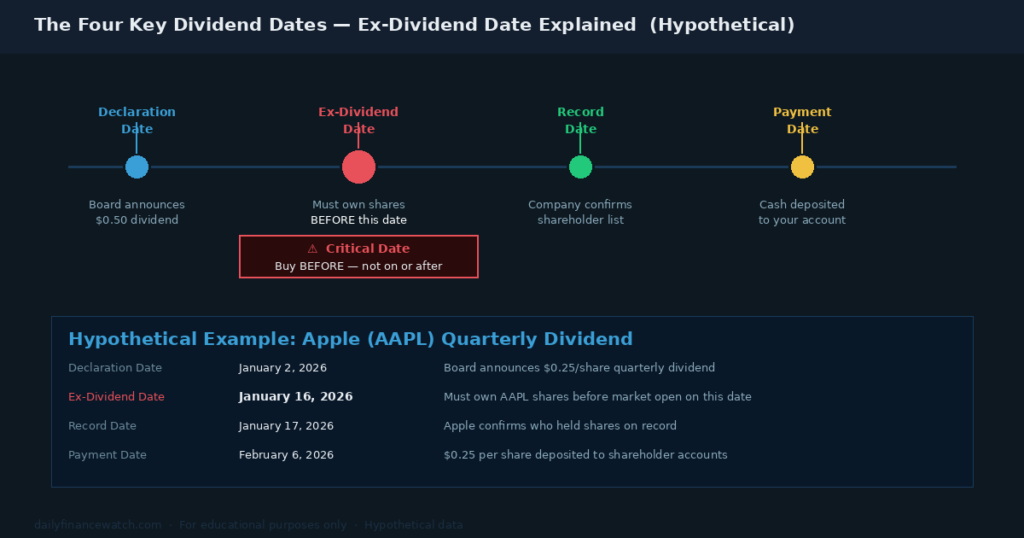
Caption: The four dividend dates every income investor must know, with a hypothetical Apple example showing exact dates from announcement to payment.
Every dividend payment follows four key dates. The declaration date is when the board of directors announces the dividend amount and schedule. The ex-dividend date is the eligibility cutoff — investors must own the shares before this date to qualify. The record date, typically one business day after the ex-dividend date, is when the company officially confirms which shareholders qualify. The payment date is when the cash reaches your brokerage account.
| Date | What Happens | Investor Action |
|---|---|---|
| Declaration Date | Board announces dividend amount | No action required |
| Ex-Dividend Date | Eligibility cutoff for new buyers | Must own shares BEFORE this date |
| Record Date | Company confirms shareholder list | No action required |
| Payment Date | Dividend deposited to account | Receive cash or reinvest |
The ex-dividend date operates on a T+1 settlement basis. When you buy shares, the transaction settles one business day later. This means you must purchase shares at least one business day before the ex-dividend date for your ownership to be on record in time. Buying shares on the ex-dividend date itself means your settlement completes after the record date — and you receive no dividend.
Consider a hypothetical Apple (AAPL) quarterly dividend: the board declares a $0.25 per share payment on January 2. The ex-dividend date is January 16. Investors who purchase AAPL shares on January 15 or earlier receive the $0.25 payment on February 6. Investors who buy on January 16 or later do not.
According to Investor.gov, the SEC’s official investor education resource, the ex-dividend date is set by the stock exchange rather than by the company itself, and it plays a central role in how dividend eligibility transfers between buyers and sellers.
What Happens to Share Price on the Cutoff Day
On the ex-dividend date, a stock’s opening price typically falls by approximately the amount of the dividend. This price adjustment is mechanical and expected — it reflects the fact that buyers on that date will not receive the upcoming payment, so the stock is worth slightly less to them.
In the hypothetical Apple example, a share price of $175.50 the day before the ex-dividend date might open near $175.25 on the ex-dividend date itself — a drop of roughly $0.25, equal to the dividend amount. This is not a signal of business deterioration. The company’s underlying earnings, assets, and prospects have not changed. Instead, the price adjusts to reflect that the dividend value has effectively transferred to shareholders of record.
For short-term traders, this price movement can create confusion. A beginner who sees their portfolio fall slightly on the ex-dividend date and simultaneously receives a cash dividend may not realize the two events are directly connected. The dividend income and the price drop offset each other, leaving total portfolio value roughly unchanged in the short term.
For a broader look at how dividend payments fit into the full income investing framework, see What Is a Dividend and How Does It Work?.
Common Timing Mistakes That Cost Income Investors Money
Buying Shares to Capture Dividend Eligibility
One of the most frequent mistakes in income investing involves purchasing shares on the ex-dividend date specifically to capture the upcoming payment. This strategy does not work. Shares purchased on the ex-dividend date settle after the record date, making the buyer ineligible. Furthermore, the share price has already adjusted downward to reflect the dividend leaving the stock. The buyer receives no dividend and holds shares at a post-adjustment price.
Selling Immediately After the Eligibility Cutoff
Some investors sell their shares on the ex-dividend date, believing they have locked in both the dividend and a full pre-dividend price. In practice, the price drops by approximately the dividend amount at market open on that date. Selling on the ex-dividend date typically results in a capital loss roughly equal to the dividend received, leaving the net result close to zero before taxes and trading costs.
Confusing the Cutoff Day with the Record Date
These two dates are distinct but related. The record date is when the company checks its shareholder registry. The ex-dividend date is set one business day before the record date to account for settlement timing. Because of this, the ex-dividend date — not the record date — is the practical deadline investors must track when timing a purchase for dividend eligibility.
For more on how dividend yield and payout ratio connect to the ex-dividend date, see What Is Dividend Yield?.
What Smart Money Watches Around the Eligibility Cutoff
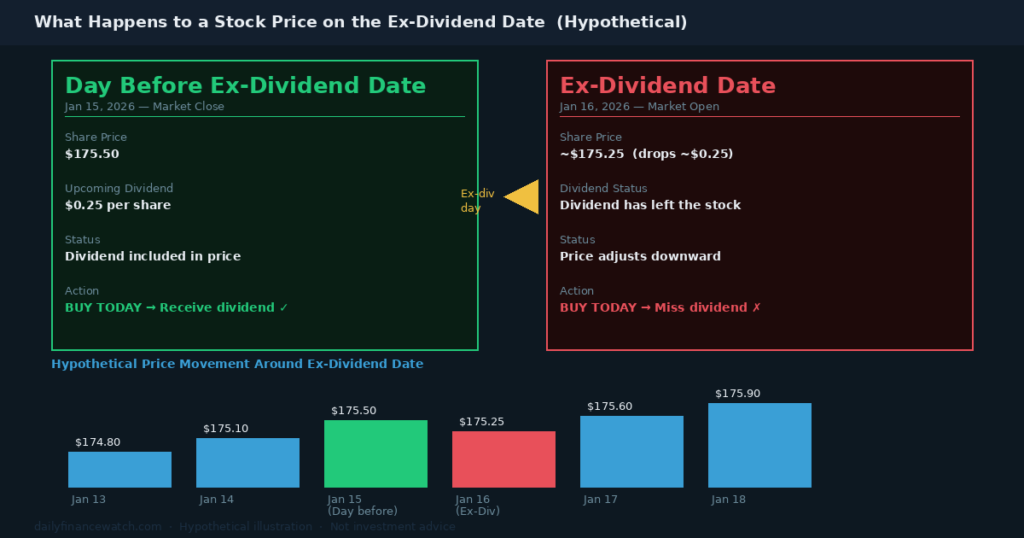
Caption: A hypothetical Apple share price drops ~$0.25 on the ex-dividend date — a mechanical adjustment that reflects the dividend leaving the stock, not a change in business fundamentals.
Disciplined investors rarely buy a stock solely because the ex-dividend date is approaching. Chasing a dividend payment without evaluating the underlying business typically produces mediocre results over time. However, the ex-dividend date does serve several legitimate analytical purposes.
Institutional investors watch volume patterns around the ex-dividend date. Unusual volume spikes in the days before the ex-dividend date can sometimes indicate accumulation by large funds seeking income — a pattern that may suggest broader institutional interest in the stock beyond the immediate dividend. This can indicate growing conviction in the business, though it does not guarantee price appreciation.
The ex-dividend date also matters for tax planning. According to FINRA’s investor resources on dividends, dividends receive favorable tax treatment as qualified dividends only when the investor holds the shares for more than 60 days during the 121-day period surrounding the ex-dividend date. Investors who buy shares two days before the ex-dividend date and sell the next week do not qualify for the lower qualified dividend tax rate — their income is taxed as ordinary income instead.
For long-term income investors, the ex-dividend date is simply part of the regular ownership calendar rather than a timing strategy. Holding quality dividend-paying stocks through multiple ex-dividend dates — and reinvesting those payments — is the foundation of compounding dividend income over years and decades.
Related articles for further reading:
What Is a Dividend and How Does It Work?
What Is Dividend Yield and How Is It Calculated?
Does buying shares one day before the ex-dividend date guarantee a profit?
No. Buying shares the day before the ex-dividend date qualifies you for the upcoming dividend payment. However, the share price typically falls by approximately the dividend amount on the ex-dividend date. The dividend income and the price drop roughly offset each other in the short term. Long-term dividend investors focus on business quality and sustainable payments rather than short-term dividend capture strategies.
What happens if I sell my shares before the payment date?
Selling shares after the ex-dividend date but before the payment date does not affect your dividend eligibility. You qualified for the dividend by owning shares before the ex-dividend date, and that entitlement stays with you regardless of when you sell. The payment will still arrive in your brokerage account on the payment date, even if you no longer hold the shares.
How far in advance is the ex-dividend date announced?
Companies typically announce the ex-dividend date when they declare the dividend, usually two to four weeks before the ex-dividend date itself. Most major U.S. companies follow a regular quarterly schedule, so experienced investors can anticipate roughly when the next ex-dividend date will fall based on historical patterns. Brokerage platforms and financial data sites display upcoming ex-dividend dates for all listed stocks.
This article is for educational purposes only and does not constitute personalized financial or investment advice. All investing involves risk, including the possible loss of principal.