Last updated: July 6, 2026
Dividend yield is the single most-cited metric in income investing — and one of the most misunderstood. A stock showing a 10% yield might look like a bargain, but the same figure can signal a company in serious financial trouble. Understanding how dividend yield works, how to calculate it, and when a high number is a warning rather than an opportunity is essential for any investor building an income portfolio.
How Dividend Yield Works and How to Calculate It
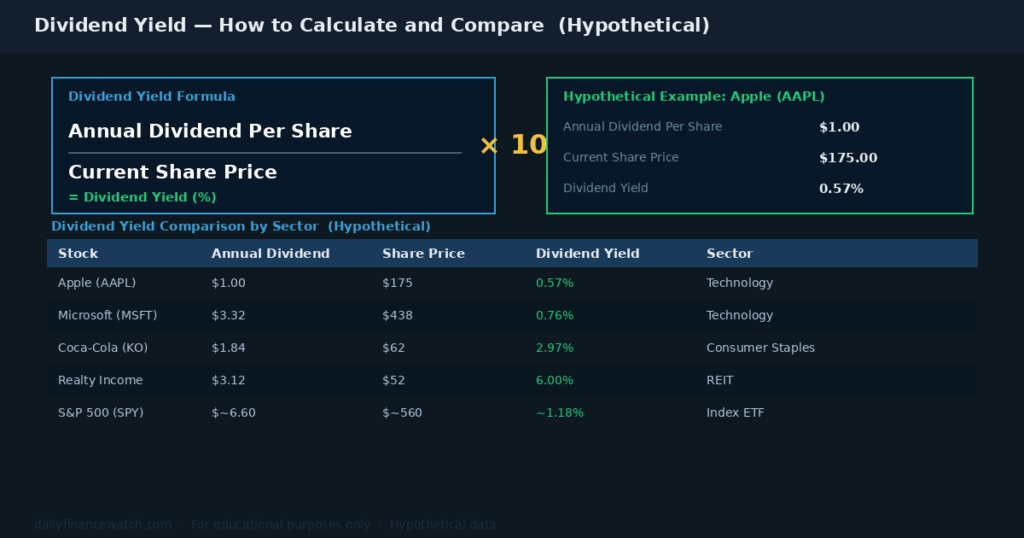
Caption: The dividend yield formula with hypothetical examples across sectors — technology, consumer staples, REITs, and index ETFs.
Dividend yield expresses a stock’s annual dividend payment as a percentage of its current share price. The calculation uses two numbers: the annual dividend per share and the current stock price.
Formula: Annual Dividend Per Share ÷ Current Share Price × 100 = Dividend Yield (%)
For example, Apple (AAPL) pays a hypothetical annual dividend of $1.00 per share. At a hypothetical share price of $175, the dividend yield equals approximately 0.57%. Microsoft (MSFT), with a hypothetical $3.32 annual dividend at $438, produces a yield of roughly 0.76%. Coca-Cola (KO), a classic income stock, pays a hypothetical $1.84 dividend on a $62 share price — producing a yield near 2.97%.
| Stock | Annual Dividend | Share Price | Dividend Yield | Sector |
|---|---|---|---|---|
| Apple (AAPL) | $1.00 | $175 | 0.57% | Technology |
| Microsoft (MSFT) | $3.32 | $438 | 0.76% | Technology |
| Coca-Cola (KO) | $1.84 | $62 | 2.97% | Consumer Staples |
| Realty Income | $3.12 | $52 | 6.00% | REIT |
| S&P 500 (SPY) | ~$6.60 | ~$560 | ~1.18% | Index ETF |
These are hypothetical figures for illustration only and do not represent current or guaranteed returns. Yield varies constantly as share prices change throughout the trading day.
What a High or Low Dividend Yield Actually Means
Dividend yield reflects both the generosity of the company and the current market price of the stock. A low yield does not necessarily mean a company is stingy — it may simply mean the share price has risen significantly, compressing the yield. Technology companies like Apple and Microsoft typically show low yields because their share prices are high relative to the dividend payment.
A high yield, however, deserves scrutiny. According to Investor.gov, the SEC’s official investor education resource, investors should evaluate dividend payments in the context of a company’s broader financial health — not in isolation. A yield above 5% or 6% may reflect genuine income potential, particularly in sectors like REITs or utilities. However, it may also reflect a sharply declining share price — a situation where the stock has fallen faster than the dividend has been cut.
Sector context matters significantly when comparing yields. Consumer staples, utilities, and real estate investment trusts historically pay higher yields than technology or growth sectors. Comparing a utility’s 4% yield to Apple’s 0.57% yield reveals nothing meaningful about which is the better investment — the comparison only makes sense within the same sector or against a relevant benchmark.
The Yield Trap — When High Dividend Yield Is a Warning Sign
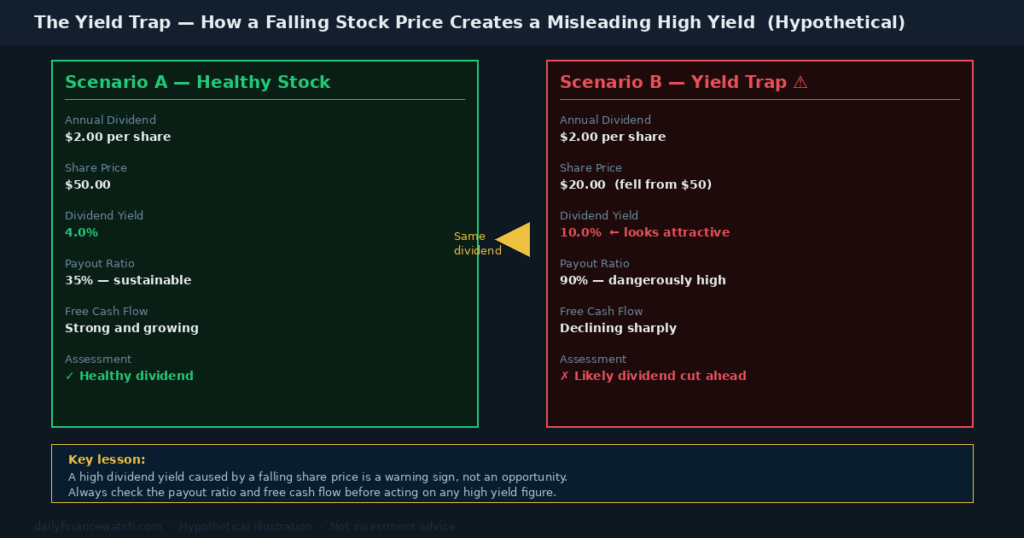
Caption: The same $2.00 dividend produces a 4% yield on a healthy $50 stock and a dangerous 10% yield on a stock that has fallen to $20.
The yield trap is one of the most common mistakes in dividend yield investing. It occurs when a stock’s share price falls sharply while the dividend has not yet been cut — temporarily inflating the yield to an eye-catching level. Investors who buy based on the high yield alone often find the company cuts the dividend shortly afterward, causing both the income stream and the share price to fall further.
Consider two hypothetical stocks, each paying $2.00 annually. Stock A trades at $50, producing a 4% yield with a 35% payout ratio and strong free cash flow. Stock B trades at $20 — down from $50 — producing a 10% yield. However, Stock B’s payout ratio has climbed to 90%, and free cash flow is declining. The 10% yield is not an opportunity; it is a warning.
Signs a High Dividend Yield May Be a Yield Trap
Disciplined investors watch for several warning signals alongside a high yield figure. A payout ratio above 80% leaves little room for the company to maintain the payment if earnings fall. Declining free cash flow is an even more direct warning, since dividends come from cash, not accounting profits. Earnings revision trends matter too: when analysts consistently cut their estimates, dividend sustainability falls with them. Finally, comparing the stock’s 12-month price performance to its sector peers reveals whether the yield has risen because of price weakness rather than dividend growth.
How Smart Money Uses Dividend Yield in Stock Research
Institutional investors rarely evaluate dividend yield in isolation. Instead, they use it as one data point within a broader analytical framework that includes the payout ratio, free cash flow yield, earnings revision trends, and balance sheet strength.
According to FINRA’s investor education resources, sophisticated investors also consider dividend growth rate alongside current yield. A stock yielding 2% today with a history of raising its dividend by 8% annually may produce more total income over ten years than a stock yielding 5% with a stagnant or declining payment. This concept — sometimes called yield on cost — rewards investors who hold quality dividend growers over long periods.
Sector rotation also influences how institutional investors read yield signals. When defensive sectors like utilities and consumer staples show unusually high yields relative to their historical averages, it can indicate that institutional money is rotating out of those sectors — a signal worth monitoring rather than acting on in isolation.
For more on evaluating stocks beyond yield alone, see What Is a Payout Ratio?.
Related articles for further reading:
What Is a Dividend and How Does It Work?
How does dividend yield change over time?
Dividend yield changes whenever the share price or the dividend amount changes. Because share prices fluctuate every trading day, yield moves constantly even when the dividend remains fixed. If a company raises its dividend, the yield increases. If the share price rises faster than the dividend, the yield compresses. Investors should treat yield as a dynamic figure rather than a fixed characteristic of any stock.
Why do technology stocks tend to have lower dividend yields?
Technology companies typically reinvest most of their earnings into research, development, and growth rather than distributing cash to shareholders. When they do pay dividends, the amounts are modest relative to often-high share prices, producing low yields. This reflects a deliberate capital allocation strategy — not a flaw. Growth-focused investors often prefer low-yield technology stocks for capital appreciation over income-focused alternatives.
Should investors always choose the highest dividend yield available?
No. A higher yield is not always better. Dividend yield must be evaluated alongside the payout ratio, free cash flow, earnings trend, and sector context. A 10% yield on a stock with a 95% payout ratio and declining earnings carries far more risk than a 3% yield on a company with consistent earnings growth and a 40% payout ratio. Yield without context is incomplete information.
This article is for educational purposes only and does not constitute personalized financial or investment advice. All investing involves risk, including the possible loss of principal.