Last updated: July 3, 2026
Apple sends its shareholders a dividend payment four times every year — in February, May, August, and November. Each quarter, investors who own the stock before the ex-dividend date receive a fixed cash amount per share, deposited directly into their brokerage accounts. For investors building income portfolios, understanding how quarterly dividends work, how companies set the payment amount, and what separates sustainable payouts from fragile ones is a core skill.
How a Quarterly Dividend Payment Works
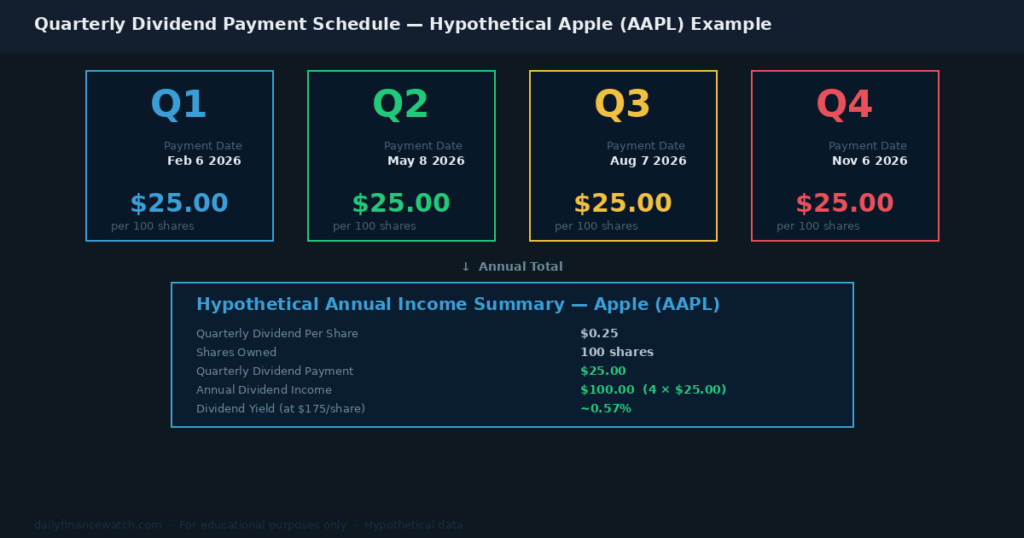
Caption: A hypothetical Apple quarterly schedule — four payments of $25.00 each produce $100.00 in annual income on 100 shares.
A quarterly dividend is a cash distribution a company makes to shareholders four times per year, once each calendar quarter. The board of directors sets the dividend amount, typically expressed as a fixed dollar amount per share. Most large U.S. companies follow this schedule because it aligns with their quarterly earnings reporting cycle.
The mechanics follow four key dates every quarter:
| Date | What Happens | Why It Matters |
|---|---|---|
| Declaration Date | Board announces the dividend | Sets the amount and payment schedule |
| Ex-Dividend Date | Eligibility cutoff for new buyers | Must own shares before this date |
| Record Date | Company confirms shareholder list | One business day after ex-dividend |
| Payment Date | Cash arrives in your account | When income is actually received |
Consider a hypothetical example: Apple (AAPL) declares a $0.25 quarterly dividend. An investor holding 100 shares receives $25.00 each quarter — $100.00 annually. At a hypothetical share price of $175, the annual dividend yield equals approximately 0.57%. Dividend yield is the annual payment divided by the current share price, expressed as a percentage.
Companies in the S&P 500 predominantly use the quarterly schedule. Consumer staples companies like Coca-Cola, financial institutions like JPMorgan Chase, and technology companies like Microsoft all distribute quarterly. This consistency makes planning straightforward for income-focused investors.
Why Companies Choose to Pay Dividends Quarterly
The quarterly schedule reflects how U.S. public companies report their financial results. Most large companies release earnings every three months, which gives their boards a regular opportunity to assess profitability and confirm that the current dividend remains affordable. This alignment between earnings visibility and payment timing reduces the risk of a surprise dividend cut.
From the investor’s perspective, quarterly income provides practical advantages over annual payments. Investors receive cash four times per year rather than once, which shortens the waiting period between payments and accelerates compounding when dividends are reinvested. A Dividend Reinvestment Plan, or DRIP, automatically uses each payment to buy additional shares — and four reinvestment events per year create more compounding opportunities than a single annual payment would.
According to Investor.gov, the SEC’s official investor education resource, dividend income has historically contributed a meaningful share of total stock market returns over long periods. Quarterly payments make that income easier to reinvest systematically rather than waiting for a once-a-year lump sum.
For a deeper look at how dividends and reinvestment compound over time, see What Is a Dividend and How Does It Work?.
How Dividend Payment Frequency Affects Total Return
The frequency of dividend payments affects compounding speed. Monthly payers like Realty Income (O) reinvest 12 times per year, while annual payers reinvest only once. Quarterly payers sit in the middle — reinvesting four times annually, which produces strong compounding while remaining the standard schedule for most large U.S. companies.
Comparing Quarterly Payments with Monthly and Annual Options
Monthly dividend stocks — often REITs and certain closed-end funds — appeal to investors who need regular cash flow, such as retirees. Annual dividend stocks are more common among international companies, particularly in Europe. Neither schedule is inherently superior. The key factors are yield sustainability, payout ratio, and the company’s earnings consistency rather than payment frequency alone.
What Disciplined Investors Watch in Income Stocks
Institutional investors and disciplined income-focused fund managers rarely evaluate a stock based on its payment schedule alone. Instead, they examine whether the dividend is sustainable through economic cycles — and whether the company can grow the payment over time.
The payout ratio — the percentage of earnings distributed as dividends — is the primary sustainability indicator. A payout ratio below 60% generally indicates the company retains enough earnings to invest in growth while maintaining the dividend. A ratio above 80% may signal vulnerability: if earnings fall slightly, the company may struggle to maintain the payment without borrowing.
Free cash flow quality matters even more than reported earnings, because dividends come from cash — not accounting profits. A company may report positive net income while generating insufficient free cash flow to cover its dividend reliably. Disciplined investors check whether free cash flow comfortably exceeds the total dividend obligation before trusting the payout.
According to FINRA’s investor education resources on dividend stocks, investors should also consider the dividend growth history. Companies with 10 or more consecutive years of dividend increases — often called Dividend Aristocrats — demonstrate a management commitment to growing shareholder income over time, which many income investors treat as a quality signal.
For more on evaluating dividend sustainability, see What Is Dividend Yield and How Is It Calculated?.
Common Mistakes When Evaluating Quarterly Income
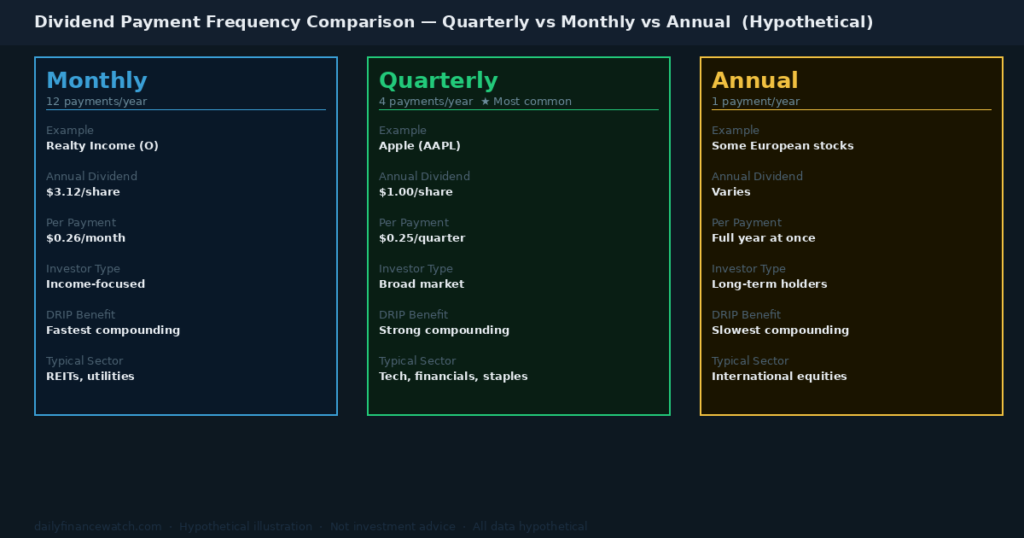
Caption: Monthly, quarterly, and annual dividend schedules compared — quarterly is the most common structure among large U.S. companies.
What a Sustainable Payout Ratio Looks Like
Beginner investors sometimes focus exclusively on yield without examining whether the company can sustain the payment. A stock yielding 8% with a 95% payout ratio and declining earnings presents far more risk than a stock yielding 2.5% with a 40% payout ratio and growing free cash flow. The higher-yielding stock may cut its dividend within a year or two, delivering both a loss of income and a sharp share price decline.
Anchoring is a behavioral finance concept describing the tendency to fixate on a reference number — in this case, the current quarterly payment — and assume it will continue unchanged. Investors who anchor to the current payment without monitoring payout ratio trends often miss early warning signs of a cut. Checking the payout ratio against the company’s five-year earnings trend each quarter prevents this mistake.
Income investors also sometimes overweight dividend yield relative to dividend growth rate. A company growing its quarterly payment by 8% annually doubles its payout in roughly nine years. Over a decade, a low initial yield with consistent growth often produces more total income than a high initial yield with stagnant or declining payments.
Related articles for further reading:
What Is Dividend Yield and How Is It Calculated?
What Is a Dividend Reinvestment Plan (DRIP)?
What determines how much a quarterly dividend pays?
A company’s board of directors sets the quarterly dividend amount based on current earnings, free cash flow, and long-term financial targets. Companies with consistent earnings typically maintain or increase the quarterly payment over time. Companies with cyclical revenues — such as energy producers or manufacturers — may vary the payment based on profitability. The payout ratio and free cash flow coverage are the most reliable indicators of whether the current amount is sustainable.
Why do some stocks pay monthly instead of quarterly dividends?
Monthly dividend payments are more common among income-focused investment vehicles such as REITs, business development companies, and certain closed-end funds. These structures distribute most of their income to shareholders by law, making frequent payments practical. Monthly payments appeal particularly to retirees and income investors who prefer regular cash flow rather than waiting three months between distributions. However, payment frequency alone does not indicate dividend quality or sustainability.
Can a company change its quarterly dividend amount?
Yes. The board of directors can raise, reduce, or suspend the quarterly dividend at any time. Dividend increases typically follow periods of strong earnings growth and signal management confidence in future profitability. Dividend cuts usually follow declining earnings, rising debt, or a need to redirect capital into the business. Monitoring the payout ratio, free cash flow trend, and earnings revisions each quarter helps investors anticipate changes before they are announced.
This article is for educational purposes only and does not constitute personalized financial or investment advice. All investing involves risk, including the possible loss of principal.