Last updated: July 3, 2026
DRIP investing turns every dividend payment into additional shares automatically, without any action required from the investor. Instead of receiving cash four times a year, a shareholder enrolled in a Dividend Reinvestment Plan sees each payment converted into fractional shares of the same stock the moment it is distributed. Over years and decades, this automatic reinvestment process compounds returns in a way that receiving cash dividends alone cannot match.
What DRIP Investing Is and How It Works
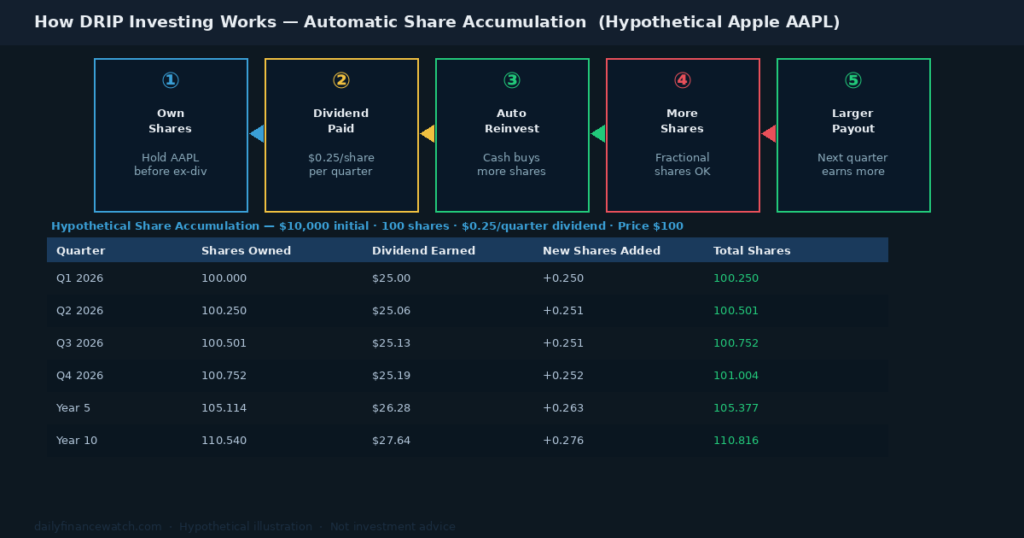
Caption: How DRIP investing works in five steps — each quarterly payment buys more shares, which earn larger payments the following quarter.
A Dividend Reinvestment Plan, or DRIP, is a program that automatically uses dividend payments to purchase additional shares of the same stock or fund. Most major U.S. brokerages — including Fidelity, Charles Schwab, and Vanguard — offer DRIP enrollment at no extra cost. The investor elects reinvestment once, and the process runs automatically every payment cycle.
The mechanics are straightforward. When a dividend payment arrives on the payment date, the brokerage uses that cash to purchase shares at the current market price. Fractional shares are permitted, so even a small dividend buys a precise fraction of a share rather than rounding down to zero. This means no cash sits idle waiting to reach a full share price.
Consider a hypothetical example: an investor holds 100 shares of Apple (AAPL) at a hypothetical $100 share price. The quarterly dividend payment is $0.25 per share — $25.00 total. Under DRIP investing, that $25.00 buys 0.250 additional shares. The investor now holds 100.250 shares. The following quarter, that slightly larger position earns $25.06 — buying another 0.251 shares. Over ten years at these hypothetical figures, the investor accumulates more than 110 shares without contributing a single additional dollar.
| Quarter | Shares Owned | Dividend Earned | New Shares Added | Total Shares |
|---|---|---|---|---|
| Q1 2026 | 100.000 | $25.00 | +0.250 | 100.250 |
| Q2 2026 | 100.250 | $25.06 | +0.251 | 100.501 |
| Q4 2026 | 100.752 | $25.19 | +0.252 | 101.004 |
| Year 5 | 105.114 | $26.28 | +0.263 | 105.377 |
| Year 10 | 110.540 | $27.64 | +0.276 | 110.816 |
All figures are hypothetical and do not represent guaranteed returns.
According to Investor.gov, the SEC’s official investor education resource, reinvesting dividends rather than withdrawing them as cash is one of the most straightforward strategies for accelerating long-term portfolio growth.
Why Automatic Reinvestment Builds Wealth Over Time
The power of DRIP investing comes from compounding — the process by which investment returns generate their own returns over time. Each reinvested dividend purchases additional shares, which generate their own future dividends, which purchase still more shares. This cycle accelerates as the share count grows.
A hypothetical $10,000 investment in a stock returning 6% annually through price appreciation and 3% through dividends produces roughly $32,000 over 20 years if dividends are taken as cash. The same investment with all dividends reinvested produces approximately $56,000 over the same period — a difference of nearly $24,000, entirely from the compounding effect of DRIP investing. These figures are illustrative only and do not reflect any specific investment.
How DRIP Investing Compounds Returns Over Time
The compounding advantage of DRIP investing grows larger with time. In the first five years, the difference between reinvested and cash dividends is modest — roughly $2,000 in the hypothetical example above. By year 10, the gap widens to approximately $5,800. By year 20, the advantage reaches nearly $24,000. This accelerating pattern reflects how compounding works: early gains are small, but the base grows larger with every cycle, making each subsequent gain proportionally bigger.
Fractional Shares and Dollar-Cost Averaging
Two features make DRIP investing particularly effective for long-term investors. Fractional shares allow every dividend dollar to go to work immediately, regardless of the current share price. Dollar-cost averaging — the practice of buying fixed dollar amounts at regular intervals regardless of price — occurs naturally through DRIP investing, since reinvestment happens every quarter at whatever price the market sets. Over time, this automatic purchase at varying prices reduces the impact of short-term price volatility on the overall cost basis.
How to Set Up and Use a DRIP Account
Enrolling in a DRIP plan through a modern brokerage takes minutes. Most platforms allow investors to enable automatic reinvestment at the individual stock or fund level rather than applying it universally. This flexibility means an investor can reinvest dividends from a core long-term holding while receiving cash dividends from a position they plan to exit soon.
Direct stock purchase plans offered by individual companies — sometimes called company-sponsored DRIPs — often allow investors to reinvest at a slight discount to the market price, typically 1% to 5%. These plans sometimes permit additional cash contributions in small amounts, allowing investors to build positions gradually. However, direct plans require managing separate accounts for each company, which adds administrative complexity that brokerage-based DRIP programs avoid.
For income investors who rely on dividends for living expenses, DRIP investing may not be appropriate for their entire portfolio. A practical approach involves reinvesting dividends from growth-oriented holdings while taking cash from income-oriented positions that fund regular spending. This balance captures the compounding benefit while maintaining the cash flow that income-dependent investors require.
For a deeper look at how dividend yield and payout ratio affect the underlying quality of reinvested income, see What Is Dividend Yield and How Is It Calculated?.
Risks and Limitations Income Investors Should Know
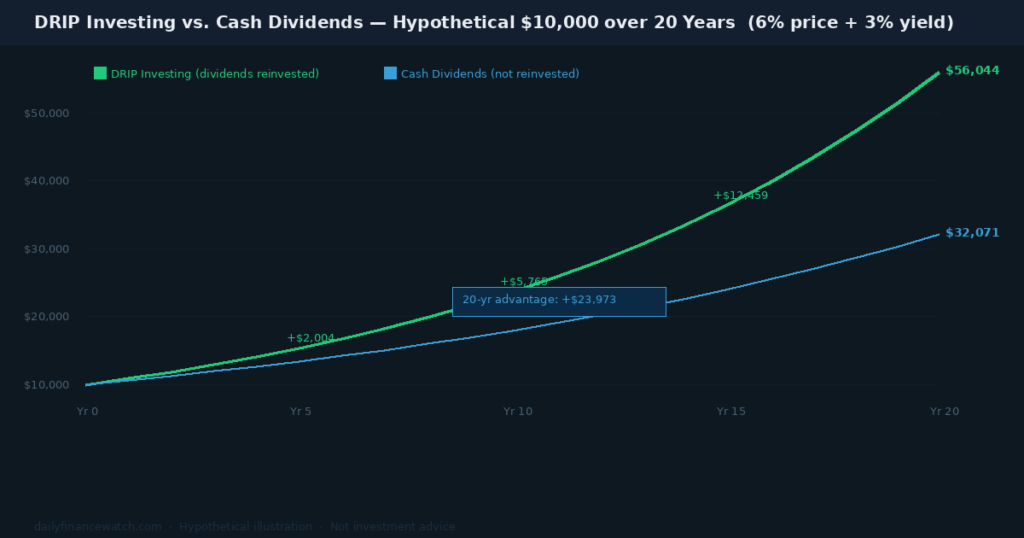
Caption: Hypothetical $10,000 comparison — DRIP investing reaches $56,044 versus $32,071 for cash dividends over 20 years, a gap of nearly $24,000.
DRIP investing is not without limitations. The most significant risk is concentration — automatically reinvesting dividends into the same stock increases exposure to that single company over time. If the company’s fundamentals deteriorate, the investor holds more shares in a weakening business than they would have without reinvestment. Disciplined investors periodically review whether continued reinvestment remains appropriate given the company’s earnings trend, payout ratio, and balance sheet strength.
Tax treatment presents another consideration. According to FINRA’s investor education resources on dividends, reinvested dividends are taxable in the year they are paid — even though the investor receives no cash. Each reinvested payment creates a small cost basis adjustment, which must be tracked for accurate capital gains reporting when shares are eventually sold. Investors in taxable accounts should confirm that their brokerage tracks these adjustments automatically, or maintain their own records.
Loss aversion — the behavioral finance concept describing the tendency to feel losses more acutely than equivalent gains — can undermine DRIP investing during market downturns. When a stock price falls, reinvested dividends purchase shares at lower prices, which is mechanically advantageous for long-term investors. However, investors who focus on short-term account value may disable DRIP during downturns and miss the opportunity to accumulate shares at reduced prices. Recognizing this pattern helps investors maintain the discipline that makes DRIP investing effective.
When Reinvesting May Not Be the Best Strategy
DRIP investing makes most sense when the investor is confident in the long-term quality of the underlying business. Automatically reinvesting dividends from a company with a deteriorating payout ratio, declining free cash flow, or weakening earnings trend compounds exposure to a deteriorating position rather than building a stronger one. Before enrolling any holding in DRIP, disciplined investors verify that the dividend is well-covered by earnings and free cash flow. For underperforming positions, taking dividends as cash preserves the option to redeploy that income into stronger opportunities elsewhere.
For more on how to evaluate dividend sustainability before reinvesting, see What Is a Quarterly Dividend?.
Related articles for further reading:
What Is a Dividend and How Does It Work?
What Is Dividend Yield and How Is It Calculated?
Does DRIP investing work with index funds and ETFs?
Yes. Most major index ETFs — including SPY, QQQ, and Vanguard funds — support automatic dividend reinvestment through standard brokerage DRIP programs. Reinvesting ETF dividends follows the same mechanics as individual stocks: each quarterly distribution purchases additional fund shares automatically. For investors using broadly diversified funds, DRIP investing eliminates concentration risk while still capturing the full compounding benefit of reinvested income.
How does DRIP investing affect my cost basis for taxes?
Each reinvested dividend creates a small additional purchase of shares at the current market price. This purchase establishes a new cost basis lot for tax purposes. Over time, a single stock position may contain dozens of separate cost basis lots — one for each reinvestment event. Most major brokerages track these lots automatically and report them on annual tax documents. Investors should verify that their brokerage provides this tracking before relying on it for tax filing.
Can I stop DRIP investing at any time?
Yes. DRIP enrollment is typically reversible at any time through your brokerage account settings. Disabling reinvestment does not affect the shares already accumulated — it simply directs future dividends to your cash balance rather than purchasing additional shares. Investors sometimes pause DRIP during periods when they want to redirect dividend income toward other opportunities, or when they plan to reduce a position and prefer not to add shares in the meantime.
This article is for educational purposes only and does not constitute personalized financial or investment advice. All investing involves risk, including the possible loss of principal.