Last updated: June 30, 2026
In 1976, John Bogle launched the first index fund for individual investors and tried to raise $150 million. He raised $11.3 million. Critics called it “Bogle’s Folly” — a fund that, by design, refused to try to beat the market. Fifty years later, that same product, the index fund, has become the default holding in millions of retirement accounts. However, the reason is not that index funds are clever. Instead, they remove two specific drags on long-term returns that most investors cannot remove on their own. Most beginner guides describe an index fund as “investing in the market.” In reality, the mechanical story is sharper than that. In 1976, John Bogle launched the first index fund for individual investors and tried to raise $150 million. He raised $11.3 million. Critics called it “Bogle’s Folly” — a fund that, by design, refused to try to beat the market. Fifty years later, that same product, the index fund, has become the default holding in millions of retirement accounts. The reason is not that index funds are clever. The reason is that they remove two specific drags on long-term returns that most investors cannot remove on their own. Most beginner guides describe an index fund as “investing in the market.” The mechanical story is sharper than that.
What an Index Fund Is and How It Works
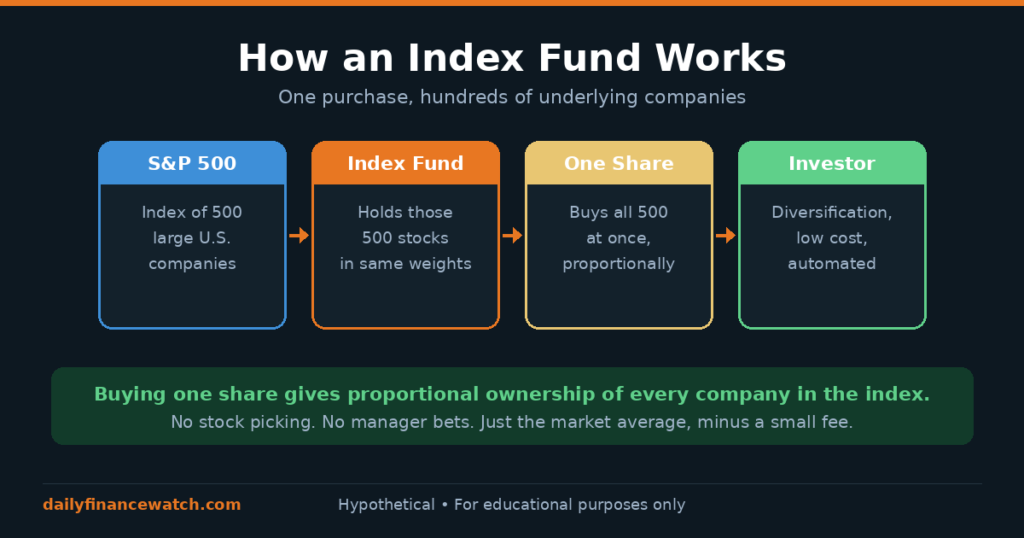
One purchase buys proportional ownership of every company in the index.
An index fund is a pooled investment that buys every security in a target market index, in the same proportions as the index itself. The S&P 500 is the most common target — a list of 500 large U.S. companies, weighted by market capitalization. An S&P 500 index fund holds Apple, Microsoft, NVIDIA, and the other 497 companies at the same weights the index assigns them. When the index changes, the fund changes. There is no manager picking winners. There is no thesis on which sectors will lead next quarter.
At first glace, this sounds almost too simple to matter. The mechanism becomes interesting when compared to its alternative. In contrast, an actively managed fund employs analysts and a portfolio manager who try to pick a subset of stocks they believe will outperform the index. To pay for that effort, the fund charges a higher fee — often 0.50% to 1.00% per year, sometimes more. The index fund charges almost nothing, because there is almost nothing to do. Vanguard’s VOO charges 0.03% per year as of its Vanguard product page. The math of compounding makes that gap matter more than it looks.
Index Funds Come in Two Wrappers
An index fund can be packaged as a mutual fund (priced once per day, like VFIAX) or as an exchange-traded fund (priced intraday, like VOO). The wrapper changes when an order fills and how taxes flow in a taxable account. The wrapper does not change the holdings. For a deeper look at when the wrapper matters, see the chapter article on ETFs vs mutual funds and their key differences.
Why an Index Fund Outperforms Most Active Managers
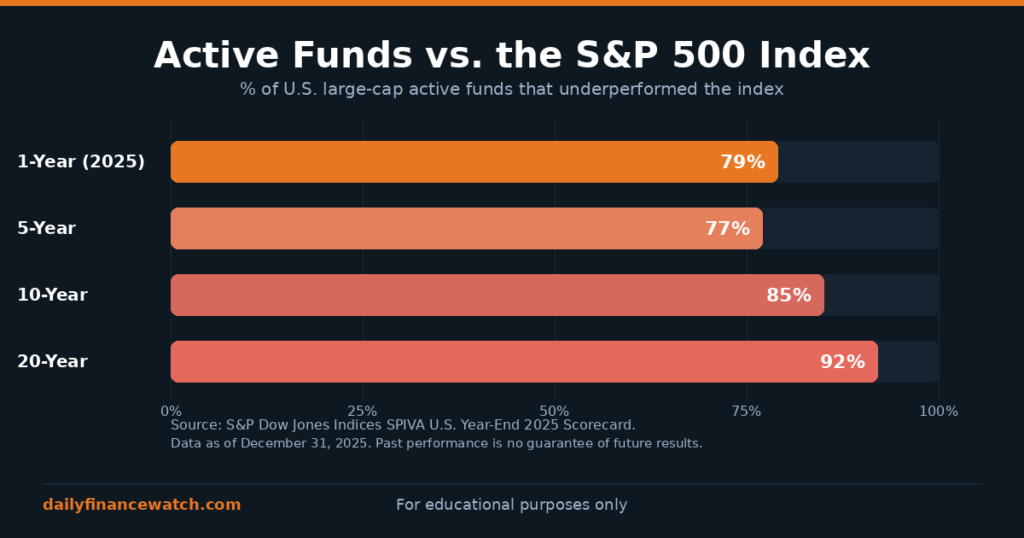
The longer the horizon, the harder it is for active managers to keep up.
Introductory articles often skip this part. According to the S&P Dow Jones Indices SPIVA U.S. Year-End 2025 Scorecard — the industry’s most-cited scorekeeper of the active-versus-passive debate — 79% of large-cap U.S. equity funds underperformed the S&P 500 in 2025, marking the fourth-worst year for active managers in the scorecard’s 25-year history. Over 20 years, roughly 92% of those funds underperformed. Moreover, this pattern holds across categories: as the time horizon lengthens, fewer active managers beat the index.
Furthermore, the mechanism behind this is not mysterious. An actively managed fund must beat the index by enough to cover its higher fee before the investor sees any benefit. A fund charging 0.80% more than an index fund must outperform by 0.80% every single year just to break even — and that hurdle compounds. As a result, combined with the difficulty of repeatedly picking winning stocks in a competitive market, the result is the SPIVA pattern: most active managers fall behind, and the gap widens with time.
The Cost Drag Beginner Guides Underestimate
Most guides describe expense ratios as “small fees that add up.” However, this framing understates the mechanism. Fees do not “add up” linearly. Instead, they compound against the entire balance, every year.
As a result, a 1.00% expense ratio is not 1% of the result. Over 30 years, it consumes roughly 25–30% of the final balance, because the fee is paid on the growing balance and the foregone growth is itself lost.
| Scenario | Annual Fee | After 30 Years* |
|---|---|---|
| Index fund | 0.03% | $75,440 |
| Low-cost active | 0.50% | $65,495 |
| Typical active | 1.00% | $56,308 |
*Hypothetical: $10,000 invested at 7.00% gross annual return, compounded for 30 years, fees deducted annually. For illustration only.
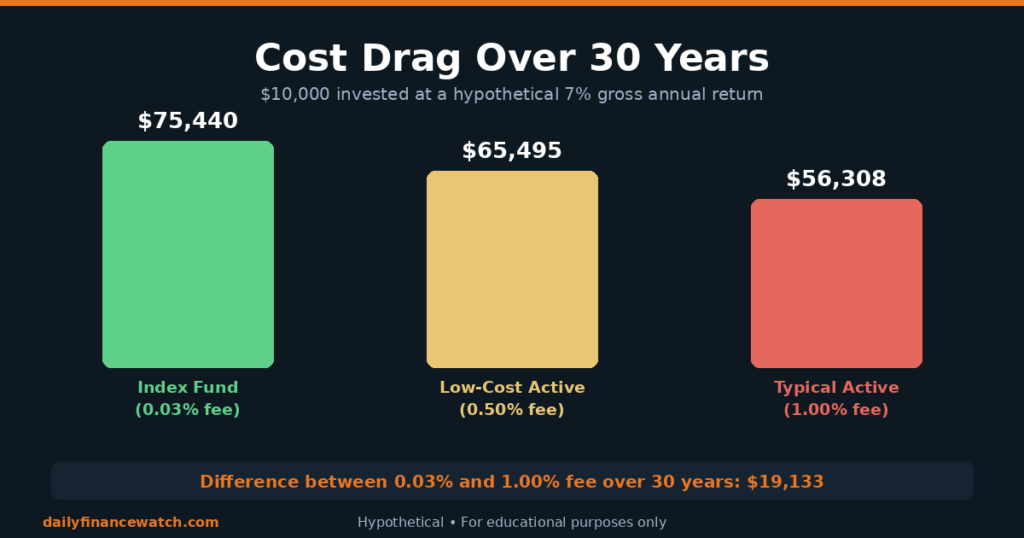
A 1.00% fee silently consumes about one-quarter of the final balance.
The gap between the 0.03% index fund and the 1.00% active fund is roughly $19,100 on a $10,000 starting investment — nearly two times the original amount, lost to fees. Tracking expense ratios across multiple fund categories over time shows this same pattern repeating, which is why institutional allocators treat cost as a primary input rather than an afterthought.
What Beginner Guides Get Wrong About Index Funds
A common piece of advice is “buy an index fund because it gives you average market returns.” This framing is technically true but incomplete in a damaging way. It implies that average is a consolation prize chosen because the investor cannot do better. Institutional research, including the multi-decade SPIVA dataset, shows the opposite: the “average” return of a low-cost index fund is, after fees and taxes, above what the majority of professional managers deliver. The accurate mental model is not “I am settling for average.” It is “I am structurally removing the costs and behavioral errors that cause most investors to fall behind.”
Common Beginner Mistakes With Index Funds
In particular, Three patterns are worth naming, because they undo the mechanical advantage the wrapper provides.
- Picking the wrong index. A leveraged S&P 500 fund or a narrow sector index fund is still labeled “index fund” but carries very different risk. The benefit described here applies to broad, market-cap-weighted indexes.
- Holding an index fund inside a high-fee account. A 1.00% advisor fee on a 0.03% index fund recreates the cost drag the fund was supposed to eliminate.
- Trading the index fund. Buying and selling based on market moves reintroduces the behavioral error — recency bias, where recent performance feels more important than long-term data — that the structure was designed to remove.
What Investors Often Watch
A disciplined investor may compare the total expense ratio, the tracking error against the stated index, and the tax efficiency relative to the account type. Long-term investors often check whether the fund’s holdings have drifted from the index it claims to track. This does not guarantee future returns. All investing carries risk, including the possible loss of principal. The SEC’s investor education page on mutual funds and ETFs provides additional context on what to evaluate before investing in any pooled fund.
How to Use Index Funds in a Portfolio
An index fund is a building block, not a finished portfolio. The most common beginner application uses one or two broad index funds — typically a U.S. total market or S&P 500 fund, optionally paired with an international index fund — as the equity foundation. In taxable accounts, the ETF wrapper tends to be more tax-efficient. Inside a Roth IRA where automatic dollar-cost investing matters more than wrapper structure, the mutual fund version can be easier to fund every paycheck.
The next article in this chapter, best ETFs for beginners including VOO, VTI, and QQQ, walks through the most-used options without ranking one above another.
Returning to the index-fund question at the end of this article is not meant to summarize definitions. Instead, it leaves the reader with the corrective frame. An index fund does not “win” by being smart. It wins by giving up the things that consistently lose: high fees and the temptation to outguess the market. That trade is what twenty-plus years of SPIVA data have priced in.
FAQ
What is an index fund in simple terms?
An index fund is a pooled investment that holds every security in a market index at the same weights as the index. When the S&P 500 changes, the fund changes. There is no manager picking stocks. The investor receives the index’s return minus a small annual fee, which is typically a fraction of what an actively managed fund charges.
Why do index funds beat most actively managed funds over time?
The mechanism is structural, not lucky. Active funds must overcome a higher fee every year just to match the index. Combined with the difficulty of consistently picking winners in a competitive market, this hurdle causes most active funds to fall behind over long horizons. SPIVA data show roughly 92% of large-cap U.S. active funds trailed the S&P 500 over 20 years through December 2025.
Should a beginner start with an index fund or an actively managed fund?
The decision depends on goals, account type, and cost tolerance, not on which fund sounds more sophisticated. For a long-term holder in a tax-advantaged account, a low-cost broad-market index fund removes two of the largest drags on returns — fees and behavioral errors — without requiring the investor to predict which stocks will outperform. This is educational, not personalized advice.
Educational content only — not personalized financial advice. All investing involves risk, including possible loss of principal.