Last updated: June 30, 2026
A beginner stares at two checkout buttons — buy VOO (an ETF) or buy VFIAX (a mutual fund) — and treats the click as a fork in the road. Both funds track the S&P 500. Both are run by Vanguard. The mutual funds vs ETFs choice in this case is real, but most of what beginners think they are choosing between is wrapper, not engine. VOO charges 0.03% per year and VFIAX charges 0.04%, both as of Vanguard’s April 2026 fact sheets. Same holdings, same index, one-basis-point gap. The decision deserves a clear head, not a coin flip dressed up as strategy.
What Mutual Funds and ETFs Have in Common
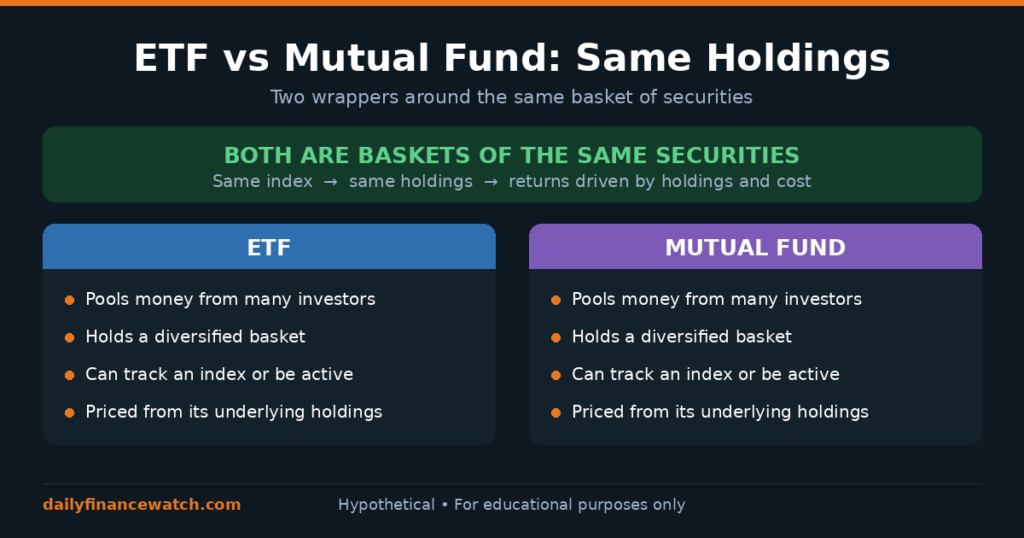
Both vehicles are pooled investments — many investors’ money combined and used to buy a basket of securities. The SEC’s investor bulletin on characteristics of mutual funds and ETFs describes both as registered open-end investment companies under the Investment Company Act of 1940. Each gives an investor instant diversification across dozens to thousands of holdings in a single purchase. Each can track an index or follow an active strategy. At the level that drives long-term returns — the holdings and the cost of holding them — same-index funds are nearly identical.
That foundation matters because the loud part of every comparison article focuses on the surface differences. Those differences are real but secondary. A 0.03% ETF and a 0.04% index mutual fund on the S&P 500 will trail each other by roughly one dollar per year on every ten thousand dollars invested.
Where the Wrapper Stops Mattering
Once two funds hold the same securities at similar cost, the wrapper becomes a logistics choice. It affects when an order fills, what minimum is required, and how taxes flow in a taxable account. It does not change what the underlying companies earn or pay out. Treating this as a strategic question inflates a clerical decision into a portfolio thesis.
Where ETFs and Mutual Funds Actually Differ
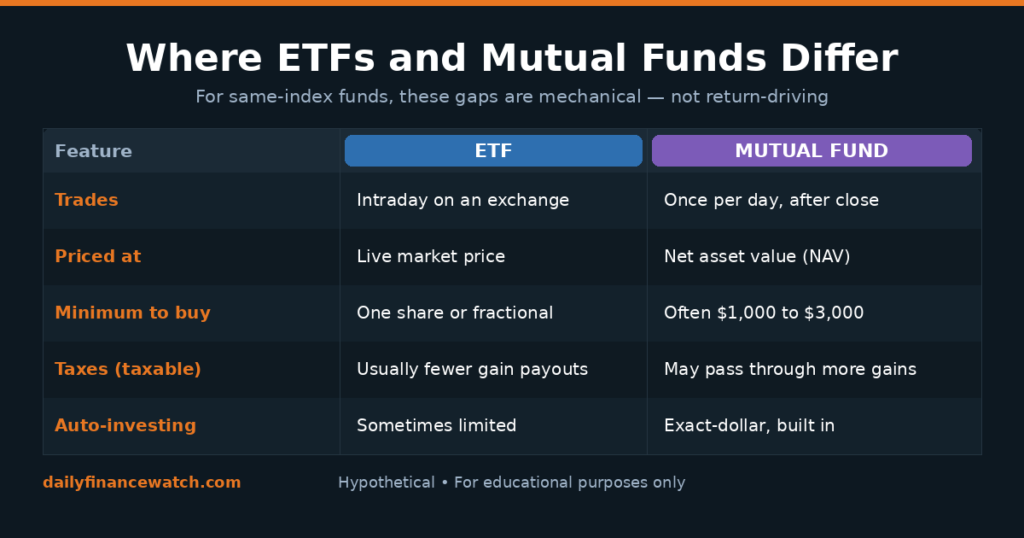
The mechanical differences cluster in four areas: trading mechanics, minimums, taxes in taxable accounts, and how automatic investing works. None of these change the holdings. All of them can change the user experience.
| Feature | ETF | Mutual Fund |
|---|---|---|
| Trades | Intraday on an exchange | Once per day at NAV after close |
| Pricing | Live market price (may differ briefly from NAV) | Net asset value, calculated once daily |
| Minimum to buy | One share or a fractional share | Often $1,000 to $3,000 |
| Taxes (taxable account) | Usually fewer capital gains distributions | May distribute more capital gains |
| Automatic investing | Sometimes limited at brokers | Exact-dollar amounts, built in |
For example, SPY — the first U.S.-listed ETF, launched January 22, 1993 according to its State Street SPDR S&P 500 ETF Trust prospectus filing — carries a 0.0945% expense ratio. A similar S&P 500 index mutual fund at Vanguard, VFIAX, charges 0.04% and requires a $3,000 minimum to open. The wrapper choice here is real money on the minimum and a roughly six-basis-point fee gap, not a stock-picking edge.
Tax Treatment Is the Difference With Real Stakes
In a taxable brokerage account, the difference that matters most is the capital gains distribution. ETFs typically use an in-kind creation and redemption process that allows the fund to push appreciated shares out without triggering a taxable sale inside the fund. The SEC bulletin linked above notes this is why ETFs tend to distribute fewer capital gains than comparable mutual funds. In a tax-advantaged account — a 401(k), a traditional IRA, or a Roth IRA — this advantage largely disappears, because distributions inside those accounts are not currently taxable.
What the Common Advice Gets Wrong About Mutual Funds
Beginner guides usually frame the choice as “ETFs are modern and tax-efficient, mutual funds are old and inefficient.” This is a category error. The relevant comparison is not ETF versus mutual fund — it is low-cost index fund versus high-cost actively managed fund, in the right account type. A 0.85% actively managed equity mutual fund and a 0.85% actively managed ETF will both drag on long-term returns. A 0.04% S&P 500 index mutual fund inside a Roth IRA behaves essentially like a 0.03% S&P 500 ETF inside the same Roth IRA. Institutional allocators frame it that way: structure follows cost and holdings, not the other way around.
Common Beginner Mistakes Worth Naming
Beginners often anchor on the wrapper and ignore the inputs — a pattern behavioral finance calls anchoring, where one prominent attribute dominates a decision and crowds out larger factors. Three frequent mistakes follow. First, paying a 0.50% load or a 1.00% expense ratio on a mutual fund when a 0.05% index alternative exists. Second, choosing an ETF for “tax efficiency” inside an IRA, where that efficiency has no effect. Third, treating intraday tradability as a feature, then using it to overtrade — which raises costs, taxes, and the odds of behavioral mistakes such as panic selling during drawdowns.
How to Choose Without Overthinking the Wrapper
A disciplined investor’s checklist starts with the account and the holdings, then ends with the wrapper.
A Three-Question Framework
- What account is this for? Taxable brokerage favors the tax-efficient wrapper, which is usually the ETF for U.S. equity index exposure. Tax-advantaged accounts make the wrapper near-neutral.
- What is the all-in cost? Add expense ratio and any load. For two same-index funds, choose the cheaper one unless something else outweighs the gap.
- Does the wrapper fit how you actually invest? Mutual funds win for exact-dollar recurring purchases. ETFs win for fractional one-share entry and intraday flexibility. Neither wins for the underlying market exposure.
This framework treats the question as one of plumbing, not picking. It also keeps the focus on what the SEC’s investor education page on mutual funds and ETFs actually urges investors to evaluate: fees, holdings, strategy, and how the fund fits the rest of the financial picture. For broader index-fund context, see the chapter pillar on what an index fund is and how it works, and for a definitional refresher, see how an ETF works mechanically.
For an investor building a first portfolio in a Roth IRA at a brokerage that supports fractional shares, the practical answer is usually “pick whichever the brokerage automates better and stop deliberating.” The point of this article is to make that conclusion feel earned, not lazy. Mutual funds and ETFs are not strategic rivals on the same index — they are two doors into the same room, priced and timed slightly differently. The difference worth obsessing over is not the door. It is the holdings, the fees, and the account they sit in.
What Investors Often Watch
A disciplined investor may compare the all-in cost (expense ratio plus any load), the tax efficiency relative to the account type, and the automation options at the broker. This does not guarantee future returns. Investing in any equity fund involves risk, including loss of principal.
FAQ
What is the main difference between mutual funds and ETFs?
The structural difference is that ETFs trade intraday on an exchange at market prices and mutual funds settle once per day at net asset value. The more important point, however, is that for two funds tracking the same index at similar cost, this difference does not change long-term returns — it changes how and when an order fills.
Why are ETFs often considered more tax-efficient than mutual funds?
ETFs typically use an in-kind creation and redemption process that lets the fund move appreciated shares out without selling inside the fund. As a result, they tend to distribute fewer capital gains than comparable mutual funds in a taxable account. This benefit largely disappears inside an IRA or 401(k), where distributions are not currently taxable.
Should beginners pick an ETF or a mutual fund first?
Neither is universally better. The answer depends on the account, the cost, and the automation. In a taxable account, a low-cost index ETF is often the simpler default. In an IRA where the broker supports auto-investing in exact dollar amounts, an index mutual fund can be easier to fund every paycheck. Holdings and cost matter more than the wrapper.
Educational content only — not personalized financial advice. All investing involves risk, including possible loss of principal.nalized financial advice. All investing involves risk, including the possible loss of principal.