Last updated: July 1, 2026
Three tickers dominate almost every beginner ETF list: VOO, VTI, and QQQ. Each one is an index ETF, a fund that holds many stocks to mirror a published market index. However, lumping them together as three flavors of one starter fund hides a real divide. VOO and VTI are broad, low-cost core holdings. In contrast, QQQ tracks the Nasdaq-100, a concentrated group of large technology and growth companies. Treating that growth bet as an all-purpose core fund is where many beginners stumble, and the gap widens sharply when markets fall.
What Each Index ETF Actually Holds
An index ETF does not try to beat the market. Instead, it copies an index and moves with it. To see how these funds are built, read what an index fund is. For example, VOO follows the S&P 500, so it holds about 500 large U.S. companies. By comparison, VTI follows the CRSP US Total Market Index, which spans roughly 3,600 stocks across large, mid, and small caps. QQQ works differently. It tracks the Nasdaq-100, which holds the 100 largest non-financial companies listed on the Nasdaq exchange.
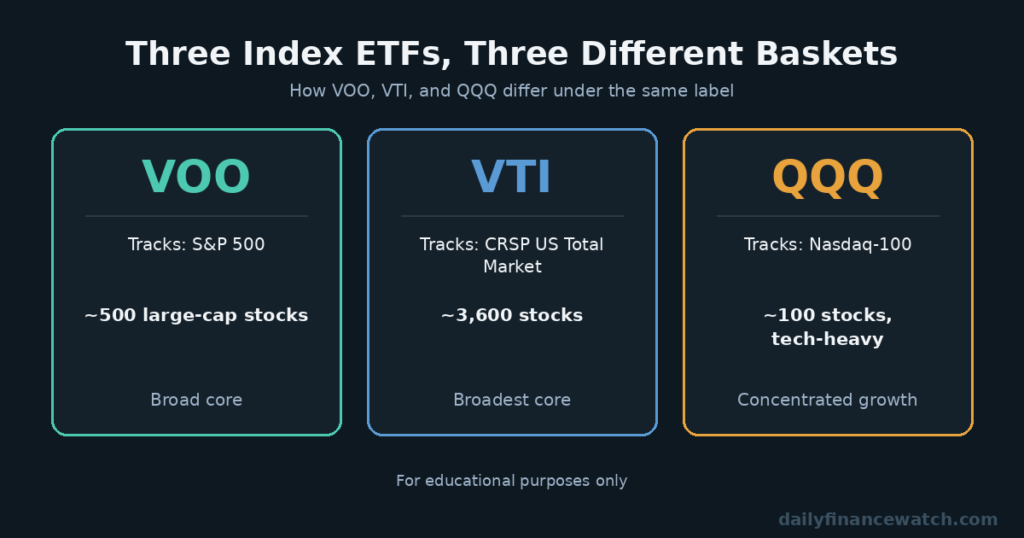
One label, three baskets — breadth is what separates a core fund from a tilt.
From the S&P 500 to the Nasdaq-100
The index behind each fund sets its character. That S&P 500 base covers large U.S. companies across every sector. A total-market index then adds thousands of smaller firms on top. The Nasdaq-100, by contrast, excludes financial companies and tilts heavily toward technology. As a result, QQQ carries far more exposure to one sector than the other two funds do.
Cost and Breadth: How VOO, VTI, and QQQ Diverge
Fees look tiny on these funds, yet they compound over decades. For example, VOO and VTI each charge a 0.03% expense ratio, the annual slice a fund takes from your money. By comparison, QQQ charges 0.18%. Moreover, Invesco cut that figure from 0.20% in late 2025 when it restructured the fund. According to the SEC’s guidance on how fund fees reduce long-term returns, even small cost gaps grow large over time.
| Fund | Index Tracked | Approx. Holdings | Expense Ratio | Annual Cost per $10,000 |
|---|---|---|---|---|
| VOO | S&P 500 | ~500 large caps | 0.03% | $3 |
| VTI | CRSP US Total Market | ~3,600 stocks | 0.03% | $3 |
| QQQ | Nasdaq-100 | ~100 large caps | 0.18% | $18 |
Sources: Vanguard and Invesco fund data; expense ratios as of June 2026.
The cost gap is real but small in dollar terms. A more important difference sits in the Holdings column. VTI owns everything in VOO, plus thousands of smaller companies that carry little weight. Therefore VOO and VTI behave almost identically, and owning both adds little. QQQ, meanwhile, holds a fraction of the market and leans on a handful of giant technology names.
Why Treating QQQ Like a Core Fund Misleads Beginners
QQQ has outrun VOO and VTI over the past decade, which makes it tempting as a first pick. Over the ten years through mid-2026, QQQ returned about 22% a year versus 15.6% for VOO, per portfolioslab.com. Past strength, however, is not the same as safety. Because QQQ concentrates in one sector, it can fall much further than a broad fund when that sector turns.
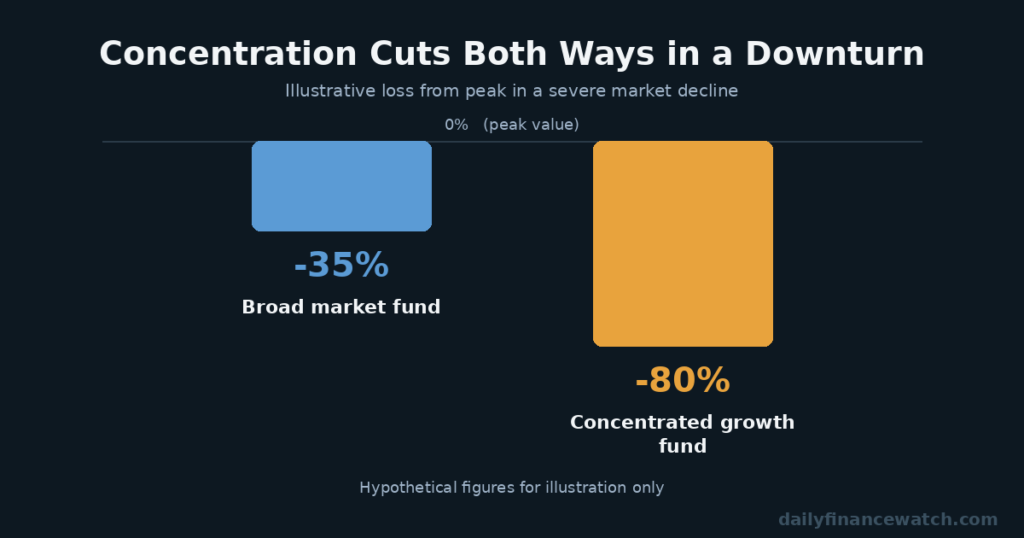
Deeper drawdowns are the price a concentrated fund pays for its upside.
The Dot-Com Lesson QQQ Still Carries
History shows how deep that risk can run. For instance, the dot-com crash hit QQQ hard. It fell about 83% from its March 2000 peak to its October 2002 low, per portfolioslab.com. The fund then took roughly 15 years to reclaim that high. By comparison, a total-market fund fell hard in the same stretch, yet nothing like that depth. In short, QQQ carries a steeper trade-off: higher potential reward, far deeper drawdowns.
Most beginner guides frame the choice simply: QQQ beats the S&P 500, so buy QQQ. However, that advice leans on one decade of results and ignores what drove them. In reality, QQQ’s edge came largely from a historic technology run, not from broad diversification. By comparison, professional allocators treat the Nasdaq-100 as a sector tilt on top of a core, not as the core itself. This means a sensible approach often pairs a broad fund for stability with a smaller, risk-sized growth position.
Choosing a First Index ETF Without Chasing Returns
Picking a first index ETF works best as a deliberate choice, not a reaction to last year’s winner. For example, a broad fund like VOO or VTI gives wide exposure at rock-bottom cost. Meanwhile, QQQ can still play a role, but as a smaller tilt rather than the whole portfolio. In the end, the right mix depends on your time horizon and how much swing you can stomach.
What Disciplined Investors Watch
Experienced investors rarely judge a fund by its recent returns alone. Instead, they look at what sits underneath. For instance, a disciplined investor checks a fund’s concentration, its single-sector exposure, and its past drawdowns. As a result, high concentration can signal higher reward in a strong cycle and steeper losses in a weak one. Still, none of this predicts the future; it simply frames the risk before money moves.
Common Index ETF Mistakes Beginners Make
A few errors show up again and again. For example, some beginners buy both VOO and VTI, paying twice for nearly the same holdings. In addition, many chase QQQ after a strong tech year, a pattern driven by recency bias, the tendency to expect recent trends to continue. Because the Nasdaq-100 rides megatrends like artificial intelligence and semiconductors, its swings can be violent in both directions. Over time, a steadier plan treats those swings as a known cost, not a surprise.
The takeaway is not that one fund wins. Instead, VOO, VTI, and QQQ are not three versions of the same thing. Two are broad, cheap core funds that behave almost identically. By comparison, the third is a concentrated growth position that can soar and sink far more sharply. Seen this way, the real question is not which ETF performed best last year, but which role each fund should play in a portfolio built to last. In every case, investing carries risk, and no fund removes it.
Keep learning: how ETFs differ from mutual funds and what an expense ratio really measures.
What makes VOO and VTI nearly interchangeable?
Both funds hold the same large U.S. companies at their core. Moreover, VTI adds thousands of smaller stocks on top, and those carry little weight. As a result, the two move almost in step, with yearly returns usually within a fraction of a percent. Because the overlap is nearly total, most investors simply pick one.
Why does QQQ carry more concentration risk than a total-market fund?
QQQ holds only about 100 companies, and technology names dominate its weight. By comparison, a total-market fund spreads money across thousands of stocks in every sector. Because QQQ leans so heavily on one slice of the market, it can fall much further when that slice struggles. For instance, during the dot-com crash it lost about 83% and took years to recover. In short, that concentration is why it is not a substitute for a broad core fund.
How much does a 0.18% expense ratio cost each year?
On a $10,000 investment, a 0.18% expense ratio costs about $18 a year. By comparison, a 0.03% fund costs roughly $3 for the same amount. The dollar gap looks minor at first. Over time, though, small fees compound as your balance grows and the charge repeats annually. In particular, cost becomes one factor worth weighing, even when it seems tiny.
This article is educational and not personalized investment advice. All investing involves risk, including the possible loss of principal.