Last updated: July 1, 2026
On October 1, 2019, Charles Schwab cut its $4.95 stock commission to zero. Within nine days, every major U.S. discount broker matched the move. Consequently, brokerage basics shifted permanently — but the platform choice is not where the real decision lives. The account type you open — taxable, Roth IRA, or Traditional IRA — locks in decades of tax treatment. For beginners today, opening the account itself is free and takes about fifteen minutes online. However, the lasting choice is which wrapper you set up around the same underlying securities. In particular, that distinction is where most beginner guides go wrong.
Brokerage Basics: Account Type Comes Before Broker Choice
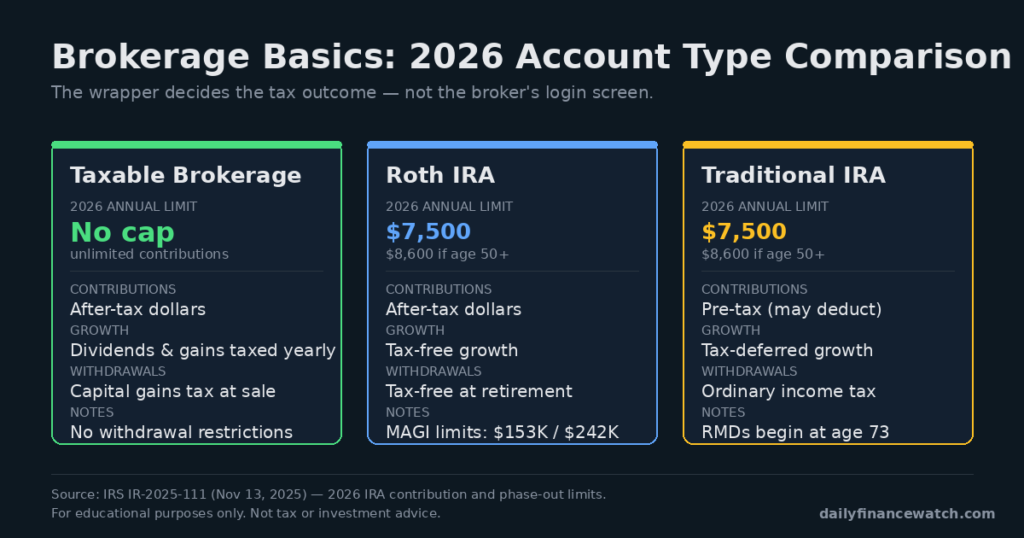
The wrapper decides the tax outcome — the same ETF sits inside all three account types.
A taxable brokerage account is the default choice for beginners who want no withdrawal restrictions. You pay tax on dividends each year, and on realized capital gains whenever you sell. This flexibility is useful. However, it produces the largest tax drag over long holding periods. By comparison, a Roth IRA takes after-tax dollars. Both the growth and qualifying withdrawals in retirement are tax-free. Meanwhile, a Traditional IRA reverses that pattern. Contributions are pre-tax today, but every withdrawal in retirement is taxed as ordinary income.
For 2026, the IRS-set contribution limit on Roth and Traditional IRAs is $7,500 per year for filers under age 50. Filers age 50 and older can add an $1,100 catch-up, for a total of $8,600. By comparison, taxable accounts have no annual cap. In addition, direct Roth contributions phase out above certain income thresholds. For single filers in 2026, the phase-out sits between $153,000 and $168,000 of modified adjusted gross income. Joint filers face a phase-out range of $242,000 to $252,000. In reality, this ordering matters. A high-income earner may lose direct Roth access later, while a taxable account remains available at any income level.
Brokerage Basics: Why Account Type Locks in Tax Treatment
Moving securities between brokers is mechanical. The industry standard is the Automated Customer Account Transfer Service, or ACATS. This system moves an entire portfolio between two U.S. brokers in about five to seven business days. By contrast, converting a Traditional IRA to a Roth IRA triggers immediate income tax on the converted balance. Moving after-tax money into a Roth for the current year is easy, but only within the annual contribution limit. As a result, this asymmetry drives professional planners to frame the account type decision as the anchor. The broker choice becomes a downstream detail.
| Account Type | 2026 Annual Limit | Tax on Contributions | Tax on Withdrawals |
|---|---|---|---|
| Taxable Brokerage | No cap | After-tax dollars | Capital gains + dividends taxed yearly |
| Roth IRA | $7,500 (under 50) / $8,600 (50+) | After-tax dollars | Tax-free in qualified retirement |
| Traditional IRA | $7,500 (under 50) / $8,600 (50+) | Pre-tax (may be deductible) | Taxed as ordinary income |
Source: IRS, “401(k) limit increases to $24,500 for 2026, IRA limit increases to $7,500” (November 13, 2025).
How to Open a Brokerage Account in Six Steps
Once the account type is settled, the mechanical process is short. Furthermore, most large U.S. brokers use an identical online application flow.
- Confirm identity. Applicants provide legal name, date of birth, Social Security or ITIN number, and a U.S. residential address. This step satisfies FINRA’s customer identification rules.
- Select the account wrapper. Choose between an individual taxable account, a joint taxable account, a Roth IRA, a Traditional IRA, or a rollover IRA. Rollover IRAs hold existing 401(k) balances from a former employer.
- Answer suitability questions. Brokers ask about income range, net worth, investment experience, and risk tolerance. These answers set default trading permissions.
- Link a funding source. Most brokers accept an ACH transfer from a bank account, a wire transfer, or a check.
- Fund the account. Zero minimum applies at the largest brokers, but pending ACH transfers typically clear within two to five business days.
- Verify and log in. Once identity checks clear, the account is usable — often within one business day for standard applications.
Every major U.S. broker offers this same flow. FINRA and the SEC require nearly identical customer identification and suitability checks. As a result, the mechanical brokerage basics look almost identical across firms. Real differentiation lives elsewhere. Cash sweep yields, fractional share support, retirement fees, and research tools separate one broker from another. The account application itself does not surface any of these differences.
What SIPC Protection Actually Covers — and What It Does Not
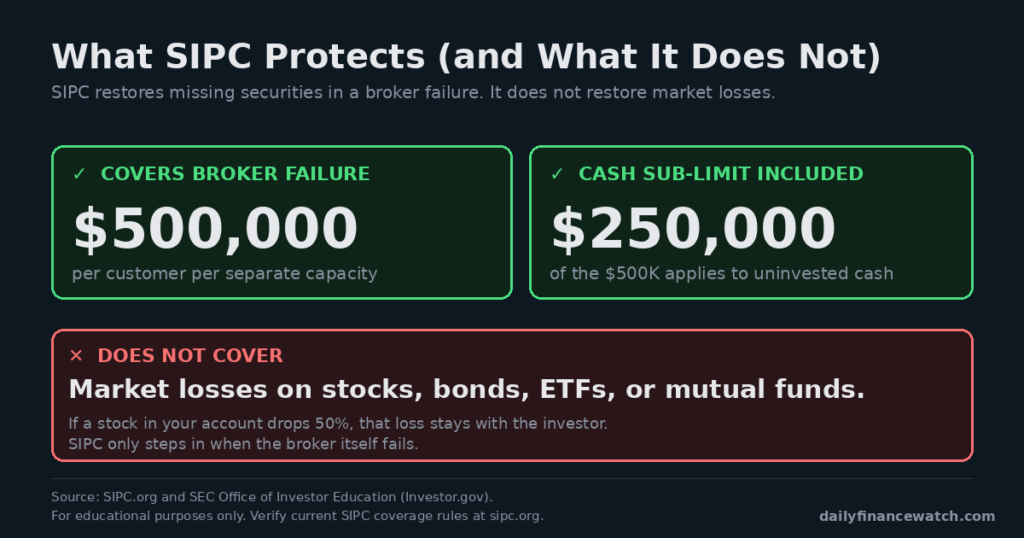
SIPC replaces missing securities in broker failure — it does not replace market losses.
Every SIPC-member brokerage carries baseline insurance that protects customer accounts if the broker itself fails. According to the SEC’s Office of Investor Education, SIPC covers up to $500,000 per customer per separate capacity. This coverage includes a $250,000 sub-limit for uninvested cash. Furthermore, coverage is automatic and requires no additional fee from the account holder. Membership status is disclosed on every broker’s public website. A public lookup on the SIPC directory takes about thirty seconds.
The critical clarification concerns what SIPC does not protect. According to SIPC, the coverage restores missing customer property when a member firm fails. It does not protect against a decline in the market value of securities. For example, if a broker collapses and cash is unaccounted for, SIPC advances funds to make customers whole. This restoration applies up to the stated limit. However, if an investor holds Apple stock and Apple’s share price falls fifty percent, SIPC provides no reimbursement. The distinction matters because many beginners conflate SIPC with a form of investment guarantee.
In reality, the practical implication is straightforward. SIPC serves as a backstop against broker failure. Meanwhile, market risk stays fully with the investor. Beginners sometimes ask whether they should split accounts across two brokers to double the coverage. In most cases, the answer is no. The $500,000 threshold sits well above nearly every first-time investor’s balance. Because of that, opening a second account creates operational drag without adding real protection.
Where Brokerage Costs Actually Hide After Zero Commissions
Zero commissions removed the most visible fee, but they redirected the industry’s revenue model. As a result, two costs now do most of the work. The yield spread on uninvested cash is one. Payment for order flow is the other.
Before October 2019, Charles Schwab charged $4.95 per online stock trade. A modestly active investor placing 100 trades per year paid $495 in commissions annually. TD Ameritrade charged $6.95, so the same trader would have paid $695 per year on that platform. E*Trade’s rate matched TD Ameritrade at $6.95. Within nine days in October 2019, all four of those charges dropped to zero. This is why the platform choice among major U.S. discount brokers no longer turns on commissions. Instead, features and cash yields do the differentiating work.
One common piece of advice: open a brokerage account with the bank that already holds your checking account. However, bank-affiliated brokerages often pay lower interest on uninvested cash sweeps than independent discount brokers do. In addition, their in-house mutual funds tend to carry higher expense ratios. Comparable index ETFs from Vanguard, iShares, or SPDR typically cost less each year. A cleaner mental model separates two decisions: which broker handles execution and custody, and which funds fill the portfolio.
The brokerage basics themselves are now a mechanical fifteen-minute task at any major U.S. broker. However, the decision that carries long-term weight is which wrapper holds the securities. Because ACATS transfers make the broker choice reversible, the platform decision is not permanent. In contrast, IRA choice carries fixed tax consequences. Consequently, the sensible sequence differs from what most guides describe. Settle the account type first. Verify SIPC membership second. Then choose the platform based on cash sweep yields, expense ratios of available funds, and fractional share support. For many beginners, a Roth IRA paired with a low-cost, broad-market index fund is a defensible starting position.
For related reading: ETFs vs Mutual Funds: Key Differences and Best ETFs for Beginners.
Frequently Asked Questions
What is the difference between a taxable account and a Roth IRA?
A taxable account has no contribution or withdrawal restrictions. However, every dividend and realized capital gain is taxed the same year it occurs. A Roth IRA caps 2026 contributions at $7,500 for filers under 50. By comparison, qualified withdrawals in retirement are entirely tax-free. Neither is universally better. The right sequence depends on income, time horizon, and whether the money is likely needed before retirement age.
Does SIPC insurance protect me if my stocks lose value?
No. SIPC coverage restores customer property when a member brokerage fails. However, it explicitly does not protect against declines in the market value of securities. If a stock in your account drops fifty percent, that loss is yours. By comparison, if the brokerage itself collapses and cash goes missing, SIPC steps in. It advances funds up to $500,000 per customer per separate capacity. A $250,000 sub-limit applies to uninvested cash.
How long does account approval and funding usually take?
Standard applications at large U.S. brokers complete identity verification within one business day. Once approved, the account can accept trades immediately. However, incoming ACH transfers from an external bank typically take two to five business days to settle. Meanwhile, wire transfers usually clear the same business day but carry a fee. A funded, tradeable account is often ready within one week from the initial application.
This content is for educational purposes only and is not personalized financial advice. Investing involves risk, including possible loss of principal.
© 2026 Daily Finance Watch. Excerpts under 50 words with attribution and a link back are permitted. Full-article reproduction requires written permission.