Last updated: July 5, 2026
The question ‘how much money do I need to start investing?’ sounds like it wants a dollar answer. In reality, the investing minimum at most U.S. brokerages today is $1. However, that number is almost beside the point. A $50 monthly contribution from a financially prepared beginner outperforms a $1,000 opening deposit made before clearing high-interest debt or building an emergency fund. Structure matters more than the starting balance — and that distinction is what most beginner guides skip entirely.
What Is the Actual Investing Minimum Today?
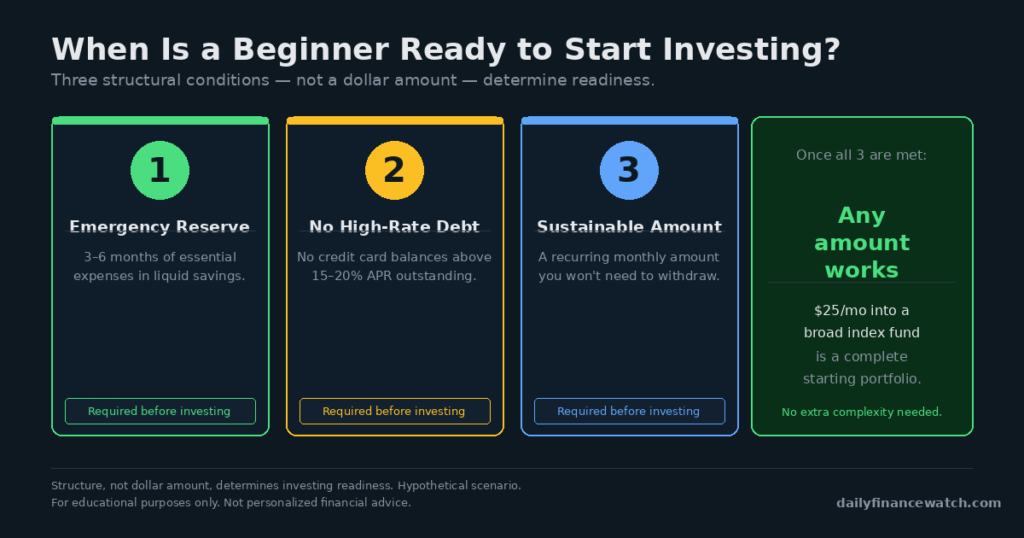
The investing minimum is not a dollar figure — it is a structural checkpoint.
For most of U.S. brokerage history, account minimums were a real barrier. Full-share prices on popular stocks made small-dollar investing impractical. Two structural changes removed that barrier. First, major brokerages eliminated trading commissions in October and November 2019. Second, fractional share investing arrived at large custodians. On June 9, 2020, Charles Schwab launched its Stock Slices service. Retail investors could then buy any S&P 500 company for $5 per slice, commission-free. Investors could purchase up to 10 different stocks or ETFs in a single order, per the Schwab press release.
Fidelity made a similar fractional share announcement in January 2020. Furthermore, Robinhood had offered fractional investing to its users well before either firm. By comparison, the practical investing minimum at major self-directed brokerages — Fidelity, Schwab, Robinhood — is now $1 for most U.S. stocks and ETFs. Consequently, the question of how much money to start with has become a question of readiness, not dollars.
Account Type and Your Investing Minimum Entry Point
Account type also affects readiness. A taxable brokerage account has no minimum and no contribution limit, making it the most flexible entry point. A Roth IRA has no account minimum at most brokerages, but contributors must have earned income. Meanwhile, a 401(k) through an employer operates under its own contribution rules with no setup cost to the employee. For most beginners, the relevant question is not which account to use. It is whether their financial conditions allow any account to work as intended.
Three Conditions Before You Reach Your Investing Minimum
A specific dollar amount is the wrong answer to the question of when to start. A more useful frame is a three-condition checklist. Condition one: a funded emergency reserve is in place, typically three to six months of essential expenses in a liquid savings account. Condition two: no high-interest debt is outstanding. Credit card balances at 20% APR or higher represent a guaranteed negative return that no investment strategy reliably beats. Condition three: the planned contribution is sustainable on a recurring monthly basis, not a one-time transfer.
Once a beginner meets all three conditions, almost any recurring amount works. For example, $25 to $50 per month into a broad index fund is a legitimate starting point. Furthermore, the habit of consistent contribution matters more than the size of the opening deposit. According to the SEC’s Investor.gov, starting early and contributing regularly gives compounding more time to operate. However, that advantage only holds when the structural conditions are already in place. Over time, a small recurring contribution from a prepared beginner outpaces a large lump sum from one who is not.
Why Debt Sequencing Matters More Than the Opening Balance
Most beginner guides answer this question with a round number — $100, $500, or $1,000 — as though the dollar figure determines investing readiness. However, that framing ignores sequencing. Consider a beginner who puts $200 into an S&P 500 ETF while carrying a $2,000 credit card balance at 24% APR. Long-run stock market returns average roughly 7–10% annualized. A 24% annual interest charge beats that margin every month. In contrast, clearing the card first and starting with $50 into an index fund produces a structurally better outcome. Institutional investors apply this logic explicitly: eliminate guaranteed negative returns before pursuing uncertain positive ones.
Why Investor Psychology Delays the Right Sequence
Investor psychology also shapes how beginners approach this question. Loss aversion — the tendency to feel losses more acutely than gains — pushes many toward investing before they are financially prepared. The fear of missing market returns can feel more urgent than the arithmetic of paying off a high-rate card. However, urgency does not change the math. Moreover, anchoring bias plays a separate role. A beginner who hears that $1,000 is a typical starting figure may delay for months. In reality, $25 per month into a low-cost index fund begins compounding on day one.
How Much to Invest: Finding Your Investing Minimum
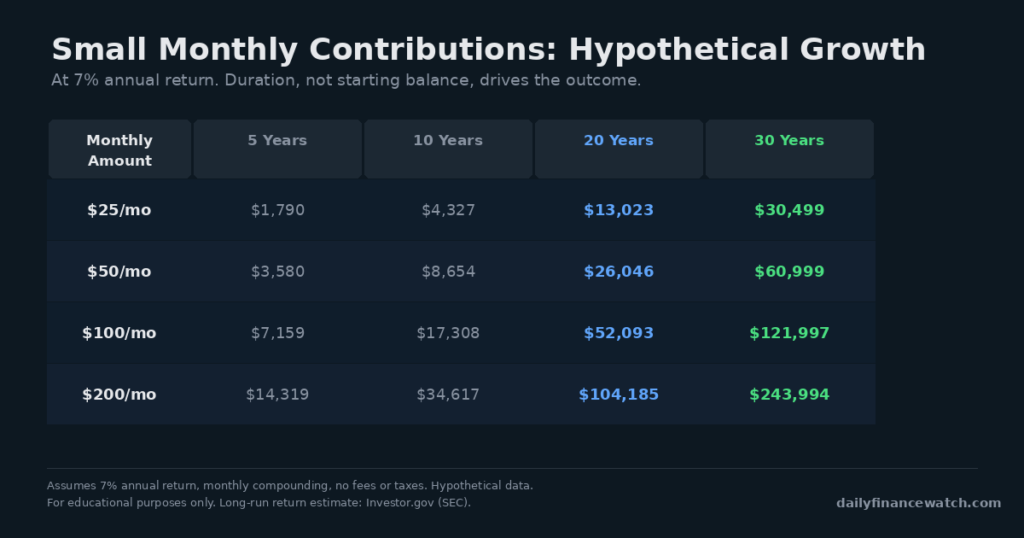
Duration, not the opening deposit, is the variable that drives the outcome over time.
Once a beginner meets the three conditions, the practical starting range is $25 to $100 per month. This range keeps the initial position manageable while establishing the contribution habit. Automating the amount removes the monthly decision entirely. In addition, most major brokerages allow no-fee automatic recurring investments in ETFs or mutual funds. For example, a $25 automated monthly purchase into a broad index fund such as VTI is a complete, functioning beginner portfolio. The setup requires no additional complexity at the outset.
The table below shows what a consistent monthly investment produces at a 7% annualized return across different time horizons. These figures are hypothetical and illustrative only. Individual returns vary based on the investment chosen, market conditions, fees, and contribution timing. Furthermore, the table assumes no interruption to contributions, which is easier to sustain with a smaller automated amount than with a large discretionary one. The key variable is duration. Over time, the length of the contribution period drives outcomes far more than the size of the first deposit.
| Monthly Amount | 5 Years | 10 Years | 20 Years | 30 Years |
|---|---|---|---|---|
| $25/mo | $1,790 | $4,327 | $13,023 | $30,499 |
| $50/mo | $3,580 | $8,654 | $26,046 | $60,999 |
| $100/mo | $7,159 | $17,308 | $52,093 | $121,997 |
| $200/mo | $14,319 | $34,617 | $104,185 | $243,994 |
Hypothetical. Assumes 7% annual return, monthly compounding, no fees or taxes. Source methodology: Investor.gov compound interest calculator (SEC).
Turning the Table Into a Plan
At most major U.S. brokerages in 2026, the investing minimum in dollar terms is $1. However, the more useful threshold is structural. A beginner needs an emergency fund in place, needs to clear high-rate debt, and needs to set the recurring contribution at an amount they will not need to sell under short-term pressure. A beginner who meets those three conditions and starts with $25 per month is better positioned than one waiting for a larger opening balance with no plan behind it. What goes into that account matters equally. For context on where to put the first deposit, see how broad index funds work and why keeping costs low is the lever most within a beginner’s control.
For related reading: 5 Effective Strategies for New Investors
Frequently Asked Questions
What is the minimum amount needed to start investing?
At most U.S. brokerages, the technical investing minimum is $1 or less. Fractional shares allow dollar-based purchases at Fidelity, Schwab, and Robinhood. However, the practical minimum is structural: a funded short-term emergency reserve, no high-interest debt, and a monthly contribution that can be sustained. A $25 recurring monthly investment that meets those three conditions is a stronger starting point than a $500 lump sum that does not.
Should I pay off debt before I start investing?
Beginners should generally pay down high-interest debt — typically credit card balances above 15% to 20% APR — before opening a taxable brokerage account. However, one common exception applies. Contributing enough to a 401(k) to capture an employer match usually makes sense first. Matching contributions provide an immediate 50% to 100% return that typically outweighs the interest on most consumer debt. Outside of that employer match, eliminating guaranteed high-rate costs before pursuing uncertain market gains is the more reliable sequence.
Can I start investing with $25 a month?
Yes. Fractional shares let investors buy a dollar amount of a stock or ETF rather than a whole share. At major brokerages including Fidelity and Schwab, the minimum is $1 per trade for most U.S. stocks and ETFs. A $25 monthly purchase of an ETF such as VTI builds a fractional position that compounds over time. However, investors should confirm that their brokerage supports fractional ETF trades specifically. Some platforms restrict fractional trading to individual stocks only.
This content is for educational purposes only and is not personalized financial advice. Investing involves risk, including possible loss of principal.
© 2026 Daily Finance Watch. Excerpts under 50 words with attribution and a link back are permitted. Full-article reproduction requires written permission.