Last updated: July 1, 2026
Fractional shares let investors buy a dollar amount of any stock rather than a whole share. Most beginner guides treat them as a workaround for expensive stocks. However, that framing misses the more important use case. In reality, dollar-based investing makes dollar-cost averaging fully automatic and leaves no idle cash sitting unused. That shift changes the mechanics of how a portfolio grows over time.
What Are Fractional Shares and How Do They Work?
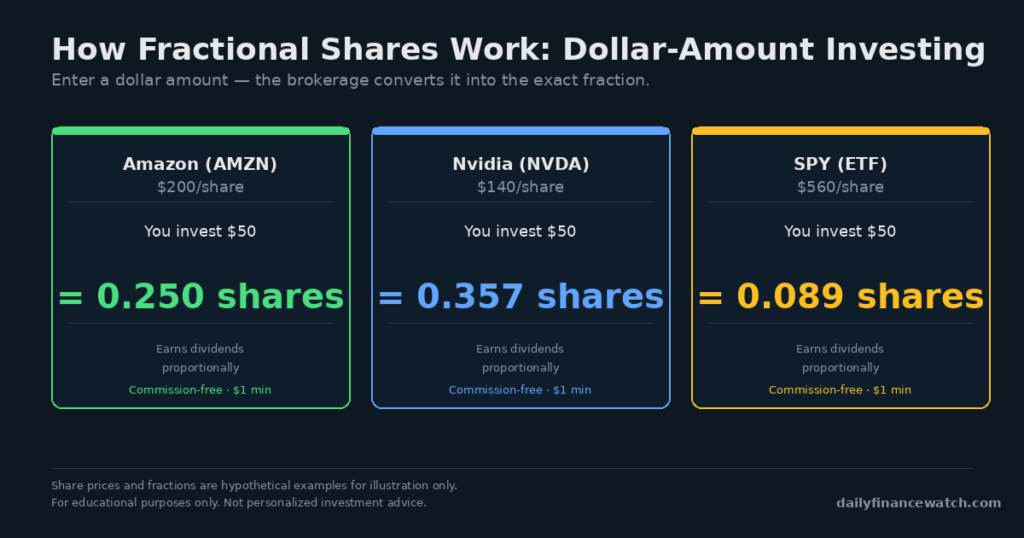
The brokerage converts any dollar amount into an exact fraction — price never limits participation.
A fractional share is any ownership stake in a stock or ETF representing less than one whole share. The brokerage calculates the fraction automatically. For example, if a stock trades at $400 and an investor contributes $100, the platform records ownership of 0.25 shares. That position earns dividends and tracks price changes proportionally. Consequently, the percentage gain or loss on a fractional position matches that on a full share exactly — only the dollar amount differs.
Dollar-based investing of this kind existed long before modern brokerage apps, but only in narrow contexts. Dividend reinvestment plans, or DRIPs, created partial positions when cash dividends did not divide evenly into whole shares. Stock splits and corporate mergers also generated fractions as a byproduct. However, investors could not purchase them directly until 2019. In December 2019, Robinhood launched this feature for retail customers with purchases starting at $1. According to CNBC reporting from December 12, 2019, Robinhood was among the first major platforms to introduce it. Fidelity followed in 2020, and Charles Schwab expanded its Stock Slices program shortly after.
How Fractional Share Investing Actually Works
The mechanics are straightforward. An investor enters a dollar amount instead of a share count. The brokerage converts that amount into the equivalent fraction at the current market price. For example, a $50 monthly contribution into a $200 stock produces 0.25 new shares each month. In addition, most major platforms — Fidelity, Schwab, and Robinhood — support this feature for thousands of U.S. stocks and ETFs with no commission. Moreover, the fractional position appears in the account immediately and begins tracking market performance from the first day. Minimums typically start at $1.
Why Fractional Shares Solve the Idle Cash Problem
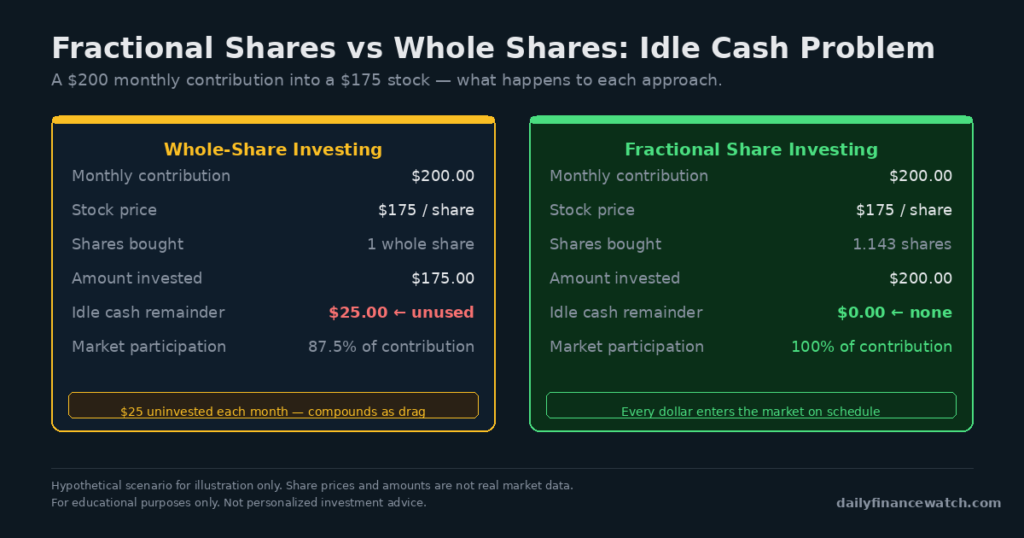
A $25 idle remainder each month sounds small — compounded over years, it represents missed market time.
Most beginner guides treat fractional shares as a solution for expensive stocks only. However, that framing misses a more useful application. Dollar-based investing eliminates the idle cash problem that affects whole-share purchasing. Consider a beginner contributing $200 monthly into a stock trading at $175. Buying one whole share leaves $25 sitting unused until the next contribution. In contrast, a dollar-based purchase invests the full $200 immediately — 1.143 shares at current price — with nothing left idle.
Over time, idle cash drag compounds noticeably. A portfolio that consistently leaves $20 to $30 uninvested per contribution misses months of market participation across years. Furthermore, dollar-cost averaging works most precisely when the full amount enters the market each period. According to the SEC’s Investor.gov, starting early and contributing consistently matters more than timing the market. Dollar-based investing makes this precision possible at any contribution size, removing the rounding problem that previously made exact dollar-amount contributions impossible.
Fractional Shares: What Varies by Brokerage
By comparison, not every brokerage handles fractional shares the same way. Three policy differences matter most for beginners. First, stock eligibility varies. Some platforms restrict this feature to S&P 500 components, while others extend it to thousands of tickers. Schwab’s original Stock Slices program, for example, limited purchases to S&P 500 stocks. Fidelity offers a broader selection, including ETFs. In contrast, some smaller platforms restrict orders to market orders only, removing limit-price control.
Second, transferability is a real limitation. Fractional positions generally cannot transfer between brokerages. When an investor moves accounts, most platforms liquidate these positions and send the cash equivalent instead. In particular, this creates an unexpected taxable event. Investors with many small positions accumulated over years may face tax complexity when switching platforms. Third, voting rights differ by brokerage. Some platforms pass fractional votes proportionally. However, others do not extend voting rights to partial shareholders at all.
| Brokerage | Minimum | Stock eligibility | ETF fractional | Transferable? |
|---|---|---|---|---|
| Fidelity | $1 | Broad (thousands) | Yes | No |
| Charles Schwab | $1 | S&P 500 + ETFs | Yes | No |
| Robinhood | $1 | Broad (thousands) | Yes | No |
Source: Fidelity.com, Schwab.com, Robinhood.com (platform policies as of mid-2026). Hypothetical data — verify current policies before investing.
The table above compares key policy differences across the three most widely used platforms. In particular, minimum investment, stock eligibility, and transferability rules vary enough to affect which platform suits a beginner’s needs.
How Disciplined Investors Actually Use Dollar-Based Investing
Most beginner advice frames dollar-based investing as a strategy for those who cannot afford full shares. However, this treats it as a consolation prize rather than a precision tool. Institutional investors use dollar-cost averaging as deliberate discipline — not because they cannot afford whole shares. The same logic applies at any portfolio size. A beginner contributing $50 per month into VTI does not need to accumulate $270 before buying one full share. Instead, every dollar enters the market on the same schedule regardless of the share price that month. Over time, that discipline matters more than any individual contribution amount.
Loss aversion — the tendency to feel losses more acutely than equivalent gains — pushes many investors toward inaction when share prices feel out of reach. Fractional investing removes that psychological barrier. However, it also introduces a subtle risk. The low entry barrier can encourage over-diversification into too many positions. A beginner who spreads $200 across 40 separate fractional positions creates a management burden without meaningful diversification benefit. Consequently, holding one or two broad index funds through dollar-based investing achieves better diversification at far lower complexity.
Fractional shares are not primarily a tool for accessing expensive stocks. That use case is real but secondary. The more important function is precision — investing the full contribution amount every period with zero idle cash remainder. For most beginners, the application is simple. Choose a broad index fund such as VTI or SPY, set a fixed monthly dollar amount, and automate the purchase. However, one caution applies: confirm that your brokerage supports fractional ETF trades specifically, since some platforms restrict this feature to individual stocks only. In either case, dollar-based investing handles the arithmetic automatically. Moreover, the result is a portfolio that compounds on a consistent schedule, independent of where the share price sits on any given month.
For related reading: How Much Money Do You Need to Start Investing? and 5 Effective Strategies for New Investors.
Frequently Asked Questions
What exactly is a fractional share?
A fractional share is any ownership stake in a stock or ETF representing less than one whole share. The brokerage calculates the fraction automatically based on the dollar amount and the current share price. For example, investing $50 in a $200 stock produces 0.25 shares. That position earns dividends and tracks price changes proportionally. In addition, most major U.S. brokerages now offer fractional shares with a $1 minimum and no commission charge.
Do fractional shares pay dividends?
Yes. Fractional positions pay dividends in proportion to the stake held. If a stock pays a $1.00 dividend per whole share and an investor holds 0.25, the dividend received is $0.25. Furthermore, price changes work the same way — a 10% gain on a $50 position produces a $5.00 return. In addition, fractional ownership confers the same economic rights as whole-share ownership in proportion to the stake held. However, voting rights are the notable exception, as policies vary by brokerage.
What are the main limitations of fractional shares?
The main limitations are transferability, voting rights, and order restrictions. Fractional positions typically cannot transfer between brokerages. When an investor moves accounts, the brokerage liquidates these positions to cash, which may trigger a taxable event. Voting rights vary by platform — some brokerages pass fractional votes proportionally, while others do not extend them at all. Furthermore, fractional orders at many platforms are limited to market orders, removing limit-price control. Reviewing your brokerage’s specific policy before building a large position is advisable.
This content is for educational purposes only and is not personalized financial advice. Investing involves risk, including possible loss of principal.
© 2026 Daily Finance Watch. Excerpts under 50 words with attribution and a link back are permitted. Full-article reproduction requires written permission.