Last updated: July 2, 2026
A stock that doubles in price creates no tax bill by itself. Stock taxes follow a realization principle: the IRS only taxes gains you lock in by selling. Most beginner guides skip straight to a table of rates. However, the trigger mechanism matters more than the rates, because the sale decision and the holding clock sit entirely in your hands. Unrealized gains are the only profit the IRS politely ignores — for as long as you keep holding.
That single idea reshapes how investors read every tax rule that follows. Timing is the one tax variable you control; returns are not. Therefore, this guide walks through what triggers the tax, how the one-year clock splits the rates, and where dividends and losses fit.
What Triggers Stock Taxes: Realized vs Unrealized Gains
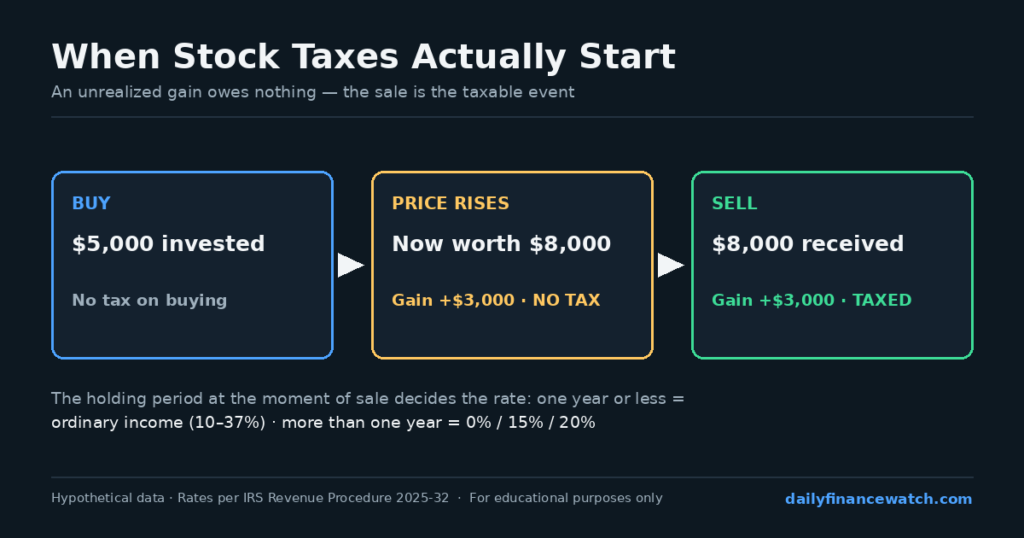
No sale, no bill — the IRS waits for you to act.
An unrealized gain is paper profit. For example, a stock bought at $5,000 that grows to $8,000 shows a $3,000 gain, yet nothing is owed while you hold. In contrast, selling converts that paper profit into a realized capital gain, and realization is the taxable event. The IRS explains this framework in Topic No. 409, Capital Gains and Losses. Buying shares, holding them, and watching prices rise all remain tax-free activities.
Two events pull stock taxes into the current year. The first is selling shares for more than you paid. The second, however, is receiving dividends, which arrive as taxable income even if you never sell a share. Meanwhile, mutual funds can pass through capital gains distributions at year-end, another bill that appears without any sale on your part.
Cost Basis: The Starting Point for Stock Taxes
The IRS measures every gain from cost basis — generally the purchase price plus any commissions. Consequently, the taxable amount is sale proceeds minus basis, not the sale price itself. For instance, suppose you buy Apple shares for $6,000 and sell them later for $9,000. The taxable gain is $3,000, regardless of how large the sale check looks. As a result, accurate basis records shrink the bill, while sloppy records inflate it.
The Holding Clock Behind Stock Taxes
Stock taxes split every realized gain with one question: did you hold for more than one year? Gains on shares held one year or less are short-term and taxed as ordinary income, at 2026 rates running from 10% to 37%. In contrast, gains on shares held longer than one year qualify for the long-term schedule of 0%, 15%, or 20%. Therefore, the clock, not the profit, decides which schedule applies.
The clock starts the day after you buy. Consequently, shares bought on March 1 turn long-term on March 2 of the following year.
2026 Long-Term Capital Gains Brackets
The IRS set the 2026 thresholds in Revenue Procedure 2025-32, released on October 9, 2025. In particular, the brackets below use taxable income, which includes the gain itself stacked on top of wages.
| Long-term rate | Single filers (taxable income) | Married filing jointly |
|---|---|---|
| 0% | Up to $49,450 | Up to $98,900 |
| 15% | $49,451 – $545,500 | $98,901 – $613,700 |
| 20% | Over $545,500 | Over $613,700 |
Source: IRS Revenue Procedure 2025-32 (Oct. 9, 2025). High earners may also owe the 3.8% Net Investment Income Tax above $200,000 (single) or $250,000 (joint) of modified adjusted gross income.
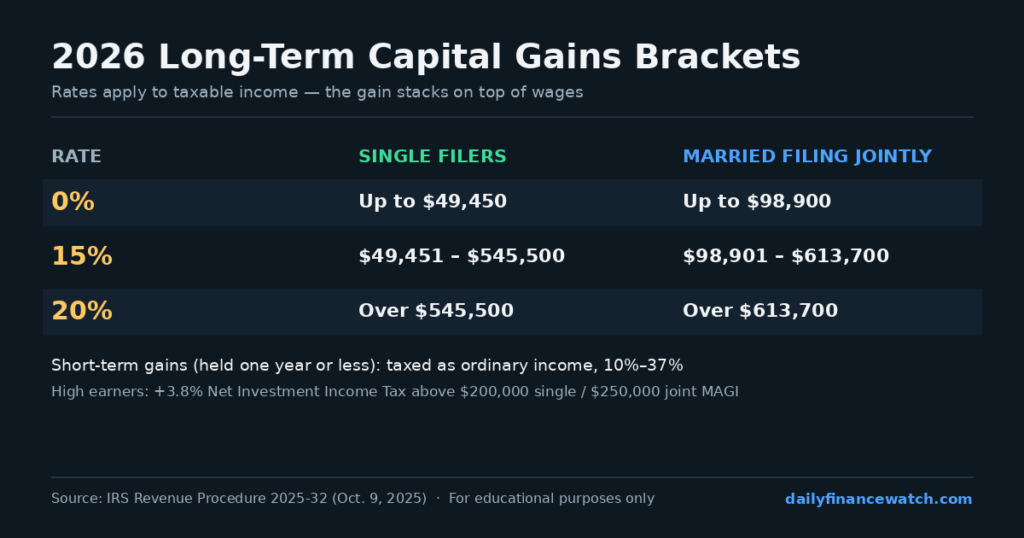
One year and one day moves the same gain into cheaper territory.
Run one comparison to see what the clock is worth. For instance, take a single filer with $80,000 of taxable income, squarely inside the 22% ordinary bracket for 2026. A $10,000 gain sold at 11 months owes roughly $2,200 as short-term income. However, the same gain sold at 13 months lands in the 15% long-term band and owes $1,500. Two extra months of holding cut the bill by $700 — seven percentage points of the gain, using Revenue Procedure 2025-32 rates.
Dividends and Losses: The Other Half of the Bill
Dividends carry their own split. Since the Jobs and Growth Tax Relief Reconciliation Act of 2003, qualified dividends have shared the long-term capital gains schedule of 0%, 15%, or 20%. In contrast, ordinary dividends face regular income rates. Meanwhile, losses run the opposite direction: they first offset realized gains, then up to $3,000 of ordinary income per year, with the remainder carried forward.
Qualified vs Ordinary Dividends
Qualification mostly comes down to holding time around the dividend date and the payer being a U.S. or treaty-country corporation. In reality, most dividends from large U.S. companies such as Microsoft qualify. Meanwhile, your broker sorts the two types on Form 1099-DIV each January, so the classification work happens for you. Moreover, reinvested dividends count as taxable income, a detail that surprises many first-year investors.
A common rule of thumb compresses stock taxes into one command: never sell before the one-year mark. That rule is incomplete on three fronts. It ignores the 0% bracket, where long-term gains can cost nothing for lower-income years. It ignores losses, which follow the opposite timing logic. Moreover, it quietly ranks a tax rate above the investment case itself. Institutional practice treats taxes as a modifier on the investment decision, never the driver of it.
Why Account Type Changes the Math
Everything above applies to a standard taxable brokerage account. Inside tax-advantaged retirement accounts like a 401(k) or Roth IRA, the entire capital gains chapter simply never happens. Because the account itself defers or eliminates the bill, trades inside those wrappers trigger no annual tax. As a result, frequent rebalancing costs nothing there, while the same activity in a taxable account generates a string of short-term gains.
Common Mistakes That Inflate the Bill
The classic error is selling a winner a few days short of the one-year line, converting a 15% gain into ordinary income. Behavioral finance calls the underlying pull the disposition effect: the tendency to sell winners quickly and cling to losers. However, that instinct pairs badly with the holding clock, because rushed winners draw the worst rate. Furthermore, forgetting that reinvested dividends were already taxed leads investors to overpay when they finally sell, by understating cost basis.
The rates table was never the real lesson of stock taxes. The real lesson is that the trigger and the clock belong to you. You owe nothing until you sell, and one year of patience moves the same gain onto a cheaper schedule. Instead of memorizing brackets, a beginner who understands realization and the holding period already controls the only inputs that respond to control.
Related articles:
Does holding a stock without selling trigger taxes?
No. Price gains stay untaxed until you sell, because the tax applies to realized gains only. However, ownership can still produce taxable income along the way. Dividends count in the year received, and funds can distribute capital gains even when you sell nothing. Therefore, the sale decision, not the price chart, starts the clock on the bill.
What is the difference between short-term and long-term capital gains?
Short-term gains come from shares held one year or less and count as ordinary income, at 2026 rates between 10% and 37%. Long-term gains come from shares held more than one year and use the lower 0%, 15%, or 20% schedule. For 2026, a single filer pays 0% with taxable income up to $49,450.
Can stock losses reduce your taxes?
Yes. Realized losses first offset realized gains dollar for dollar. If losses exceed gains, up to $3,000 per year can offset ordinary income, and anything beyond that carries forward to future years. However, repurchasing the same stock within 30 days can disallow the loss under the wash sale rule, so timing matters on the loss side too.
This content is for educational purposes only and is not personalized financial advice. Investing involves risk, including possible loss of principal.
© 2026 Daily Finance Watch. Excerpts under 50 words with attribution and a link back are permitted. Full-article reproduction requires written permission.