Last updated: July 2, 2026
In 2026, a worker under 50 can shelter $32,000 across the two core retirement accounts. The IRS caps 401(k) deferrals at $24,500 and IRA deposits at $7,500, per Notice 2025-67. Most guides frame the pair as rivals and ask which one deserves your dollars. In reality, they are teammates with different jobs, and funding order matters more than preference. One of them may even pay you to participate.
The comparison starts with who provides each account and ends with when the tax bill arrives. Between those two points sits the employer match, the one number that settles most funding debates. Therefore, this comparison covers the mechanics first, then the match math, then the sequence disciplined savers tend to follow.
How Roth IRA and 401(k) Retirement Accounts Differ
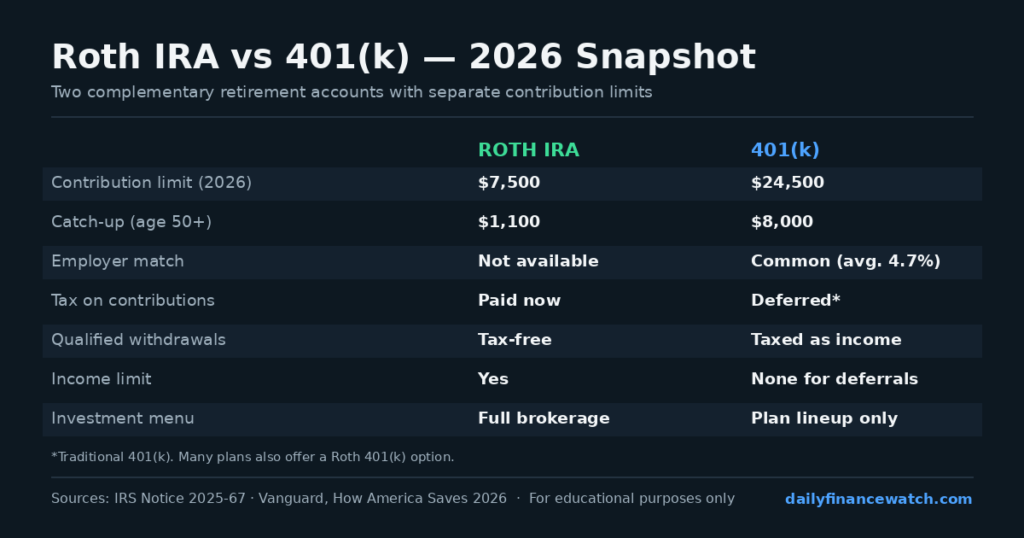
Two different wrappers, two different rule books — tax timing drives everything else.
A 401(k) is a workplace plan. Your employer selects the provider, sets the investment lineup, and moves money straight from each paycheck. Because payroll handles everything, saving happens automatically once you enroll. Moreover, many employers add matching contributions, which no other account type offers. The trade-off is control: you invest only within the plan’s menu, and plan fees vary widely from one employer to the next.
An IRA works the opposite way. You open it yourself at any brokerage, a process similar to opening a standard brokerage account. In exchange for a much lower contribution cap, you get the full investment menu — individual stocks, index funds, ETFs, and bonds. Meanwhile, the Roth version takes after-tax money today and promises tax-free qualified withdrawals later. However, Roth eligibility phases out at higher incomes, while 401(k) deferrals face no income ceiling.
| Feature | Roth IRA | 401(k) |
|---|---|---|
| 2026 contribution limit | $7,500 | $24,500 |
| Catch-up (age 50+) | $1,100 | $8,000 |
| Provided by | You, at a brokerage | Your employer |
| Employer match | Not available | Common (avg. 4.7% of pay) |
| Tax on contributions | Paid now (after-tax) | Deferred (pre-tax)* |
| Tax on qualified withdrawals | None | Ordinary income |
| Income limit to contribute | Yes | None for deferrals |
| Investment menu | Full brokerage menu | Plan lineup only |
*Traditional 401(k); many plans also offer a Roth 401(k) option. Sources: IRS Notice 2025-67 (Nov. 13, 2025); Vanguard, How America Saves 2026.
What the 2026 Contribution Limits Mean
The caps on these retirement accounts run on separate tracks. Consequently, you can fill both in the same year: $24,500 plus $7,500 equals $32,000 of sheltered savings for a worker under 50. In addition, savers aged 50 and older can add catch-up contributions of $8,000 and $1,100 respectively. Moreover, employer contributions sit outside your personal 401(k) cap, under a combined employee-plus-employer ceiling of $72,000 for 2026, according to the IRS.
Why “Roth IRA vs 401(k)” Is the Wrong Question
The versus framing assumes you must pick a side. For most workers, that assumption fails immediately, because both accounts are available at once and their caps never touch. Instead, the real question is which dollars go where first. Framed that way, the decision stops being a tax debate and becomes arithmetic. The match is the rare place in investing where the phrase “free money” survives contact with the fine print.
The Employer Match Changes the Math
Real data shows how large that arithmetic is. According to Vanguard’s How America Saves 2026 report, released in June 2026 and covering nearly 5 million participants, employer matching contributions reached a record average of 4.7% of pay. Plan participation also hit a record 86% of eligible employees.
Run those figures through a concrete case. For instance, on a $60,000 salary, a common formula matches 50% of the first 6% you defer. Therefore, contributing $3,600 triggers a $1,800 employer deposit — an immediate 50% gain before markets move at all.
By comparison, Vanguard’s 4.7% average employer contribution on that same salary equals $2,820 per year. That single employer stream covers 37.6% of the entire $7,500 IRA cap ($2,820 ÷ $7,500), based on IRS Notice 2025-67 figures. No tax preference on either account produces a first-year number close to that.
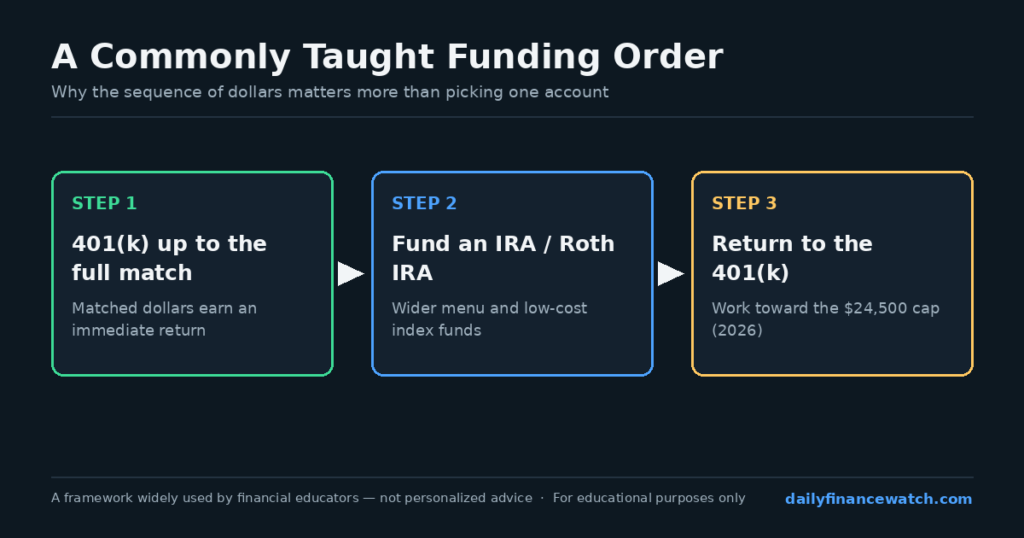
The sequence exists because matched dollars outrun any tax preference.
Tax Treatment: Pay Now or Pay Later
Tax timing is where the two retirement accounts genuinely diverge. A traditional 401(k) takes pre-tax dollars, lowers your taxable income today, and taxes every withdrawal as ordinary income later. A Roth IRA flips the schedule: you contribute money that has already been taxed, and qualified withdrawals in retirement arrive tax-free. In addition, many workplace plans now offer a Roth 401(k) option, which applies Roth timing inside the workplace wrapper.
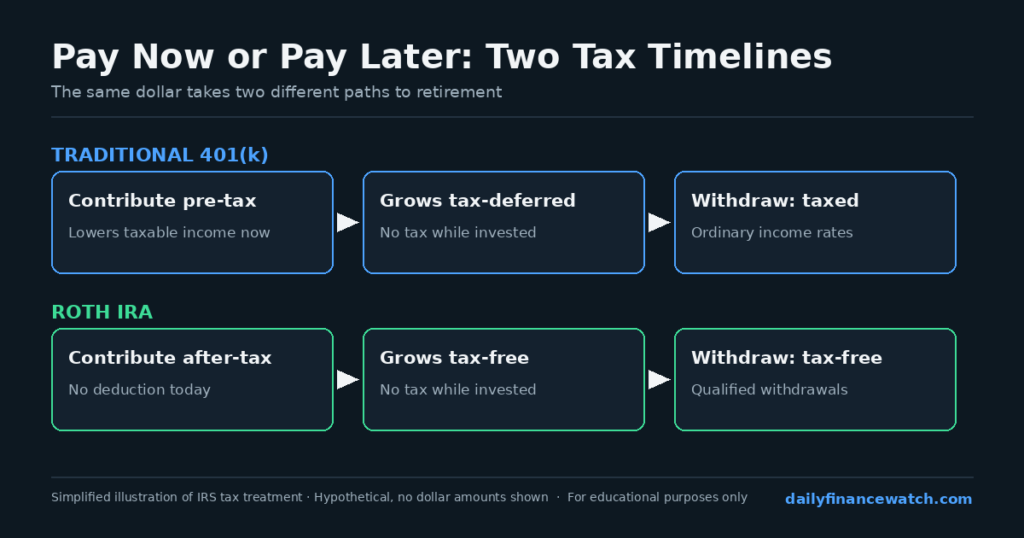
Same dollar, same growth — only the tax collector’s arrival time changes.
Roth IRA Income Limits for 2026
In particular, eligibility rules differ between the two. For 2026, the IRS phases out Roth IRA contributions between $153,000 and $168,000 of income for single filers, and between $242,000 and $252,000 for married couples filing jointly. In contrast, anyone with access to a 401(k) can defer the full $24,500 regardless of income. As a result, high earners often lean on the workplace plan for exactly this reason.
A common rule of thumb says pick the Roth while young, because your tax rate will rise later. That advice sounds tidy, but it quietly demands a 30-year forecast of your income, tax law, and retirement spending — a forecast nobody can make reliably. Institutional planners frame the choice differently: they build tax diversification, holding both pre-tax and after-tax buckets so a retiree can choose which one to draw from each year. Instead of betting on one tax future, the professional model hedges across several.
How Investors Sequence Retirement Accounts
Financial educators commonly describe a three-step funding order for these retirement accounts. First, defer enough in the 401(k) to capture the full employer match, because matched dollars carry a guaranteed instant return. Second, direct additional savings to an IRA or Roth IRA, where the wider menu and low-cost index funds live. Third, return to the 401(k) and work toward the $24,500 cap as income allows. Even modest amounts follow the same sequence, as covered in how much money you need to start investing.
Common Mistakes With Retirement Accounts
The most expensive mistake is leaving the match unclaimed, since skipped matched dollars never come back. Furthermore, cashing out a 401(k) when changing jobs ranks close behind, because taxes and penalties consume the balance. Behavioral finance names the underlying pattern present bias: the tendency to overweight today’s paycheck against a benefit decades away. Meanwhile, some savers guess future tax rates with false confidence and go all-in on one account type. Instead, diversifying the tax treatment costs nothing and removes the need to be right.
Seen as a sequence, the two retirement accounts stop competing and start compounding together. The 401(k) supplies automation, a high ceiling, and the match; the Roth IRA supplies menu control and a tax-free bucket. Consequently, the useful question was never which account wins. It is which dollar goes where first — and the match answers that one before taxes ever get a vote.
Related articles:
Can you contribute to both a Roth IRA and a 401(k) in the same year?
Yes. The two limits run independently, so a worker under 50 can defer $24,500 into a 401(k) and deposit $7,500 into an IRA in 2026. However, Roth IRA eligibility phases out between $153,000 and $168,000 of income for single filers. High earners above the range can still use the 401(k) fully.
Does the employer match count toward your 401(k) contribution limit?
No. The $24,500 limit for 2026 applies only to your own salary deferrals. Employer matching contributions sit in a separate bucket, capped by a combined employee-plus-employer ceiling of $72,000 under IRS rules. Consequently, a generous match never crowds out your ability to contribute the personal maximum.
Should you fund a Roth IRA or a 401(k) first?
The commonly taught sequence starts with the 401(k), but only up to the full employer match, because matched dollars carry an immediate return no tax preference can rival. After that point, the split depends on income, plan fees, and investment menu rather than a universal rule. This is educational framing, not personalized advice for any specific situation.
This content is for educational purposes only and is not personalized financial advice. Investing involves risk, including possible loss of principal.
© 2026 Daily Finance Watch. Excerpts under 50 words with attribution and a link back are permitted. Full-article reproduction requires written permission.