Last updated: July 2, 2026
In October 2025, the Federal Reserve surveyed nearly 13,000 American adults about their finances. The result: 37% could not cover a $400 surprise expense with cash, per the Fed’s 2025 SHED report. Emergency savings exist to absorb exactly those surprises, but for investors the stakes run deeper than comfort. Without a cash buffer, the next car repair gets paid by selling stocks, often at the worst possible moment. The fund is not a rival to your portfolio — it is the wall that protects it.
Most guides file this topic under responsibility. In reality, it belongs under return protection. Therefore, this article covers why the sequence matters and what the 2022 bear market proved about forced selling. It also shows how to build the buffer without postponing investing for years.
Why Emergency Savings Come Before Investing
The buffer’s job is keeping temporary losses from becoming permanent ones.
Emergencies and market declines share one inconvenient habit: they ignore your schedule. For instance, a job loss, a medical bill, or a broken furnace arrives whenever it likes. Meanwhile, stocks routinely spend months or years below their previous highs. Sooner or later, an unplanned expense will land during a drawdown, and an investor without emergency savings must sell into that decline. Over time, the collision stops being bad luck — across a long investing life, it is close to guaranteed.
What the Fed’s Data Shows About Cash Buffers
The Fed’s 2025 survey, released on May 13, 2026, found that only 63% of adults could handle a $400 emergency using cash or its equivalent. Moreover, earlier editions of the same survey show roughly 55% of adults hold three months of expenses in a rainy day fund. This means a large share of households would meet a surprise bill by borrowing or by selling something. For stockholders, “selling something” usually means shares.
The Real Job: Protecting Returns, Not Just Safety
Stock declines are usually temporary; selling during one makes the loss permanent. In reality, that single sentence is the entire investment case for emergency savings. In addition, a forced sale of recently bought shares lands in the short-term bucket, taxed at ordinary income rates, as covered in how stock sales are taxed. The buffer’s job is to make sure the market’s timeline, not your plumbing’s, decides when you sell.
The Forced-Sale Math of 2022
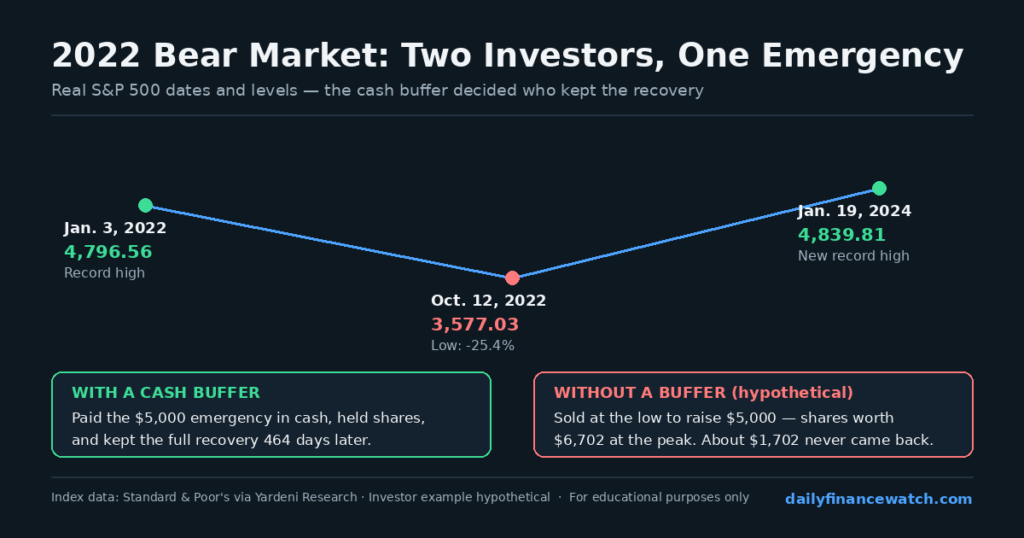
The 2022 bear market shows the cost with real numbers. According to Standard & Poor’s data compiled by Yardeni Research, the S&P 500 closed at a record 4,796.56 on January 3, 2022. However, it then fell 25.4% to 3,577.03 by October 12, 2022.
| Date | S&P 500 close | What happened |
|---|---|---|
| Jan. 3, 2022 | 4,796.56 | Record high before the decline |
| Oct. 12, 2022 | 3,577.03 | Bear-market low: −25.4% |
| Jan. 19, 2024 | 4,839.81 | New record high — recovery in 464 days |
Source: Standard & Poor’s; Yardeni Research, Bull & Bear Markets tables (Jan. 2024).
Now run the forced-sale case. For example, suppose an investor with no cash buffer needed $5,000 at the October 2022 low. Raising it meant selling index shares that had been worth $6,702 at the January peak ($5,000 ÷ 0.746). However, the index regained its old high within 464 days. As a result, the patient investor recovered everything. The forced seller permanently surrendered about $1,702 — 34% of the cash raised — plus any tax on the sale.
How Much Emergency Savings Is Enough
An emergency fund is the one account in personal finance designed to be boring on purpose. The size question has a widely cited answer: three to six months of essential expenses, a range echoed in the CFPB’s guide to building an emergency fund. However, the right spot inside that range depends on income stability. For example, a household with two steady paychecks can lean toward three months, while a freelancer with variable income leans toward six or more.
Where to Keep the Cash
Location matters as much as size. The buffer belongs somewhere liquid, stable, and separate from spending money — typically a high-yield savings account or a money market account with federal deposit insurance. In contrast, it does not belong in stocks, because 2022-style declines can cut the buffer exactly when it is needed. Consequently, emergency savings will earn less than the market most years. Nevertheless, that underperformance is not a flaw; it is the fee for reliability.
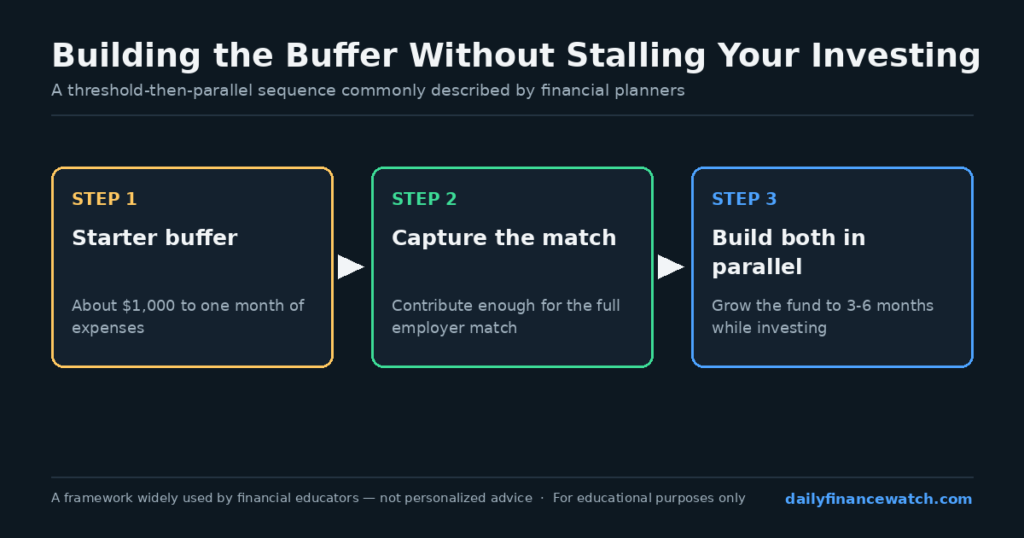
A common rule tells beginners to finish the full three-to-six-month fund before investing a single dollar. At first glance, that sequencing sounds disciplined, but it is incomplete. It can park someone in cash for years while an employer 401(k) match — an immediate return on matched dollars — goes unclaimed. Furthermore, a starter buffer of about one month already prevents most forced sales. Financial planners therefore commonly describe a threshold-then-parallel model: build a starter buffer first, capture the match, then grow both sides at once.
Building the Buffer Without Delaying Investing Forever
The threshold-then-parallel model runs in three steps. First, save a starter buffer — commonly cited as $1,000 to one month of expenses — to absorb routine shocks. Second, contribute enough at work to capture any employer match. Third, split new savings between the fund and investments until the buffer reaches its full size. At that point, the pipeline into a brokerage account or retirement plan takes over completely.
A starter buffer unlocks investing years earlier than the full fund.
Automation carries the model. For instance, two standing transfers on payday — one to savings, one to investments — remove the monthly decision entirely. Over time, the buffer quietly reaches full size while the portfolio compounds beside it.
Common Mistakes With Emergency Savings
The classic error is investing the fund itself in stocks, which quietly deletes the protection it was built to provide. Behavioral finance offers a useful tool here called mental accounting: the habit of assigning money to separate labeled buckets. Used deliberately, it keeps the emergency bucket untouchable for concert tickets yet instantly available for a transmission failure. Meanwhile, the opposite mistake — never starting because six months feels enormous — costs more than an imperfect buffer ever will.
The lesson runs against the usual framing. Emergency savings are not the cautious alternative to investing; they are the mechanism that lets investing work. The 2022 numbers say it plainly: the market took back every point of a 25% decline, but only for the investors who were never forced to sell. Instead of choosing between the buffer and the portfolio, build the wall first — then let compounding do its job behind it.
Related articles:
How much emergency savings should you have before investing?
The widely cited target is three to six months of essential expenses, tuned to income stability. However, many planners describe a threshold-then-parallel approach: a starter buffer of roughly one month, then investing and saving simultaneously, so an employer match is not forfeited for years. This is educational framing, not personalized advice for any specific situation.
Should your emergency fund be invested in stocks?
No. The fund exists to be spendable during bad markets, and stocks are least dependable exactly then. In 2022, the S&P 500 fell 25.4% before recovering, per Standard & Poor’s data. Consequently, a buffer invested in stocks could shrink by a quarter right when a job loss hits. Liquid, insured accounts trade lower returns for reliability on demand.
Can you build emergency savings and invest at the same time?
Yes, and after a starter buffer exists, doing both is common practice. For example, automation makes the split workable: a fixed transfer to savings and a fixed contribution to investments each payday. Because the buffer removes the risk of forced selling, even a partial fund already protects the portfolio while both balances grow in parallel.
This content is for educational purposes only and is not personalized financial advice. Investing involves risk, including possible loss of principal.
© 2026 Daily Finance Watch. Excerpts under 50 words with attribution and a link back are permitted. Full-article reproduction requires written permission.