Last updated: July 2, 2026
Type a market buy for a stock quoted at $20.00 and the fill often returns at $20.02. Nothing went wrong — market orders transact against live prices, and the quote you watched was already history. Every open market carries two prices at once: the bid and the ask. Most guides present the stock price as a single number. In reality, the gap between the two live prices is a cost you pay without ever seeing a fee.
Understanding that gap changes how every order looks. Therefore, this guide covers the two prices behind each quote, what the spread quietly costs, and how order types trade speed against price.
The Two Prices Behind Every Stock Quote
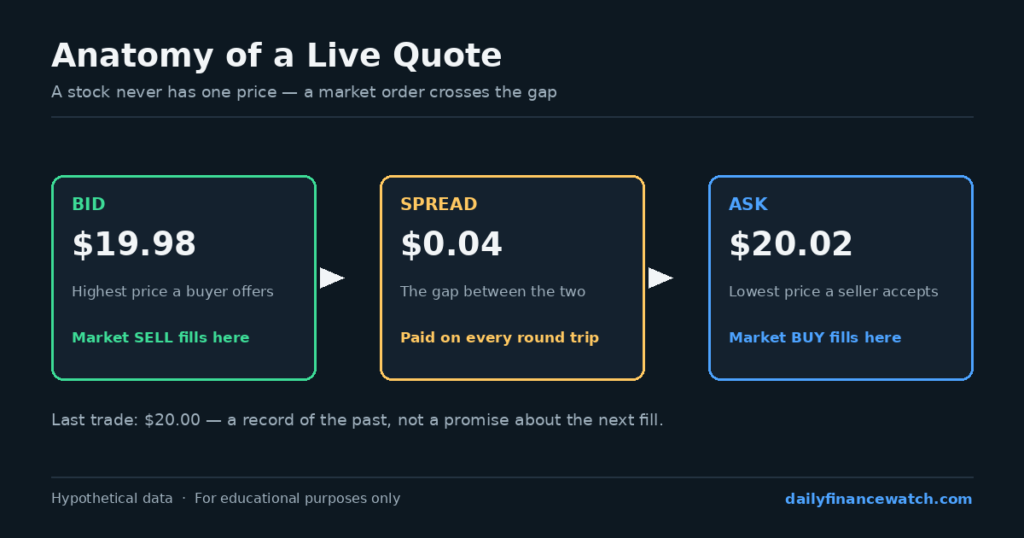
The last trade is history — your order meets the live spread.
The bid is the highest price any buyer currently offers. In contrast, the ask is the lowest price any seller currently accepts. Meanwhile, the number flashing on your screen is usually the last trade — a record of the past, not a promise about the next fill. The distance between them is the bid-ask spread. It exists because buyers and sellers rarely agree to the penny at the same instant. For instance, a bid of $19.98 against an ask of $20.02 makes a four-cent spread.
How Market Orders Actually Fill
A market order carries one instruction: execute now at the best available price. Consequently, market orders to buy fill at the ask, and market orders to sell fill at the bid. For example, suppose Apple shows a bid of $200.00 and an ask of $200.04. Therefore, a market buy for 10 shares fills at $200.04, two cents above the midpoint. The order guarantees speed; it does not guarantee the exact price. In addition, prices can shift between your click and the exchange, a gap traders call slippage.
The Spread: The Invisible Cost of Market Orders
The spread is the quietest fee in investing — it never appears on a statement. For example, buy at the ask and sell a second later at the bid — the position instantly loses the spread. Consequently, that round trip is the baseline transaction cost even at commission-free brokers. However, the size of the cost varies enormously. Heavily traded mega-caps often quote spreads of a penny or two, while thin stocks can show gaps of several percent.
What Decimalization Did to the Spread
Over time, regulators worked to shrink exactly this cost. Until 2001, U.S. markets quoted stocks in fractions, with a minimum increment of 1/16 of a dollar — 6.25 cents. Consequently, no quote could sit closer than 6.25 cents to the other side. Under an SEC decimalization order, the NYSE completed the switch to penny pricing on January 29, 2001, and Nasdaq followed on April 9, 2001.
| Era | Minimum quote increment | Minimum spread on a $20 stock |
|---|---|---|
| Fractions (before 2001) | 1/16 = $0.0625 | 0.31% |
| Decimals (2001 onward) | $0.01 | 0.05% |
Source: SEC decimals implementation order (2000); NYSE conversion completed Jan. 29, 2001; Nasdaq Apr. 9, 2001.
Run the arithmetic on that change. In particular, the minimum increment fell from 6.25 cents to 1 cent — an 84% reduction. On a $20 stock, the smallest possible round-trip cost dropped from 0.31% to 0.05% of the position. This means one regulatory change cut the floor on spread costs by more than six times, using the SEC’s own increments.
Market Orders vs Limit Orders: The Trade-Off
A limit order flips the guarantee. It names the worst price you will accept: a maximum for buys, a minimum for sells. Beyond that line, it simply refuses to fill. As a result, the choice is a clean trade-off. Market orders guarantee execution but not price, while limit orders guarantee price but not execution. Nevertheless, neither is superior; they solve different problems.
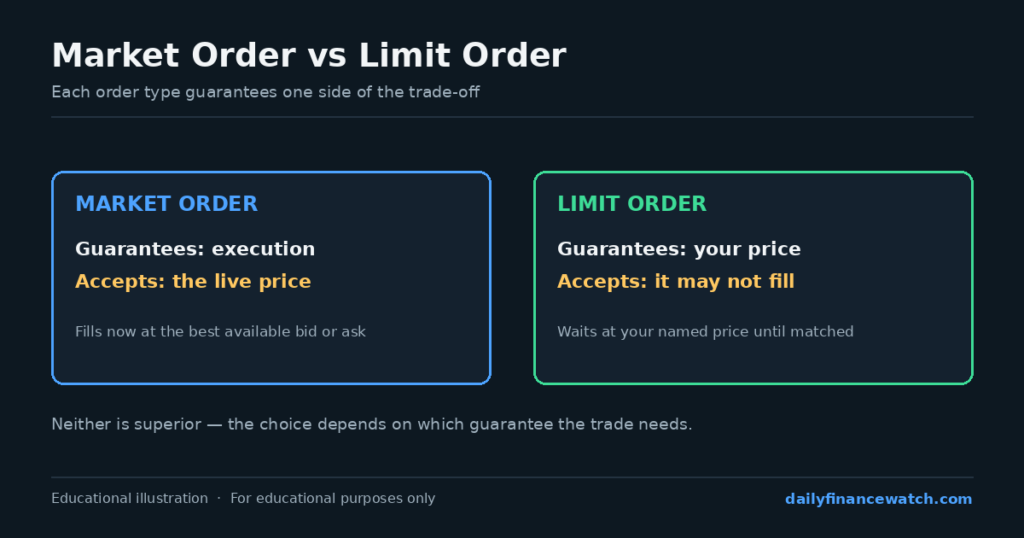
Every order type guarantees one thing by giving up the other.
When Spreads Widen: Volatility and Thin Stocks
Spreads are not fixed. They widen at the market open and close, during volatile stretches, and in stocks with low trading volume, because fewer participants stand ready on each side. Therefore, disciplined investors often check the spread before committing capital, since a wide gap can signal thin liquidity. This may suggest caution, but it does not predict where the price goes next.
Institutions also watch the quoted size at each price, because a large order can walk through several levels of the book. A tight quote for 100 shares says little about the cost of trading 100,000.
A common beginner rule says to avoid market orders entirely. At first glance, that sounds careful, but it is incomplete. For a long-term buyer of a liquid mega-cap, a one-cent spread is trivial, while a limit order sitting below the market can go unfilled for days. By comparison, institutional desks weigh urgency against price improvement for each trade, instead of applying one rule to every situation. The order type is a tool, not a rule.
Reading a Quote Before You Trade
The practical habit is simple: check the bid, the ask, and their sizes before sending any order. These are the same fields covered in how to read a stock quote. As a result, a tight spread with size on both sides means an order will fill close to what you see.
Moreover, spreads often sit at their widest in the first and last minutes of the session, so patient orders wait out the open. In contrast, a wide or jumpy spread is the market’s way of saying the next fill may surprise you.
Common Execution Mistakes to Avoid
The classic error is sending orders outside regular hours, when thin books can fill trades far from the last close. Chasing a fast-moving stock is a close second. Behavioral finance names the driver FOMO: fear of missing out, the urgency that overrides checking the quote first. Moreover, many beginners judge trading costs by commissions alone. Commission-free never means costless; the spread is still there, paid silently on every round trip.
The lesson reverses the usual picture. A stock never had one price. It always has two, and a market order simply crosses between them. Once you read the bid and ask as the real market, the mystery of fills at “different prices” disappears. The spread was the price all along.
Related articles:
Why did my market order fill at a different price than the quote?
Because the quote you watched was most likely the last trade — a past transaction. A market order fills against the live bid or ask, so a buy executes at the ask and a sell at the bid. Furthermore, prices move between the moment you click and the moment the order reaches the exchange, especially in fast markets.
What is the difference between the bid and the ask?
The bid is the highest price a buyer currently offers; the ask is the lowest price a seller currently accepts. The gap between them is the bid-ask spread. Meanwhile, tight spreads signal deep, liquid markets, while wide spreads signal thin trading. Every completed trade happens when someone agrees to cross that gap.
Should beginners use market orders or limit orders?
It depends on which guarantee matters for the trade. Market orders guarantee execution but accept the live price, which works well in liquid stocks with tight spreads. In contrast, limit orders guarantee price but may never fill. Many educators suggest checking the spread first and matching the order type to it. This is educational framing, not personalized advice.
This content is for educational purposes only and is not personalized financial advice. Investing involves risk, including possible loss of principal.
© 2026 Daily Finance Watch. Excerpts under 50 words with attribution and a link back are permitted. Full-article reproduction requires written permission.