Last updated: July 2, 2026
Each earnings season, most reports drop between 4:00 p.m. and 8:00 p.m. Eastern Time — after the closing bell but before the trading day ends. Extended-hours trading lets investors react to that news inside the same session. However, the rules shift in ways most beginners never expect. Moreover, the extended-hours quote on a screen is not always the price the next morning opens with.
The session exists for a reason, however. Understanding its structural limits matters as much as knowing the hours. Therefore, this guide covers when the session runs and what makes it different. It also examines what spread data reveals about its real cost.
What After-Hours Trading Is and When It Runs
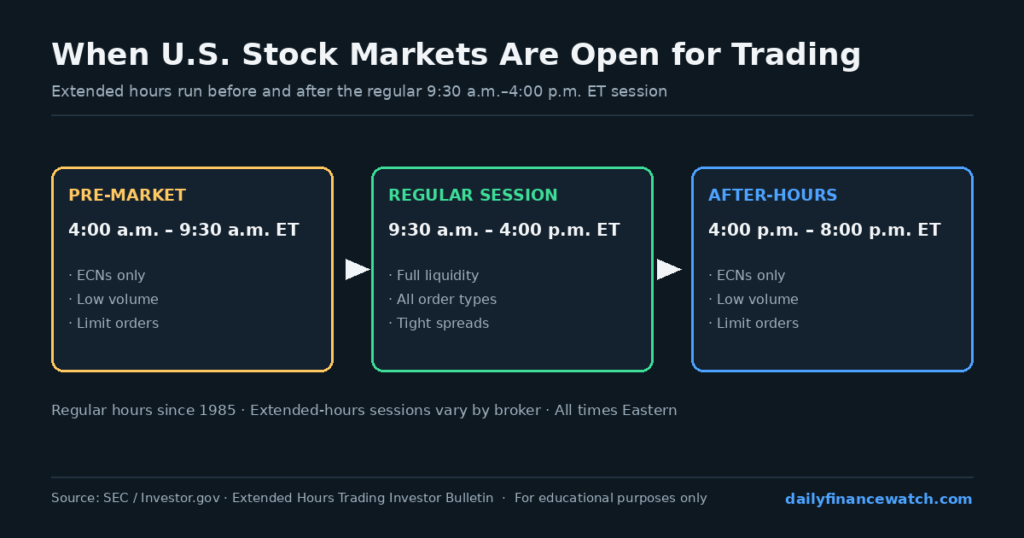
Extended hours give access to news — but not the regular session’s depth.
Regular trading hours for U.S. listed stocks run from 9:30 a.m. to 4:00 p.m. Eastern Time, as the SEC defines them. In contrast, after-hours trading extends that window to 8:00 p.m. ET, while pre-market trading opens as early as 4:00 a.m. ET, according to Investor.gov’s extended-hours bulletin. Together, both sessions fall under the extended-hours umbrella. Furthermore, most retail brokers give access to both through the same regular-session account.
How Electronic Communication Networks Power the Session
Extended-hours trading runs on Electronic Communication Networks, or ECNs. Specifically, these automated systems match buy and sell orders directly without a traditional market maker. Before ECNs, this activity belonged almost entirely to institutional traders. Moreover, market makers who provide liquidity during regular hours generally do not participate after 4:00 p.m., according to FINRA Rule 2265. That withdrawal is one key reason the session behaves differently. Consequently, liquidity comes only from other ECN participants on the other side of each order.
Why After-Hours Prices Differ From the Regular Session
Volume drops sharply once the closing bell rings, however. According to NYSE’s 2025 market data analysis, overnight trading accounts for less than 0.11% of total daily share volume.
That figure covers the window outside the standard SIP reporting window. Even the fuller post-close window from 4:00 p.m. to 8:00 p.m. remains a small fraction of the day’s total. By comparison, the regular session processes tens of millions of transactions. Therefore, fewer participants mean each order has more impact. In turn, prices can move on activity that would barely register at noon.
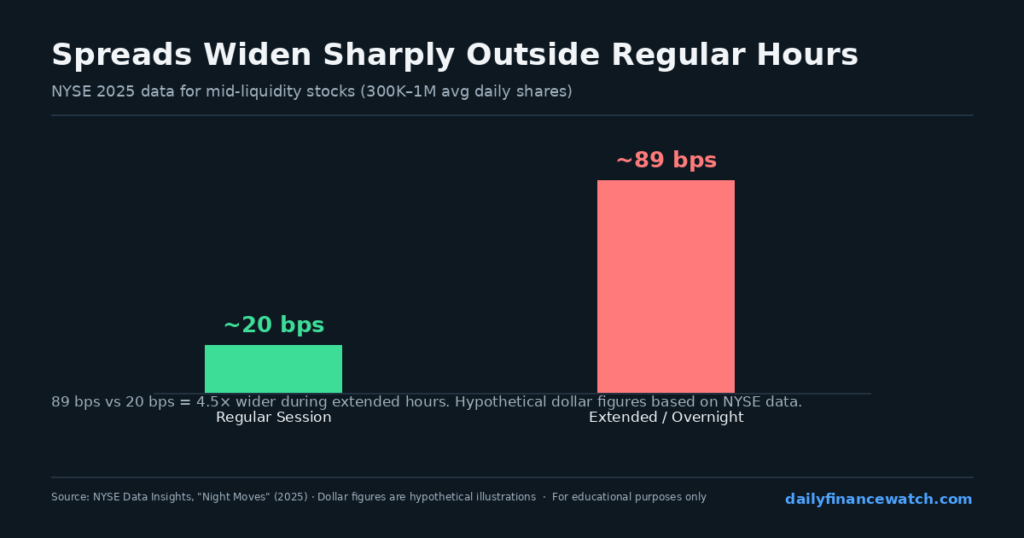
Thin participation after 4 p.m. pushes spreads wider than most beginners expect.
The Spread Evidence
The spread data, however, makes the difference concrete. For stocks with 300,000 to 1 million average daily shares, NYSE data from 2025 shows volume-weighted spreads of 89 basis points during overnight sessions. In contrast, the regular session shows 20 basis points — a 4.5-times widening.
On a $50 stock, 89 basis points equals a round-trip cost of roughly $0.45 per share before any commission. By comparison, the same stock during regular hours carries a round-trip cost of about $0.10. This analysis uses real NYSE data; the dollar figures are hypothetical illustrations.
| Session | VWAP spread (mid-liquidity stocks) | Round-trip cost on $50 stock (illus.) |
|---|---|---|
| Regular (9:30 a.m.–4:00 p.m.) | ~20 bps | ~$0.10/share |
| Extended hours / overnight | ~89 bps | ~$0.45/share |
Source: NYSE Data Insights, “Night Moves: What Trades and When in the Overnight Market” (2025). Dollar figures are hypothetical illustrations using reported NYSE basis-point data.
Risks FINRA Requires Brokers to Disclose
FINRA Rule 2265 requires every brokerage firm to disclose six specific risks before allowing customers to trade in extended hours. In particular, the list names lower liquidity, higher volatility, wider spreads, changing prices, unlinked markets, and news announcements. However, the changing-prices risk catches beginners off guard most often. An after-hours quote at $52.00 after a strong earnings report may open the next morning at $49.50, as other markets absorb the news overnight and additional sellers appear at the open.
Why Limit Orders Are the Only Order Type Available
Extended-hours sessions only accept limit orders, not market orders. The reason connects directly to the bid-ask spread mechanics covered in Chapter 11’s pillar article. Without deep order books, a market order in an extended-hours session can walk through multiple price levels and fill far from the quoted price. For example, a stock showing $52.00 might have only 100 shares available there; a 500-share market order would fill across five different prices.
As a result, FINRA and the SEC require limit orders to prevent this outcome.
A common rule beginners encounter says: check the after-hours price to predict tomorrow’s open. That framing is incomplete on two counts. First, extended-session prices reflect only the participants present in that ECN — not the full market.
Second, pre-market trading from 4:00 a.m. to 9:30 a.m. re-prices the stock as more participants arrive. Institutional traders, index funds, and market makers all enter positions before the open. Consequently, the pre-market price at 9:29 a.m. is usually a better signal of the opening print than the extended-session close at 7:59 p.m. However, neither is a guarantee.
When After-Hours Activity Actually Matters
Volume surges reliably around earnings releases. According to Bloomberg Tradebook analysis, during major earnings releases, post-close volume can reach 64% of a stock’s average daily volume in a single session. In particular, for a long-term investor watching fractional shares, those sessions are often more relevant as signals than as trading opportunities.
Common Mistakes in Extended Hours
The most common error is treating the post-close print as tomorrow’s opening price.
In reality, prices reprice through the night and again in pre-market. Furthermore, placing a market order outside regular hours risks a fill at prices far from intent. Meanwhile, behavioral finance names the driver here: recency bias. Specifically, this is the tendency to anchor on the most recent price, even when it comes from a session with 89-basis-point spreads. The after-hours price is real data — just data from an unusually thin market.
In reality, the extended session uses the same stocks, the same ECNs, and the same accounts — but with a fraction of the participants. For most long-term investors, the practical value is informational: watch what moved after 4 p.m., then let the regular session’s liquidity determine the actual trade price. The extended session tells you what happened; the morning open tells you what it was worth.
Related articles:
Can you buy and sell any stock during after-hours trading?
Not always. While most major U.S.-listed stocks trade on ECNs during extended hours, liquidity varies widely. Some smaller or less-traded stocks may have no buyers or sellers present, meaning orders sit unfilled. Additionally, brokers set their own extended-hours policies — some restrict the session to certain account types or products. Checking your broker’s specific rules before placing an extended-hours order is essential.
Does the after-hours price predict where the stock opens tomorrow?
It offers a directional signal, but not a precise prediction. After-hours prices reflect only the participants on ECNs at that moment. Pre-market trading from 4:00 a.m. onward reprices the stock as more participants arrive, and the regular-session open involves the full order book. Large gaps between the after-hours close and the next morning’s open are common, especially after major news.
Why do after-hours prices sometimes swing wildly on earnings?
Earnings releases carry new information that changes the consensus value of a stock. Because extended-hours sessions have far fewer participants than the regular session, even moderate order flow can move prices significantly. As NYSE data shows, spreads widen substantially in thin markets. Consequently, this amplifies the price impact of each trade. The swings reflect genuine information — but also genuine illiquidity.
This content is for educational purposes only and is not personalized financial advice. Investing involves risk, including possible loss of principal.
© 2026 Daily Finance Watch. Excerpts under 50 words with attribution and a link back are permitted. Full-article reproduction requires written permission.