Last updated: July 2, 2026
Sell a stock on Monday and, by Tuesday, the money appears in your account. That one-day gap has a name: T+1 settlement. It answers a question most investors never think to ask — why can’t cash arrive the same second a trade executes? The answer reveals an entire layer of market infrastructure that runs quietly beneath every transaction. Stock settlement is not a delay; it is a deliberate verification system.
Most guides treat settlement as a minor detail. In reality, the cycle controls when you can reinvest proceeds and when short-sellers face pressure. It also determines how much collateral the entire industry posts each night. Therefore, this article covers what happens between trade and settlement. It also explains why the SEC shortened the cycle and what T+1 means in practice.
What Stock Settlement Actually Is
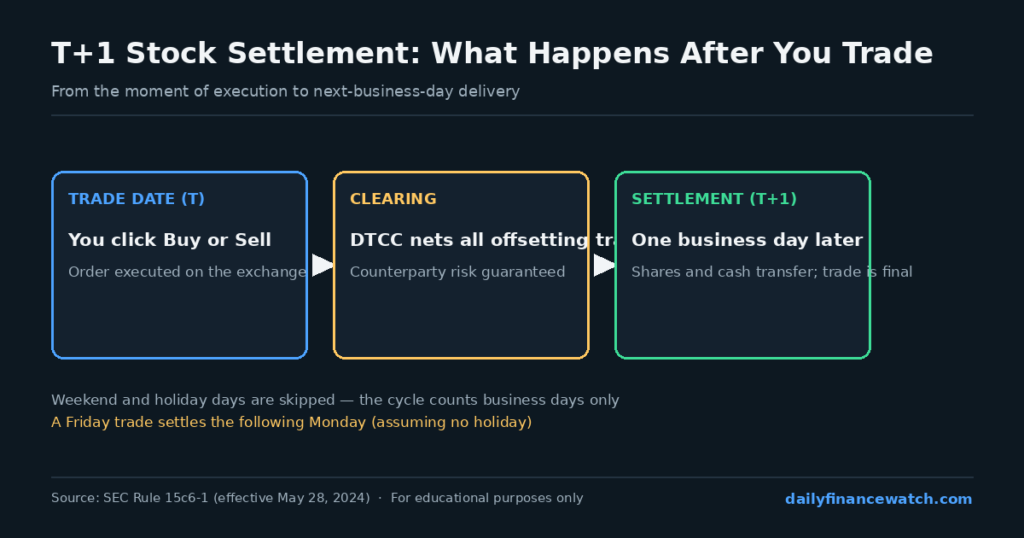
The trade executes in milliseconds — settlement takes until the next business day.
Stock settlement is the process by which a trade becomes final: the buyer receives the shares and the seller receives cash. Before that point, both sides carry counterparty risk. The seller has not yet received payment, and the buyer has not yet received securities. The DTCC (Depository Trust & Clearing Corporation) acts as the central counterparty for nearly all U.S. equity trades, guaranteeing completion even if one side defaults between trade and settlement.
The T Notation Explained
In this notation, T stands for trade date — the calendar day you execute the order. Importantly, the number after the plus sign counts business days, not calendar days. Therefore, a stock sold on Friday under T+1 settles on Monday, skipping the weekend entirely. For example, selling shares of Microsoft on a Wednesday means the proceeds clear by Thursday close. Furthermore, holidays extend the cycle by one additional business day for each in the chain.
The Settlement Timeline: T+2 to T+1
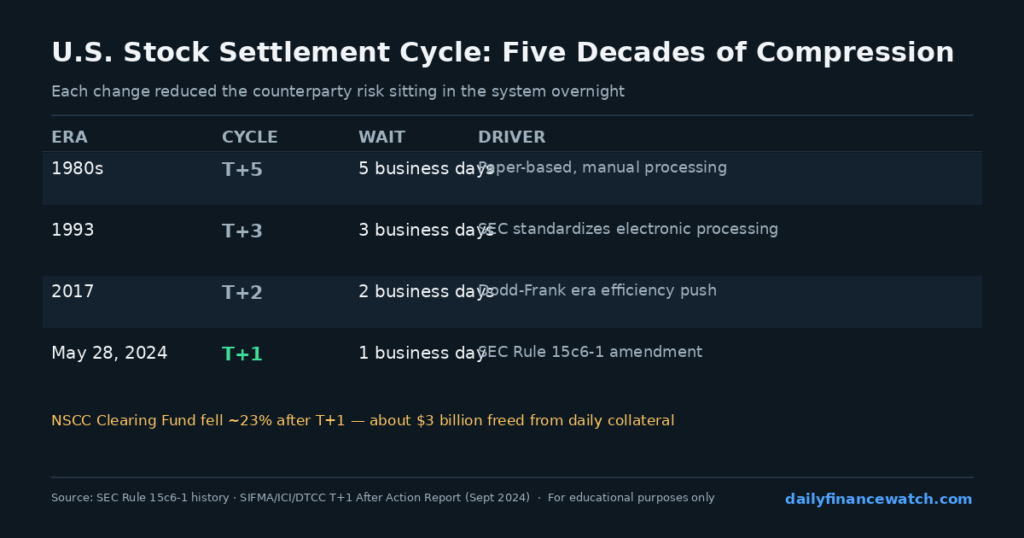
Each step in the timeline reflects a reduction in counterparty risk and clearing cost.
The SEC originally established T+3 as the standard settlement cycle in 1993, shortening the prevailing five-day practice of the 1980s. The agency later moved markets to T+2. On February 15, 2023, the SEC adopted rule amendments under Rule 15c6-1 to shorten the cycle to T+1, effective May 28, 2024.
| Era | Settlement cycle | Minimum days cash held at risk |
|---|---|---|
| Pre-1993 | T+5 | 5 business days |
| 1993–2017 | T+3 | 3 business days |
| 2017–2024 | T+2 | 2 business days |
| May 28, 2024 – present | T+1 | 1 business day |
Source: SEC Rule 15c6-1 amendment history; SEC press release, May 2024.
In particular, the SEC’s goal was to reduce credit, market, and liquidity risks that accumulate while trades remain unsettled. According to the SIFMA/ICI/DTCC T+1 After Action Report (September 2024), the move cut the NSCC Clearing Fund by approximately 23%. Consequently, that freed about $3 billion locked daily as collateral. That is a concrete measure of how much risk the extra day was carrying.
What Changed for Retail Investors
For most retail investors, T+1 shortened the wait for sale proceeds by one business day. However, T+1 created one practical constraint T+2 did not.
Therefore, placing a new buy order with same-day sale proceeds requires the sale to settle first. Moreover, selling a stock on Monday to fund a Tuesday purchase works cleanly under T+1. In contrast, buying on the same day as the sale — before settlement — may trigger a good-faith violation if the account lacks settled cash.
Why Settlement Fails Still Happen
Even under T+1 stock settlement, a small share of trades fail to settle on time. According to the DTCC, the Continuous Net Settlement fail rate on May 29, 2024 — T+1’s first day — was 1.90%, below the May T+2 average of 2.01%. By July 2024, the CNS fail rate stabilized at 2.12%, consistent with historical T+2 rates. For example, these failures occur when one party cannot deliver shares or cash by the settlement deadline.
What a Settlement Fail Means in Practice
A settlement fail does not erase the trade. Instead, the DTCC’s clearing subsidiary steps in as guarantor, completing delivery while pursuing the failing party. For retail investors, this backstop is largely invisible — your broker handles the mechanics. However, repeated institutional fails trigger regulatory buy-in procedures. In these cases, the market purchases securities on behalf of a non-delivering seller, often at a premium.
A common guide simplifies the stock settlement cycle to “the day you get your money.” That framing misses the real mechanism. Settlement is actually a risk-management system. The one-day window gives clearinghouses time to net offsetting trades, verify solvency, and reduce collateral across the system. As a result, that figure shows settlement is structural plumbing, not merely a waiting period.
T+1 in Context: What Comes Next
The U.S. move to T+1 is part of a broader global trend. For instance, India shifted to T+1 in January 2023 ahead of the U.S. Moreover, Canada and Mexico joined the U.S. transition on May 27, 2024. Meanwhile, the EU, UK, and Switzerland plan to move from T+2 to T+1 by October 2027.
The logical extension — T+0 settlement — remains technically possible through blockchain systems. However, the SIFMA/DTCC After Action Report notes that T+0 is not simply the next step, given the complexity of real-time netting and collateral management.
How the Cycle Connects to Trading Costs
Stock settlement timing also connects to order execution and spreads. Market makers set prices partly based on the inventory risk they carry between trade and settlement. A shorter cycle reduces that window, which in theory narrows the premium they need to charge. In practice, T+1’s effect on spreads has been modest — liquid stocks were already tight. Nevertheless, the structural argument connects settlement policy to trading costs on every transaction.
Understanding stock settlement turns a background process into a visible mechanism. The T+1 rule means proceeds arrive faster and less systemic risk accumulates overnight. However, the cycle imposes timing constraints on same-day reinvestment. It also explains why opening a brokerage account with settled cash avoids confusion from trading on unsettled funds. As it turns out, settlement resolves counterparty risk — one business day at a time.
Related articles:
What happens if I sell a stock and try to use the proceeds immediately?
Under T+1, sale proceeds settle one business day after the trade. Attempting to reinvest those funds before settlement completes may trigger a good-faith violation at certain brokers if the account does not hold sufficient settled cash. Most brokers display your settled and unsettled cash separately. Checking that balance before placing a same-day reinvestment avoids the issue.
Why does settlement take a full business day instead of being instant?
Settlement involves more than transferring money. The clearinghouse nets millions of offsetting trades, verifies counterparty solvency, and adjusts collateral for every participant. Completing those steps safely takes time, even with automated systems. Same-day or T+0 settlement remains technically possible through blockchain-based infrastructure, but the operational complexity of real-time netting has prevented adoption at scale so far.
Does the T+1 rule apply to all investments?
No. T+1 applies to most U.S.-listed stocks, ETFs, corporate bonds, and municipal securities. However, U.S. Treasury securities already settled at T+1 before the 2024 rule change. Certain mutual funds, options, and some private securities follow different cycles. Checking settlement terms with your broker before executing a time-sensitive trade is always advisable.
This content is for educational purposes only and is not personalized financial advice. Investing involves risk, including possible loss of principal.
© 2026 Daily Finance Watch. Excerpts under 50 words with attribution and a link back are permitted. Full-article reproduction requires written permission.