Last updated: July 2, 2026
When NVIDIA’s share price crossed $1,200 in May 2024, the company announced a 10-for-1 stock split. On June 10, 2024, every one NVIDIA share became ten, and the price adjusted from $1,208.88 to roughly $120. Stock splits make headlines, but the financial logic is simpler than most coverage suggests. In reality, a split changes nothing about what a company earns, owns, or owes. However, it changes something subtler — who can afford to participate, and how easily shares change hands.
Most guides stop at “value doesn’t change” and move on. However, the more useful question is why companies bother at all, given that the math nets to zero. Therefore, this guide covers the mechanics, the liquidity rationale, the reverse split, and where investor psychology enters the picture.
What Stock Splits Are and How They Work
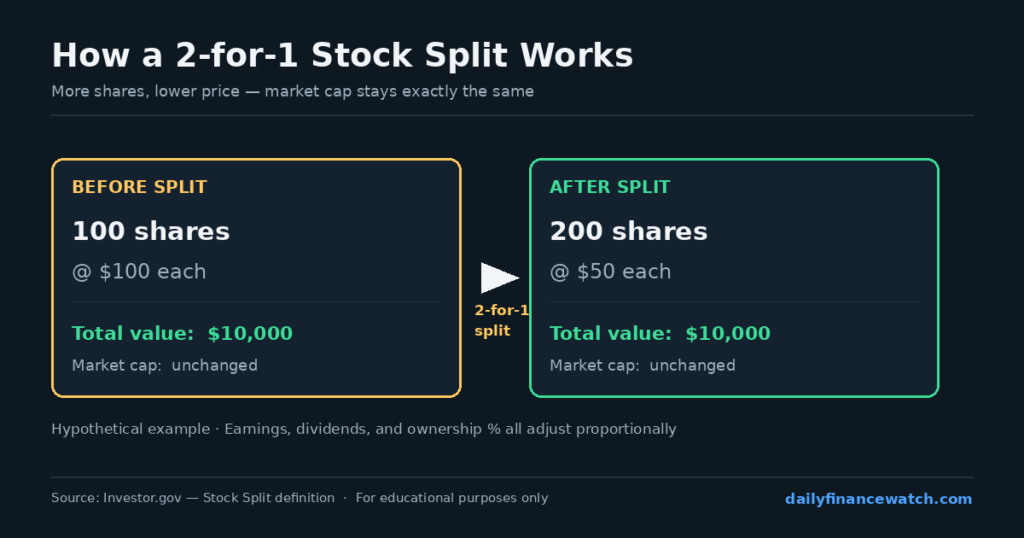
One pizza, more slices — the total amount stays exactly the same.
In mechanics, a stock split increases the number of outstanding shares while reducing the price per share by the same ratio. According to Investor.gov, a split does not change shareholders’ equity or dilute existing ownership interests. For example, in a 2-for-1 split, an investor holding 100 shares at $50 ends up with 200 shares at $25. The total value — $5,000 — stays identical before and after.
The Math Behind Common Split Ratios
Split ratios come in many forms. The most common forward splits run 2-for-1, 3-for-1, and 4-for-1. NVIDIA’s 10-for-1 in 2024 showed that no upper limit exists. Specifically, the formula multiplies share count by the ratio and divides the price by the same ratio. Consequently, market capitalization stays fixed at the moment of the split. Moreover, dividends per share adjust by the same factor, so total dividend income per holding remains unchanged.
| Split ratio | Example: 100 shares at $100 | After split: shares | After split: price per share |
|---|---|---|---|
| 2-for-1 | $10,000 value | 200 | $50 |
| 3-for-1 | $10,000 value | 300 | $33.33 |
| 10-for-1 | $10,000 value | 1,000 | $10 |
All values are hypothetical illustrations. Market cap remains the same at the moment of the split.
Why Companies Actually Do Stock Splits
If the math is neutral, the motivation must lie elsewhere. The answer comes down to two related effects: accessibility and liquidity, specifically. A share priced at $1,200 excludes investors who cannot afford a single unit or who lack fractional share access. More buyers tend to mean tighter bid-ask spreads and less price impact per trade. In other words, that is exactly the liquidity improvement companies seek.
The NVIDIA 2024 Case: A Real-Data Example
NVIDIA’s June 10, 2024 split illustrates the accessibility rationale with real numbers. Specifically, NVIDIA closed at $1,208.88 on June 7, 2024, per NVIDIA’s investor relations filings. After the 10-for-1 adjustment, shares opened at approximately $120.88 on June 10.
In particular, NVIDIA stated in its FAQ that the split aimed to make ownership “more accessible to employees and investors.” At the pre-split price, a single share exceeded the monthly contribution limit of many retirement accounts. In contrast, the post-split price brought the stock into reach of smaller regular purchases.
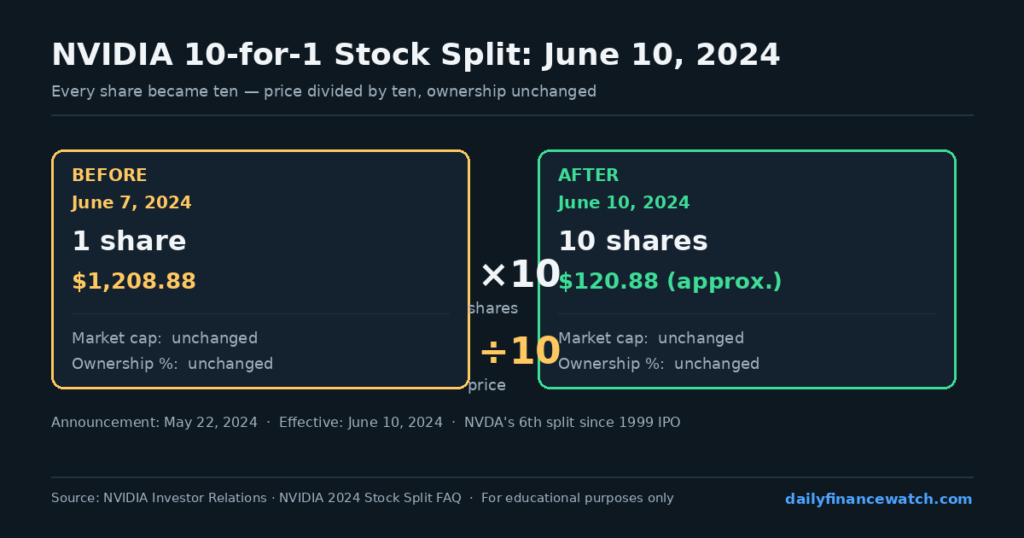
Ten for one — the price divides by ten, ownership percentage stays constant.
Reverse Splits: The Opposite Direction
A reverse split runs the same math in reverse. Share count falls and price per share rises by the same factor. As FINRA states, a split does nothing to change the value of a company. Consequently, a 1-for-10 reverse split converts 1,000 shares at $1 into 100 shares at $10. The total value stays $1,000 either way.
Why Reverse Splits Carry a Different Signal
However, the context around reverse splits differs sharply from forward splits. Companies typically execute forward splits after significant price appreciation. In contrast, reverse splits more often follow prolonged price declines.
Companies use them when a stock risks delisting for falling below an exchange’s minimum price threshold. For instance, Nasdaq requires a minimum bid price of $1 for continued listing. Therefore, a reverse split can rescue a listing but rarely signals business improvement on its own. Investors therefore read the two actions very differently, even though the arithmetic is identical.
What Stock Splits Do Not Change — And What They Might
As FINRA states, a split does nothing to change the value of a company. Earnings per share, dividends per share, and book value per share all adjust proportionally. The underlying fundamentals stay unchanged on an equivalent basis. Tax basis also adjusts. For instance, if an investor paid $1,000 for 10 shares and the stock splits 2-for-1, the basis becomes $500 per 20 shares — same total, different per-share number.
The Psychology Gap Most Guides Skip
A common guide presents stock splits as purely cosmetic — mathematically neutral, therefore irrelevant. At first glance, that view is accurate on fundamentals but misses the behavioral layer. Researchers observe a consistent pattern they call the split bump: elevated buying interest around split announcements. The mechanism involves retail investors treating a lower nominal price as a signal of affordability.
Valuation multiples remain identical, but the perception of cheapness persists. Institutional investors typically see through this effect. Consequently, the split bump tends to fade within weeks. Furthermore, splits can affect index mechanics. The Dow Jones Industrial Average uses price-weighting, so a very high per-share price distorts a stock’s index contribution.
Understanding these splits requires separating two questions. Most coverage conflates them: does a split change fundamental value (no), and does it change anything at all (yes — liquidity, accessibility, and short-term demand)? The math nets to zero, but the market is not purely mathematical. A disciplined investor treats the split as operational context, not a signal to act. The question to ask is whether the underlying business justifies the valuation at any price per share.
Related articles:
Does a stock split make shares a better investment?
No. A split does not change earnings, revenue, cash flow, or any other fundamental measure of value. The price per share drops by the split ratio, and shares outstanding rise by the same factor. Market capitalization stays unchanged. However, a split can improve liquidity and broaden access. Any post-split price movement reflects investor psychology or pre-existing business momentum, not the split itself.
What happens to my dividends after a stock split?
Dividends per share adjust proportionally by the split ratio. For example, a 2-for-1 split halves the dividend per share but doubles the shares held. Consequently, total dividend income stays the same. Investor.gov confirms that a split does not change shareholders’ equity. Reinvestment plans, automatic payments, and tax records all adjust to the new per-share figures through your broker.
What is the difference between a stock split and a reverse stock split?
A forward split increases shares outstanding and reduces price per share by the same ratio. In contrast, reverse splits more often follow prolonged declines and sometimes target minimum exchange listing requirements. The math is identical, but the context differs. Forward splits typically follow strong price appreciation; reverse splits carry a different signal about the company’s recent trajectory.
This content is for educational purposes only and is not personalized financial advice. Investing involves risk, including possible loss of principal.
© 2026 Daily Finance Watch. Excerpts under 50 words with attribution and a link back are permitted. Full-article reproduction requires written permission.