Last updated: July 2, 2026
The short answer is yes — a stock price can fall to zero.
However, that answer is technically true yet incomplete without understanding how it actually happens.
In reality, stock prices do not simply drift downward until they reach zero the way a gas tank empties.
Instead, a specific chain of legal events creates the zero outcome. A company files for bankruptcy protection, a court approves a reorganization plan, and existing common equity gets formally canceled. Specifically, the price reaches zero because the legal claim it represented no longer exists.
In particular, that distinction matters for one practical reason. It is the difference between a price dip and a permanent legal erasure. It helps investors separate companies in a sharp decline from companies where the legal process has already begun to erase shareholder claims permanently. Therefore, this article covers the legal mechanism that creates this outcome and the creditor priority that explains why common shareholders get hit hardest. It also covers the signals that appear before equity reaches zero.
How a Stock Price Reaches Zero
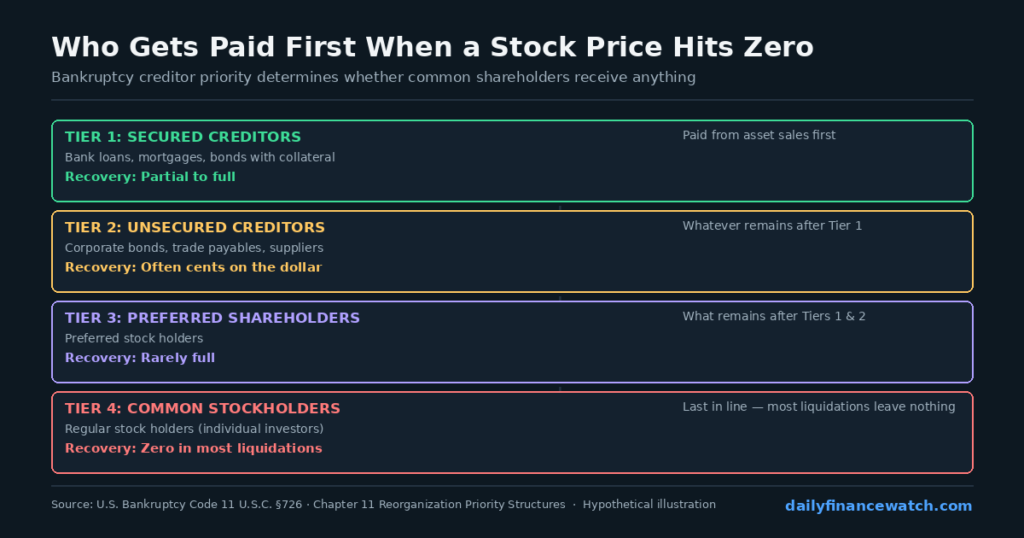
A stock price reaches zero through a legal sequence, not just price movement.
Specifically, a stock represents ownership of a fractional share of a company’s net assets. When a company files for bankruptcy, a court takes control of the process. Consequently, it oversees the liquidation or reorganization. Secured creditors — banks and bondholders with collateral pledged against their loans — collect from asset sales first. Unsecured creditors follow. In turn, preferred shareholders come next. Consequently, common stockholders receive whatever remains after those prior claims get satisfied in full. In most liquidations, nothing remains for common shareholders.
The Legal Events That End a Share’s Value
Three distinct events can formally reduce a share’s value to zero. First, a Chapter 7 liquidation under U.S. bankruptcy law directs the court to sell all company assets, distribute the proceeds through the priority order, and close the business. Second, in a Chapter 11 reorganization, the company may continue operating. However, it often cancels existing common stock and issues new shares to creditors as part of the plan.
Third, an exchange can delist a company, forcing shares onto over-the-counter markets. Liquidity collapses and prices typically drop to fractions of a cent before halting entirely. In each case, therefore, common shareholders hold certificates that represent no meaningful claim.
What Happens to Shareholders When a Stock Price Collapses
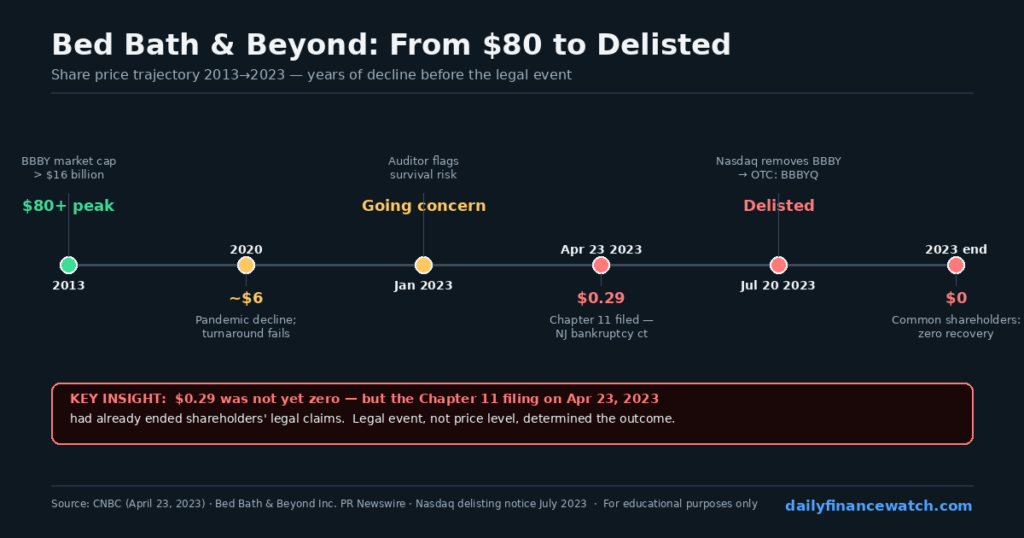
The peak-to-zero journey takes years of declining fundamentals — then a single legal event.
In the bankruptcy priority waterfall, common stock always ranks last. This structure explains why the share value reaches zero even when a company has assets. A company with $4 billion in assets and $5 billion in debt leaves nothing for equity holders after creditors collect their claims. Consequently, the share value does not need to drop below zero; it simply reaches a point where the equity claim has no value, and the market reflects that conclusion.
The Creditor Priority Waterfall
Investors often misunderstand why price declines accelerate as a company approaches insolvency. As debt distress rises, each dollar of asset value becomes more available to creditors and less available to equity holders. Therefore, a company with $1 billion in assets and $1.5 billion in liabilities has theoretical equity value of zero. The assets simply cannot cover the debt.
In practice, however, institutional investors and bond traders make this calculation continuously. When the bond market prices a company’s debt below 50 cents on the dollar, it signals that even creditors may not collect in full. Let alone equity holders.
| Claim type | Priority in bankruptcy | Typical outcome in liquidation |
|---|---|---|
| Secured creditors (bank loans, mortgages) | First | Partial to full recovery |
| Unsecured creditors (bonds, trade payables) | Second | Partial recovery, often cents on dollar |
| Preferred shareholders | Third | Rare recovery in most liquidations |
| Common stockholders | Last | Zero in most liquidations |
Source: U.S. Bankruptcy Code, 11 U.S.C. §726; Chapter 11 reorganization plan priority structures.
Bed Bath and Beyond: The Zero Outcome in Practice
Bed Bath & Beyond’s trajectory demonstrates how the price-to-zero sequence unfolds over years before the legal event that finalizes it. In 2013, Bed Bath & Beyond stock peaked above $80 per share, giving it a market capitalization above $16 billion. Over the following decade, however, the company failed to adapt to e-commerce competition. Consequently, it repeatedly missed earnings estimates.
From $80 to Delisted in a Decade
On April 23, 2023, Bed Bath & Beyond Inc. (Nasdaq: BBBY) filed voluntary Chapter 11 petitions in the United States Bankruptcy Court for the District of New Jersey. At the time of the filing, the company disclosed approximately $5.2 billion in total liabilities against $4.4 billion in assets. Shares closed at $0.29 on the final trading day before the filing.
This represented a roughly 88% decline from the start of 2023 alone. The Nasdaq Stock Market formally delisted the shares effective July 20, 2023. Nasdaq cited Listing Rules 5101, 5110(b), and IM-5101-1 (Nasdaq regulatory notice, July 2023).
Shares subsequently traded on OTC markets under the ticker BBBYQ before becoming economically worthless. Consequently, common shareholders recovered nothing.
Notably, the $0.29 closing price was not zero. Nevertheless, the legal clock had already run out for shareholders. Investors who bought shares after the bankruptcy filing faced the same outcome as those who held from higher prices. The low nominal price offered no legal protection. In reality, the filing date — not the price level — determined the legal sequence that ended their claim.
A common piece of guidance says to ‘average down’ when a strong company’s stock drops 80%. Buy more shares at the lower price to reduce the average cost per share. For financially sound companies experiencing temporary setbacks, this approach has a valid application. However, it becomes dangerous when applied to companies showing signs of actual insolvency.
The distinction between a temporary price decline and a structurally impaired company depends on reading balance sheets and bond markets, not stock charts alone. In other words, averaging down into a company with $5 billion in debt and $4 billion in assets only adds more capital to a claim already likely to be worthless.
How to Read the Signals That Precede Zero
Understanding when equity faces genuine zero risk requires looking beyond the share price itself. Moreover, three signals appear consistently before companies reach the bankruptcy stage. First, a ‘going concern’ note in an auditor’s report marks a significant escalation in risk. This is a formal statement that the auditor questions whether the company can survive the next 12 months. For instance, Bed Bath & Beyond issued a going concern notice in January 2023, three months before its April filing.
Warning Signals Before a Stock Price Reaches Zero
Second, debt trading far below face value signals that even creditors expect losses. Third, high debt-to-equity ratios combined with negative free cash flow create the conditions where a declining price accelerates toward zero. In practice, investors who track SEC filings can identify these warning signs from quarterly 10-Q reports and annual 10-K filings.
Furthermore, the SEC’s Investor.gov bulletin on bankruptcy confirms that stockholders rank last and rarely receive any recovery. A price at $0.50 may or may not signal zero risk. In reality, the answer depends entirely on the company’s capital structure and legal status. Price level, in other words, is the wrong lens. In contrast, a company’s debt metrics, auditor notes, and bond market pricing provide the actual signals that precede a price hitting zero.
Ultimately, knowing the mechanism makes those signals readable. In particular, it shifts the investor’s focus from price charts to legal filings. Investors who understand that this outcome arrives through a legal sequence — not a gradual drift — can monitor the right indicators. In other words, the question is not whether the price is low. It is whether the legal and financial conditions that produce a zero outcome already exist or are forming.
Related articles:
Can a stock price actually go to zero?
Yes. A stock price reaches zero when a company files for bankruptcy and a court cancels existing common equity, or when shares become economically worthless through delisting and liquidation. The price does not drift gradually to zero — a specific legal event creates the outcome. Common shareholders rank last in bankruptcy priority and typically receive nothing when a company liquidates or reorganizes its debt.
What happens to my shares when a company goes bankrupt?
Under U.S. bankruptcy law, common stockholders rank last in the priority order for receiving proceeds from a liquidation or reorganization. Secured creditors, unsecured creditors, and preferred shareholders all hold prior claims. In most liquidations, these prior claims consume all available assets. As a result, common shares are formally canceled with no recovery for stockholders. Bed Bath & Beyond’s April 2023 Chapter 11 filing illustrates this outcome — shareholders received nothing while assets were distributed to creditors and acquired by outside buyers.
How do I know if a stock might go to zero?
Three signals precede most zero outcomes. First, a going-concern note in the company’s auditor report warns that the business may not survive the next 12 months. Second, the company’s bonds trading far below face value signal that even creditors expect only partial recovery. Third, total liabilities exceeding total assets on the balance sheet indicates the company’s equity has no residual value even before any formal bankruptcy filing. Monitoring SEC filings provides direct access to all three of these indicators.
This content is for educational purposes only and is not personalized financial advice. Investing involves risk, including possible loss of principal.
© 2026 Daily Finance Watch. Excerpts under 50 words with attribution and a link back are permitted. Full-article reproduction requires written permission.ibution and a link back are permitted. Full-article reproduction requires written permission.