Last updated: July 2, 2026
Every public company in the United States files legal documents with the SEC. Anyone can read them for free. Most investors know this and, nevertheless, never open one. SEC filings are long, and the table of contents alone can run three pages. However, the length disguises a useful fact. Three sections inside each filing carry almost all the information that actually moves prices. The rest is largely boilerplate.
Most guides describe SEC filings as documents investors should “eventually” explore. In reality, certain sections demand the most candor. Federal law requires disclosure there even when the news is uncomfortable. Therefore, this guide covers what each filing type contains and which sections matter most. It also shows how to read one without clearing a weekend.
What SEC Filings Actually Are
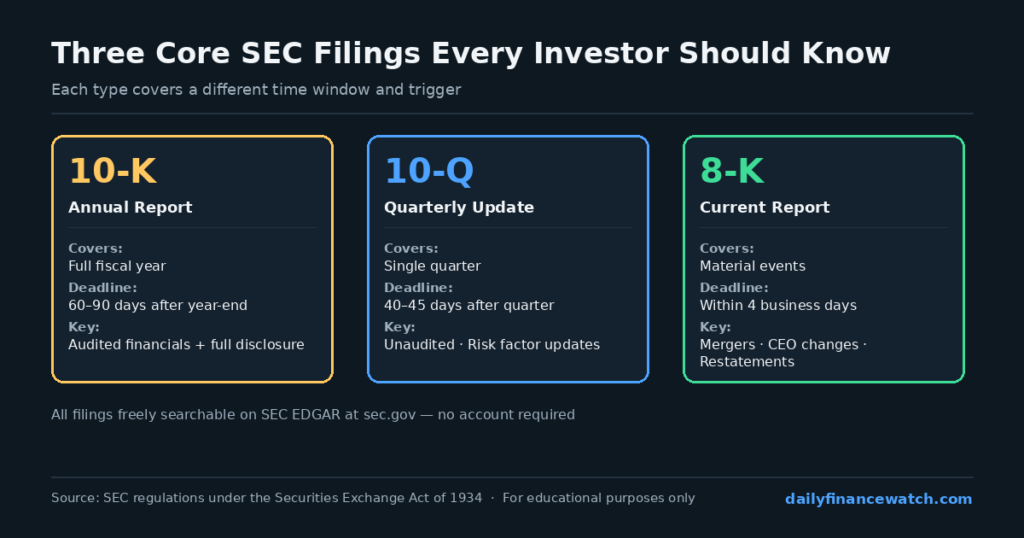
Three filing types, three different windows into the same company.
In fact, a public company’s filing obligation begins the moment its shares trade on a registered exchange. The SEC’s EDGAR database holds every filing, freely searchable by company name or ticker. Three report types make up the core of what equity investors read.
The Three Filing Types at a Glance
The 10-K is the annual report. Companies must file it within 60 days of their fiscal year-end for large accelerated filers. Accelerated filers have 75 days, per SEC rules. The 10-Q is the quarterly update, due within 40 days for large accelerated filers. In contrast, the 8-K is a current report triggered by specific material events. Examples include a merger announcement, a CEO departure, or an earnings restatement. Companies must file it within four business days of the event.
| Filing type | Covers | Typical deadline | Frequency |
|---|---|---|---|
| 10-K | Full fiscal year | 60–90 days after year-end | Annual |
| 10-Q | Single quarter | 40–45 days after quarter-end | Three per year |
| 8-K | Specific material events | 4 business days after event | As needed |
Source: SEC regulations under the Securities Exchange Act of 1934.
How to Read a 10-K: Where the Signal Lives
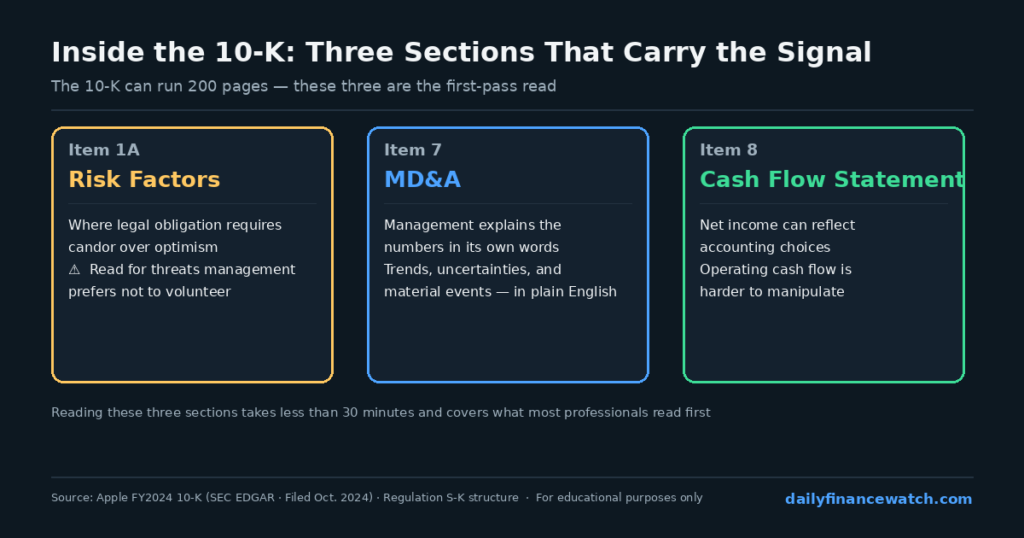
In practice, a large-company 10-K can run 100 to 200 pages. Consequently, every 10-K places the same information in the same location under Regulation S-K. However, three sections carry the most signal for investors.
Risk Factors and MD&A: Where Candor Is Required
Item 1A (Risk Factors) lists every material risk the company faces. Management has strong incentive to describe these risks accurately. Understating them creates legal liability if a hidden risk later harms investors.
Consequently, Risk Factors carry a legal incentive toward candor that press releases do not. Therefore, Risk Factors is one of the few places where legal obligation nudges disclosure toward candor rather than optimism.
For instance, Apple’s FY2024 10-K, filed with the SEC for the fiscal year ending September 28, 2024, disclosed a $10.2 billion EU tax charge in Item 1A. The same section named supply chain concentration in Asia and regulatory challenges across multiple jurisdictions.
These disclosures appeared alongside $391 billion in annual revenue. The Risk Factors section named the threats that earnings releases might omit.
Item 7, the MD&A, is where management explains the numbers. However, it also requires management to identify trends, uncertainties, and material events. Analysts treat the MD&A as the company’s own account of what is happening beneath the headline figures.
The cash flow statement in Item 8 rounds out the essential reading. Net income can reflect accounting choices; cash flow from operations is harder to manipulate. A company showing rising earnings but declining operating cash flow warrants closer examination. Together, these three sections cover the ground most professional investors cover in a first pass.
The 10-Q and 8-K: Tracking Changes Between Annuals
Quarterly and event-driven filings update the picture the 10-K established.
Over time, each 10-Q updates the investment thesis established by the annual report. In contrast to the 10-K’s full-year view, the 10-Q answers whether the trends management described are continuing, accelerating, or reversing.
Furthermore, the notes to financial statements in a 10-Q often contain disclosures that never appear in the earnings press release. Examples include a new legal proceeding, a change in accounting estimate, or a segment restructuring. The press release comes from the company; in contrast, the 10-Q is a legal document filed under oath.
The 10-Q follows the same structure as the 10-K but focuses on a single quarter. Specifically, it adds an interim financial update and a brief MD&A. Critically, it also includes Item 1A Risk Factors.
Moreover, a 10-Q that quietly adds a new risk factor often carries more information than the headline revenue number. The company must note any material changes since the most recent 10-K.
The 8-K provides real-time disclosure of material events. A company filing an 8-K to report a CEO resignation or a regulatory investigation could not wait for the next quarterly cycle. Because 8-Ks appear in near real time, they often serve as the first legally documented source of information that moves a stock price. Disciplined investors often track 8-K filings. Consequently, the SEC’s EDGAR system sends email alerts as new filings arrive.
What the 10-Q Adds to the 10-K Picture
Each quarterly filing updates the investment thesis from a different angle. In contrast to an earnings press release, it files under legal penalty for misstatement. Moreover, the notes section of a quarterly report often contains disclosures that management chose not to highlight in the call or the release. Investors who read only the headline number miss the section where the most significant news sometimes arrives quietly.
How to Use SEC Filings Without Reading Everything
A beginner approach to SEC filings does not require reading the full document. Most disciplined investors follow a filing sequence. First, read the Risk Factors for anything new since the last filing. Then skim the MD&A for management’s own assessment, and check the cash flow statement to verify earnings convert to actual cash.
By comparison, the balance sheet and income statement receive the most media attention. However, they appear in every earnings release, so the filing adds less new information there.
Common Mistakes With SEC Filings
A common assumption treats SEC filings as documents only professional analysts read. In reality, every figure a financial journalist reports originally came from an SEC filing. The source is always publicly accessible.
Moreover, a second mistake focuses on headline revenue while skipping Risk Factors — precisely inverting the information value of each section. Furthermore, reading the earnings press release and calling it research is like reading a movie poster instead of a review. The press release comes from the company’s marketing team. In contrast, the 10-K and 10-Q are legal documents filed under Section 13 of the Securities Exchange Act. Investors who understand the difference read from the same source as the professionals.
The underlying insight is simple. SEC filings exist because investors and management have conflicting incentives. Management prefers good news; investors need balanced information.
The disclosure regime resolves that tension with legal force. As a result, the sections where that tension peaks — Risk Factors, MD&A, cash flow — deliver the most honest picture. Reading those three sections in a 10-K takes less than thirty minutes. In practice, the rest exists for lawyers, auditors, and very deep-dive analysts. For most investors, those three sections are the filing — and that is enough.
Related articles:
What is the difference between a 10-K and a 10-Q?
A 10-K covers a company’s full fiscal year, filed within 60 to 90 days of year-end. A 10-Q covers a single quarter and is due within 40 to 45 days. Both follow the same SEC structure, but the 10-Q is an interim update. It adds to the 10-K rather than replacing it. The annual filing contains the full audited financial statements; quarterly reports are unaudited.
Where can I find SEC filings for any public company?
The SEC’s EDGAR database at sec.gov is free and contains every filing from all U.S.-registered public companies. Searching by company name or ticker symbol returns all filings in chronological order. Investors can also set up email alerts through EDGAR. Consequently, they receive notifications whenever a company files a new 10-K, 10-Q, or 8-K.
What is an 8-K and why does it matter?
An 8-K is a current report that public companies must file within four business days of any material event. Examples include a merger, leadership change, regulatory action, or earnings restatement. Because 8-Ks appear in near real time, they often serve as the first legally documented source of information that moves a stock price. Reviewing 8-Ks alongside quarterly filings gives investors a more complete picture than earnings releases alone.
This content is for educational purposes only and is not personalized financial advice. Investing involves risk, including possible loss of principal.
© 2026 Daily Finance Watch. Excerpts under 50 words with attribution and a link back are permitted. Full-article reproduction requires written permission.