Last updated: July 4, 2026
Nearly every mortgage article repeats the same number. Keep your debt ratio under 43 percent, they say. However, fewer mention that the federal regulator behind that number removed it as a hard requirement years ago.
What Debt-to-Income Ratio Measures
Debt-to-income ratio (DTI) is the percentage of your gross monthly income that goes toward paying debts. Lenders calculate it by adding up all monthly debt payments. Then they divide that total by gross monthly income — income before taxes and other deductions. The Consumer Financial Protection Bureau defines DTI this way. It uses this figure as one measure of a borrower’s ability to manage additional debt.
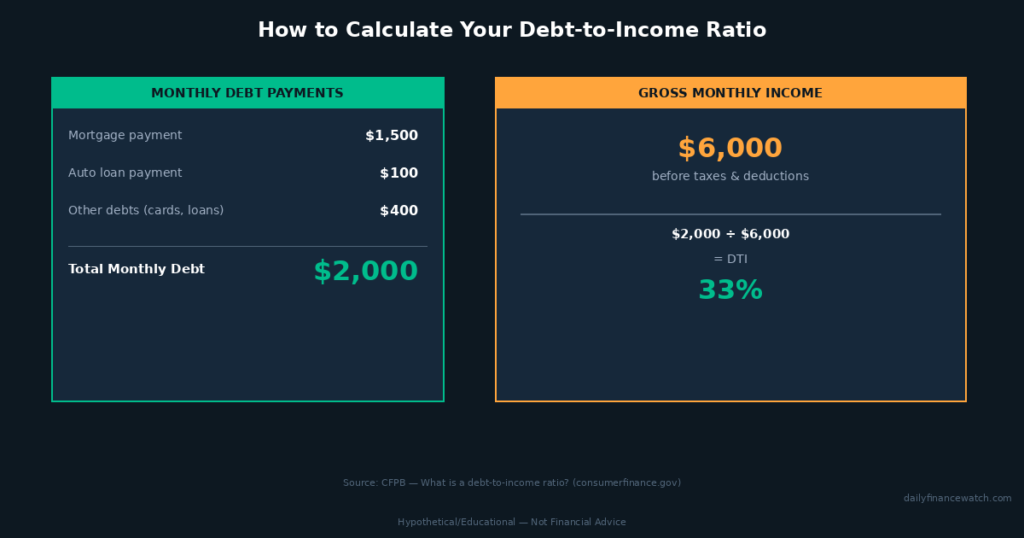
A worked example showing how to calculate debt-to-income ratio from monthly debt payments and gross monthly income.
Consider an example. A borrower pays $1,500 a month toward a mortgage. They also pay $100 toward an auto loan and $400 toward other debts. That adds up to $2,000 in total monthly debt payments. With a gross monthly income of $6,000, dividing $2,000 by $6,000 produces a DTI of 33 percent. You can review the CFPB’s own version of this calculation at consumerfinance.gov.
Front-End vs. Back-End Ratios
Lenders often calculate two separate DTI figures. The front-end ratio includes only housing-related costs. This means mortgage principal, interest, property taxes, and insurance, divided by gross income. The back-end ratio includes housing costs plus every other recurring debt. Car loans, student loans, credit card minimums, and personal loans all count. Most lenders rely primarily on the back-end ratio for a final underwriting decision. However, both figures typically appear in a mortgage application file.
Why “43 Percent” Became the Number Everyone Quotes
The 43 percent threshold traces back to a specific rule. The CFPB’s 2013 Ability-to-Repay/Qualified Mortgage rule created it after the 2008 financial crisis. Under that original rule, a loan needed a DTI at or below 43 percent to qualify for “General QM” status. That status gave lenders certain legal protections. This is where the widely repeated rule of thumb originated. It is also where the thesis of this article begins.
The Experience Anchor: When the 43% Rule Actually Changed
On December 29, 2020, the CFPB published a final rule. That rule removed the 43 percent DTI limit from the General QM loan definition entirely. In its place, the Bureau adopted a price-based test instead. A loan now qualifies as a General QM if its annual percentage rate stays within a set threshold of the average prime offer rate for a comparable transaction. For most first-lien loans of $110,260 or more, that threshold is 2.25 percentage points. The rule became effective March 1, 2021. Its mandatory compliance date was ultimately set for October 1, 2022. The CFPB explained that a loan’s price is a more holistic indicator of ability to repay than a single DTI cutoff. You can review the rule directly at consumerfinance.gov’s Rules & Policy page.
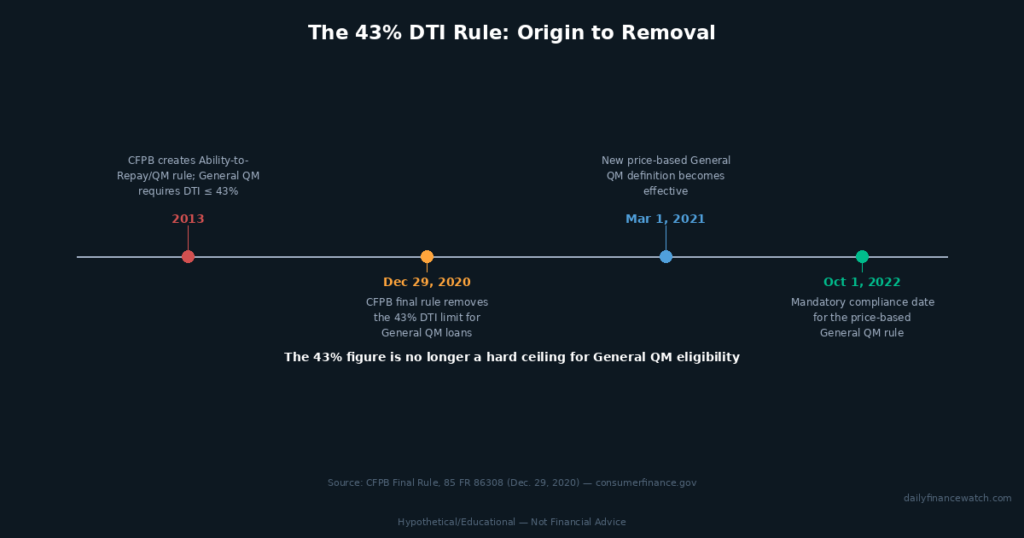
A timeline showing the evolution of the 43% DTI threshold, from its 2013 origin to its 2020 removal from the General QM definition.
This change does not mean DTI stopped mattering, though. Lenders must still consider a borrower’s DTI ratio or residual income during underwriting. What changed is simpler: 43 percent is no longer a fixed legal ceiling for General QM eligibility. Instead, it became one factor folded into a broader pricing test.
Why Different Loan Types Use Different Thresholds
Government-backed loan programs never adopted a strict 43 percent ceiling in the first place. FHA-insured loans can allow DTI ratios above 50 percent with sufficient compensating factors. Strong credit history or significant cash reserves often qualify as such factors. VA loans use a similar flexible approach. They weigh residual income alongside DTI rather than applying one fixed cutoff. Conventional loans eligible for purchase by Fannie Mae or Freddie Mac often allow DTI ratios up to 45 or even 50 percent. This depends on other factors under automated underwriting. Here is the practical consequence of the thesis: no single percentage governs every mortgage product. The number a borrower needs to hit depends heavily on which loan program they are using.
How DTI Connects to Other Underwriting Factors
Lenders rarely evaluate DTI in isolation. Credit score, discussed in our guide on what is a credit score, interacts with DTI to shape loan approval odds. A borrower with a high DTI but excellent credit history may still qualify. Meanwhile, a borrower with moderate DTI but weak credit history may face rejection or a higher rate. Down payment size, loan-to-value ratio, and cash reserves round out the full underwriting picture. All of these factors work alongside DTI, not in place of it.
Lowering Your Debt Ratio
Two mechanisms improve a debt ratio. You can pay down existing debt, or you can increase income. Each one directly affects a different side of the ratio’s calculation. Consolidating high-interest debt into a lower monthly payment can reduce the ratio. This works even without paying down principal faster. Avoiding new debt obligations before applying for a mortgage matters too. Doing so preserves the existing ratio rather than pushing it higher. Building overall financial health also supports the process. Our guide on what is net worth covers this broader financial profile that lenders consider beyond DTI alone.
The Anti-Advice Reminder
A debt ratio is one input among several that lenders use to evaluate a loan application. The specific threshold that applies to any individual depends on the loan program, the lender’s overlays, and compensating factors unique to that borrower. Treating 43 percent as a universal pass-or-fail line overlooks how much loan qualification standards vary by product and lender. Before assuming a specific DTI will or will not qualify for a mortgage, review the requirements of that specific loan program. Speaking with a loan officer or housing counselor provides a far more accurate picture than any single rule of thumb.
The 43 percent figure earned its reputation from a rule that technically no longer applies as a hard ceiling. This holds true for most conventional mortgage originations today. Understanding which loan programs still use it — and which have moved to more flexible standards — is far more useful than memorizing one percentage as a universal answer.
This article is for educational purposes only and does not constitute financial or lending advice. Mortgage underwriting standards vary by lender and loan program and are subject to change.
© 2026 Daily Finance Watch. All rights reserved.