Last updated: July 3, 2026
Most people know a higher credit score is better. Fewer understand that the five factors behind the number carry very different weights — and that gap explains why some actions move the needle far more than others.
What a Credit Score Actually Measures
A credit score is a three-digit number that predicts how likely a borrower is to repay a loan on time. Lenders use it to decide whether to approve a loan, set an interest rate, or determine credit limits. According to the Consumer Financial Protection Bureau, most credit scores range from 300 to 850, with higher scores indicating lower predicted risk. You can review the CFPB’s definition at consumerfinance.gov.
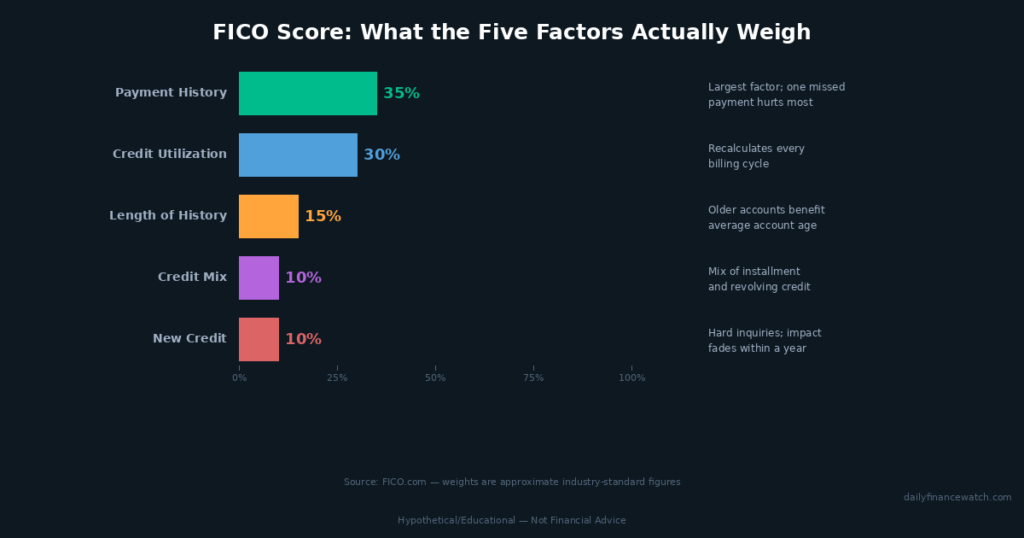
A bar chart showing the five FICO score factors and their percentage weights in the overall score calculation.
The most widely used model is the FICO Score, which 90% of top U.S. lenders use according to FICO’s own reporting. VantageScore is the other major model, created jointly by the three credit bureaus — Equifax, Experian, and TransUnion. Both models use the same 300–850 range and pull from the same underlying credit report data, but their weighting formulas differ in some categories.
The Five Factors and Why Their Weights Are Not Equal
FICO breaks its score into five categories. Understanding the weight of each reveals why certain behaviors matter more than others.
Payment history (35%) is the single largest factor. Every on-time payment strengthens it. Even one missed payment can drop a score significantly, especially for borrowers who start with high scores. Credit utilization (30%) measures how much of your available revolving credit you are using. Together, these two factors account for 65% of the total FICO score.
Length of credit history (15%) rewards older accounts. Closing an old credit card can shorten the average account age and reduce this factor’s contribution. Credit mix (10%) reflects whether a borrower manages different types of credit — such as installment loans and revolving accounts — responsibly. New credit (10%) tracks recent applications. Each hard inquiry can lower a score by a few points, though the impact fades over time.
Why Utilization Moves Faster Than History
Credit utilization recalculates every time a lender reports a new balance to the bureaus, which typically happens monthly. By contrast, length of credit history changes only as accounts age. This is why paying down a credit card balance can improve a score within one to two billing cycles, while rebuilding a damaged payment history takes much longer.
The Experience Anchor: What the 2025 National Average Reveals
According to Experian’s State of Credit report published in March 2026 using 2025 data, the average FICO Score in the U.S. fell to 713 at year-end 2025 — a two-point drop from 2024, and the first annual decline in over a decade. Experian attributed the drop to rising credit card utilization and an increase in missed payments, consistent with the end of pandemic-era payment relief programs. The national average had climbed from 686 in 2010 to a peak of 715 in 2023, a gain that itself reflected pandemic-era stimulus, lower spending, and payment accommodations from lenders. The 2025 reversal shows how quickly the utilization and payment history factors — the two heaviest-weighted categories — can pull the average down when economic conditions tighten.
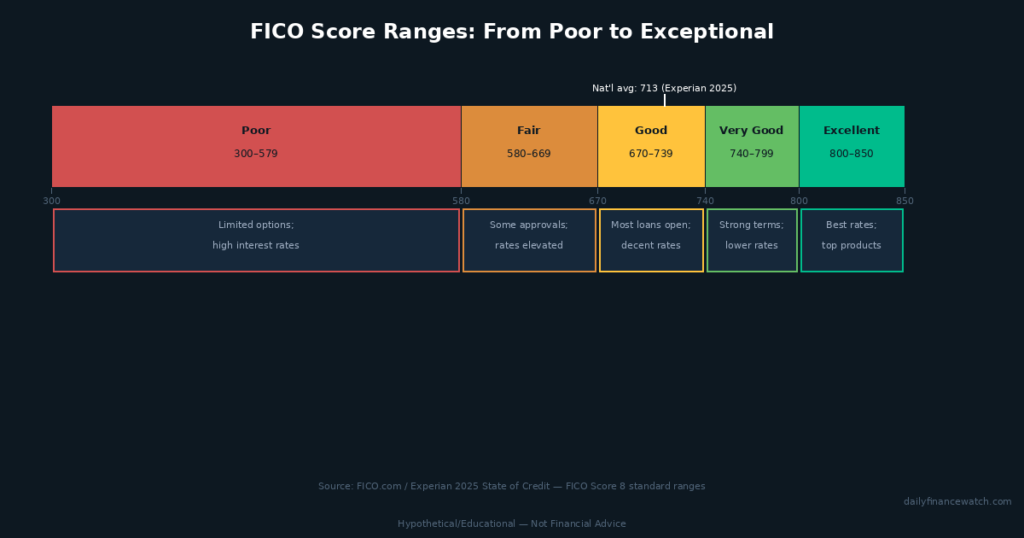
A horizontal tier diagram showing the five FICO score ranges from Poor to Exceptional with approximate qualifying thresholds.
Credit Score vs. Credit Report: Not the Same Thing
A credit report and a credit score serve different functions. The credit report is the raw data — a record of every account, payment, and inquiry reported by lenders to the bureaus. The credit score is a calculated output derived from that data using a scoring model’s formula. You can review your credit reports for free at AnnualCreditReport.com, as required by federal law under the Fair Credit Reporting Act. The CFPB’s guide to understanding your credit score walks through how each factor applies in practice.
Errors in your credit report can lower your score without any action on your part. Reviewing your reports regularly and disputing inaccuracies is one of the few ways to correct a score without changing your borrowing behavior.
Hard vs. Soft Inquiries
Not all credit checks affect your score. A soft inquiry — such as checking your own score or a pre-approval check — does not reduce your score. A hard inquiry — triggered when you formally apply for credit — can lower your score by a few points. Multiple hard inquiries for the same type of loan within a short window (typically 14–45 days) often count as a single inquiry under FICO’s rate-shopping rules for mortgages, auto loans, and student loans.
What a Credit Score Does Not Tell You
A credit score measures credit risk — specifically, the probability of a 90-day or worse delinquency within the next 24 months. It does not measure income, assets, savings, or overall financial health. Two borrowers with identical scores can have vastly different financial situations. One might hold significant investments and earn a high income. The other might carry no savings at all. Lenders supplement the credit score with income verification, debt-to-income ratios, and employment history for this reason.
The Anti-Advice Reminder
Understanding how a credit score is calculated can help you make more informed financial decisions. However, no single action guarantees a specific score outcome, because every borrower’s credit file is different. Improving a score by paying down utilization may produce a large gain for one person and a modest one for another, depending on the rest of their credit profile. Before making financial decisions based on your credit score, consider speaking with a nonprofit credit counselor or a financial professional to understand your specific situation.
A credit score is one data point in a broader financial picture. The score tells lenders how you have managed borrowed money in the past — but the unequal weights built into its formula mean that what you do with your payment history and utilization matters most, not the number of accounts you hold or how recently you opened them.
This article is for educational purposes only and does not constitute financial or credit advice. All consumers have multiple credit scores that may vary by model and lender.
© 2026 Daily Finance Watch. All rights reserved.