Last updated: July 5, 2026
ESG investing sounds like it follows a consistent, rules-based standard. Actually, no such standard exists. The SEC has fined major asset managers precisely because they claimed otherwise.
What ESG Investing Actually Means
ESG stands for environmental, social, and governance. According to Investor.gov, funds considering these factors may also get called sustainable investing. Others call it socially responsible or impact investing. You can review the official bulletin at investor.gov. Also, fund managers examine criteria within these three categories to select securities. However, the specific weighting varies enormously from fund to fund.
The Thesis: Why “ESG” Doesn’t Mean One Consistent Thing
Here is the mechanism behind the thesis. Investor.gov states this plainly. No SEC rating or score of E, S, and G applies across a broad range of companies. Different funds weight environmental, social, and governance factors differently. For instance, one fund might emphasize board diversity for governance. Another might focus entirely on carbon emissions. Notably, both can carry the same “ESG” label.
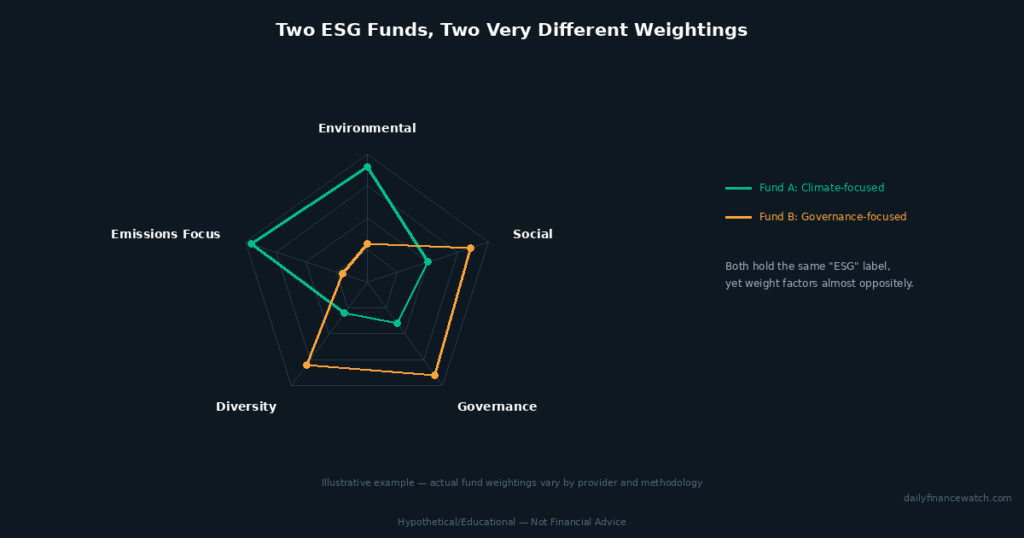
A radar chart comparing how two ESG funds weight environmental, social, and governance factors.
Third-Party Scores Add Another Layer of Inconsistency
Notably, some fund managers rely on third-party ESG scoring providers. However, these scores often differ significantly between providers. Specifically, a company can receive a high ESG score from one rating agency. That same company might earn only a mediocre score from another. This happens because each provider weights criteria differently. Also, some of the underlying data remains unverified.
The Experience Anchor: When Claims Didn’t Match Practice
Regulators have taken this inconsistency seriously. In November 2022, the SEC charged Goldman Sachs Asset Management. Specifically, the firm failed to follow its own written ESG policies. According to the SEC’s official announcement, the firm agreed to pay a $4 million penalty. Specifically, the order found policy failures spanning from April 2017 to February 2020. Notably, this included ESG questionnaires completed only after securities had already been selected.
However, Goldman Sachs was not an isolated case. Earlier that same year, the SEC fined BNY Mellon Investment Adviser too. Specifically, the firm made misleading statements about ESG reviews on some funds. Then, in September 2023, the SEC fined DWS Investment Management $19 million. This penalty targeted the firm’s exaggerated claims about ESG integration. Notably, that fine stood as the largest ESG-related penalty against an asset manager at the time.
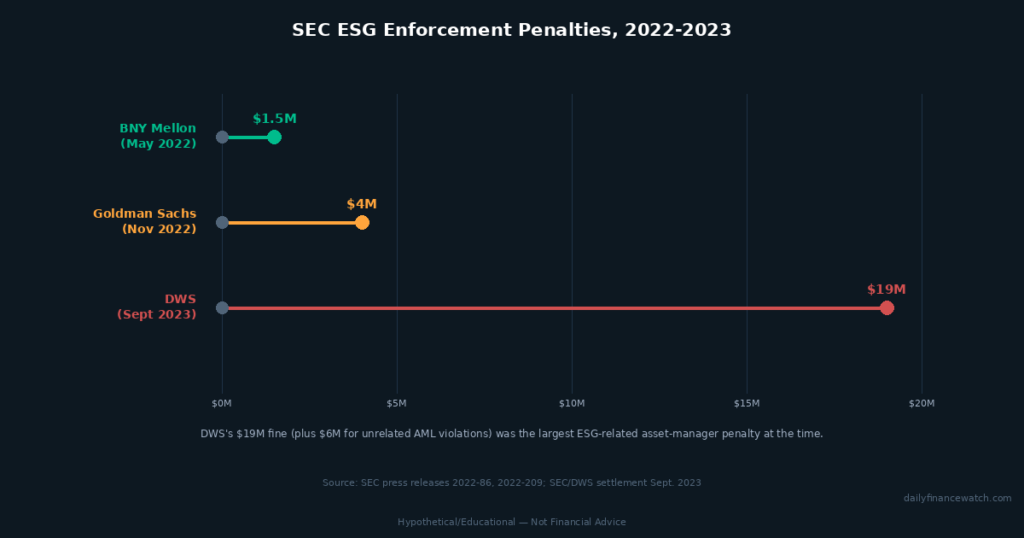
A range chart showing SEC penalty amounts across three ESG enforcement actions.
What These Cases Actually Prove
Each case involved a similar pattern. Specifically, a firm marketed funds as “ESG” without consistently following its own evaluation process. Notably, the SEC’s Deputy Director of Enforcement made this point directly. Investment advisers must ensure their actions match their words when marketing ESG products. This enforcement pattern confirms something important. An ESG label alone guarantees nothing about a fund’s actual holdings or process.
How to Actually Evaluate an ESG Fund
Investor.gov recommends reading a fund’s prospectus and shareholder report first. Notably, these documents show actual portfolio holdings, not just marketing language. Comparing a fund’s stated ESG approach against its real holdings reveals the truth. Specifically, some funds exclude entire industries entirely. Instead, others invest in “best in class” companies within commonly excluded sectors. This second approach bets on improvement rather than exclusion.
Greenwashing Has a Specific Definition
Investor.gov defines greenwashing as exaggerating how much a product considers sustainability factors. This differs from simply having a loosely defined ESG strategy. Specifically, greenwashing involves marketing that misleads investors about what a fund’s process actually verifies. The enforcement actions above targeted this exact gap. Ultimately, claims did not match actual practice.
ESG Funds Are Not Automatically Higher or Lower Risk
Notably, an ESG fund’s performance can differ meaningfully from a comparable non-ESG fund. This holds true in either direction. Specifically, excluding entire sectors reduces diversification. As a result, this changes a portfolio’s risk profile regardless of the ESG label’s intent. Our guide on portfolio rebalancing covers a related principle. Any screening criteria that narrows your investment universe affects risk. This holds true independent of the reasoning behind that screen.
The Anti-Advice Reminder
Several factors determine whether an ESG fund fits your goals. These include your specific values, your risk tolerance, and whether actual holdings match expectations. Notably, no universal ESG standard exists. As a result, comparing funds requires reading actual disclosure documents, not marketing labels. Before investing based on an ESG designation, review the fund’s prospectus first. Also, consider how its specific criteria align with your own priorities.
ESG investing describes a broad category, not a single verified standard. The SEC’s own enforcement record proves this clearly. Even large, well-resourced asset managers have failed to consistently follow the ESG processes they advertised. Ultimately, reading the actual fund documentation, not the label, determines whether an ESG fund does what you expect.
This article is for educational purposes only. It does not constitute financial advice. ESG fund criteria, ratings, and regulatory requirements are subject to change.
© 2026 Daily Finance Watch. All rights reserved.