Last updated: July 5, 2026
Most beginners think of cryptocurrency as a digital form of money. Actually, the IRS disagrees entirely. That distinction creates tax obligations most new crypto owners never expect.
What Cryptocurrency Actually Is
Cryptocurrency is a type of virtual currency. Specifically, it uses cryptography to secure transactions recorded on a distributed ledger, such as a blockchain. According to the IRS, this differs from government-issued currency in one critical way. You can review the official definition at irs.gov. Bitcoin, Ethereum, and thousands of other coins fall under this broad category. Notably, each operates on its own blockchain network, without a central bank or government backing its value.
The Thesis: Why Crypto Isn’t Taxed Like Money
Here is the mechanism behind the thesis. In 2014, the IRS issued Notice 2014-21. This notice established a foundational rule. Specifically, virtual currency is property for federal tax purposes, not currency. This classification carries major consequences. When you buy and sell property, you generate capital gains or losses. Notably, spending dollars between your own accounts triggers no tax. However, spending Bitcoin works completely differently.
Every Disposal Is a Taxable Event
Selling crypto for dollars is obviously taxable. However, so is spending it on a cup of coffee. Also, so is swapping one coin for another. According to IRS guidance, exchanging virtual currency for goods, services, or other property creates a capital gain or loss. Notably, this applies even to crypto-to-crypto trades. Someone converting Bitcoin into Ethereum has technically disposed of property. As a result, they must calculate gain or loss on that specific transaction.
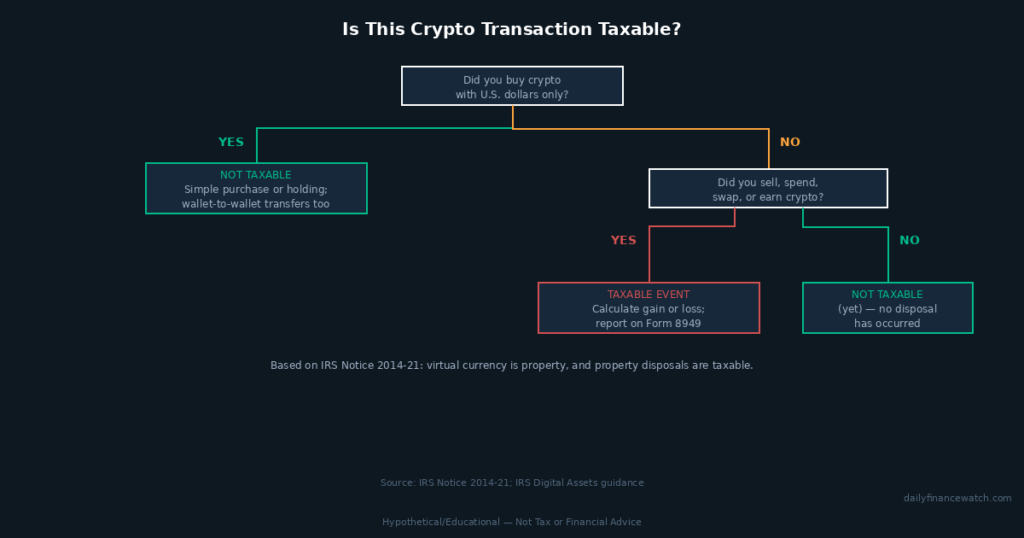
A decision tree showing which crypto transactions trigger taxes.
The Experience Anchor: How This Plays Out at Tax Time
Every Form 1040 now asks a direct question. Specifically, at any time during the year, did you receive, sell, exchange, or dispose of a digital asset? Answering “no” incorrectly constitutes a false statement on a federal tax return. Notably, purchasing crypto with U.S. dollars and simply holding it does not require a “yes” answer. Also, transferring crypto between your own wallets stays non-taxable. However, nearly every other type of transaction does trigger the reporting requirement.
This compliance gap used to rely heavily on self-reporting. Then, new broker regulations changed the picture. Specifically, starting January 1, 2025, brokers must report digital asset sales and exchanges directly to the IRS. This reporting happens on a new form called Form 1099-DA. Also, brokers must report cost basis information for certain transactions beginning January 1, 2026. You can review the full broker reporting requirements at irs.gov.
Why This Surprises So Many Beginners
Many new crypto owners hold one common assumption. Specifically, they think the tax obligation only kicks in when they cash out to a bank account. However, that assumption is incorrect. Buying a $5 item with Bitcoin, once the coin has appreciated, technically requires calculating and reporting that gain. Notably, few beginners realize this reporting requirement applies at such a granular level.
Understanding the Broader Digital Asset Category
Here, cryptocurrency sits within a larger legal category. Specifically, the IRS calls this category “digital assets.” This category also includes stablecoins and non-fungible tokens (NFTs). All three share the same property classification. However, specific rules can still vary by asset type.
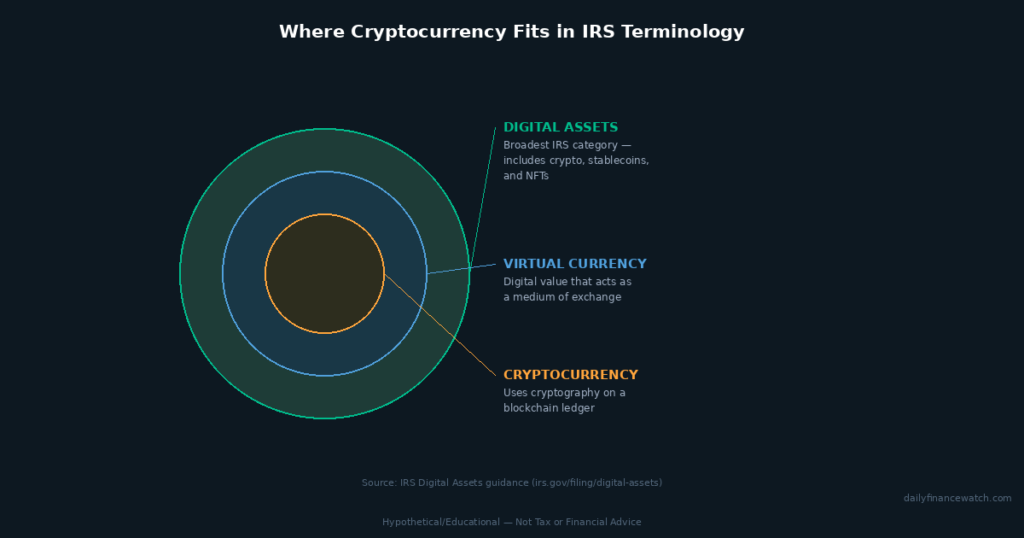
A ring diagram of digital asset categories.
Should Beginners Buy Cryptocurrency?
Cryptocurrency carries substantially higher price volatility than most traditional investments. Specifically, prices can swing by double-digit percentages within a single day. This pattern rarely appears in established stock indexes. Also, this volatility connects directly to the tax mechanism discussed above. Every trade made during a volatile period generates a reportable gain or loss. Notably, this holds true regardless of whether the investor intended a permanent, long-term holding.
A Different Kind of Portfolio Allocation Question
Financial professionals often follow a specific framing habit. Specifically, they treat cryptocurrency as a small, speculative allocation rather than a core holding. This framing exists for two reasons. Price volatility matters, but so do unresolved regulatory questions surrounding many specific tokens. Also, our guide on options trading covers a related concept. Understanding a product’s actual mechanics protects you more than following general market enthusiasm.
The Anti-Advice Reminder
Several factors determine whether cryptocurrency fits your portfolio. These include your risk tolerance, your tax situation, and your willingness to track detailed records. Notably, the property classification means meticulous recordkeeping matters more here than with most traditional investments. Before buying cryptocurrency, consider one key question. Can you accurately track cost basis across potentially dozens of transactions per year? Also, consult a tax professional about your specific recordkeeping obligations.
Cryptocurrency behaves like property under federal tax law. It does not behave like the currency it resembles in daily use. Ultimately, understanding that a coffee purchase can trigger the same reporting obligation as selling stock separates informed ownership from an expensive surprise at tax time.
This article is for educational purposes only. It does not constitute tax or financial advice. Cryptocurrency regulations and tax rules are subject to change by Congress and the IRS.
© 2026 Daily Finance Watch. All rights reserved.