Last updated: July 5, 2026
Most people assume hiring a human financial advisor automatically means stricter protection than using a robo-advisor. Actually, the type of registration matters far more than whether a human is involved.
What Determines an Advisor’s Duty to You
Notably, a financial professional’s duty depends on how regulators classify them. Specifically, this depends on registration type, not whether a human or an algorithm provides the advice. According to the SEC, registered investment advisers (RIAs) owe clients a fiduciary duty. You can review the official explanation at investor.gov. Broker-dealers, by contrast, follow a different standard entirely. This holds true regardless of how experienced or well-intentioned the individual representative may be.
The Thesis: Why “Human” Doesn’t Automatically Mean Stricter Protection
Here is the mechanism behind the thesis. In 2019, the SEC adopted Regulation Best Interest, known as Reg BI. This rule requires broker-dealers to act in a client’s best interest specifically when making a recommendation. However, this fiduciary-adjacent standard applies only to individual recommendations. Notably, it does not require ongoing account monitoring the way a full fiduciary duty does.
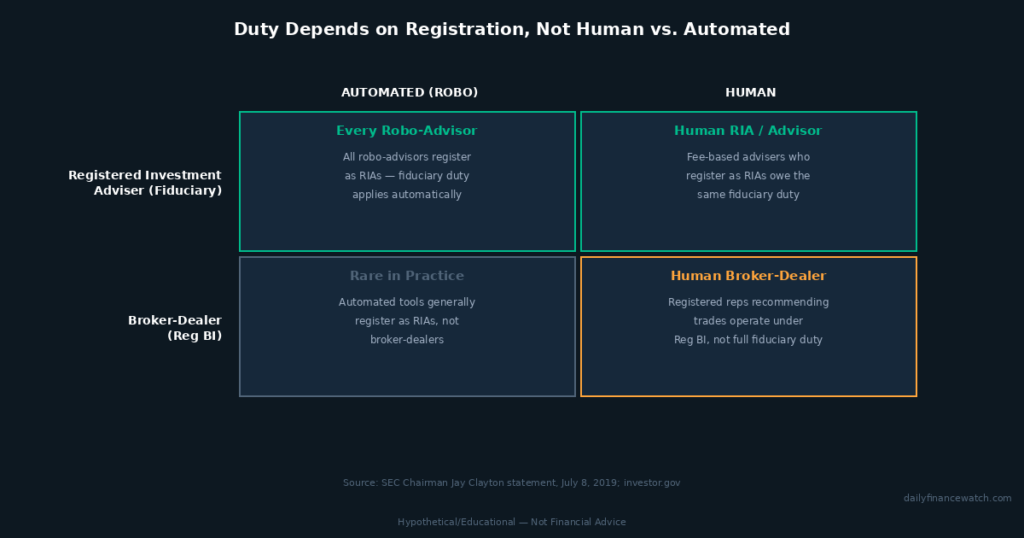
A matrix showing four combinations of automated versus human advice and fiduciary duty versus Regulation Best Interest.
Fiduciary Duty Covers the Entire Relationship
Notably, an investment adviser’s fiduciary duty works differently. Specifically, this duty applies continuously across the entire client relationship. It includes both a duty of care and a duty of loyalty. Every robo-advisor operates as a registered investment adviser. As a result, every robo-advisor owes this continuous fiduciary duty automatically. A human advisor may or may not carry this same obligation. This depends entirely on their specific registration.
The Experience Anchor: Two Standards, Not One
The SEC has been explicit about this distinction. Specifically, Chairman Jay Clayton addressed it directly in a 2019 statement on the rulemaking. He confirmed that Reg BI and the fiduciary duty represent genuinely different standards. They are not merely different labels for the same protection. Reg BI satisfies its obligation through four components. These are disclosure, care, conflict of interest, and compliance. The fiduciary duty works differently still. Specifically, it requires an adviser to serve the client’s best interest at all times. This applies well beyond just the moment of a specific recommendation.
This Distinction Surprises Many Investors
Notably, many retail investors hold a specific assumption. Specifically, they believe a human financial advisor offers more protection than software. However, this assumption depends entirely on what type of professional that human actually is. A broker-dealer representative operating under Reg BI faces real obligations. Still, these obligations carry a narrower scope than a fiduciary duty. Meanwhile, every robo-advisor automatically carries the broader fiduciary standard. This happens simply by virtue of its RIA registration.
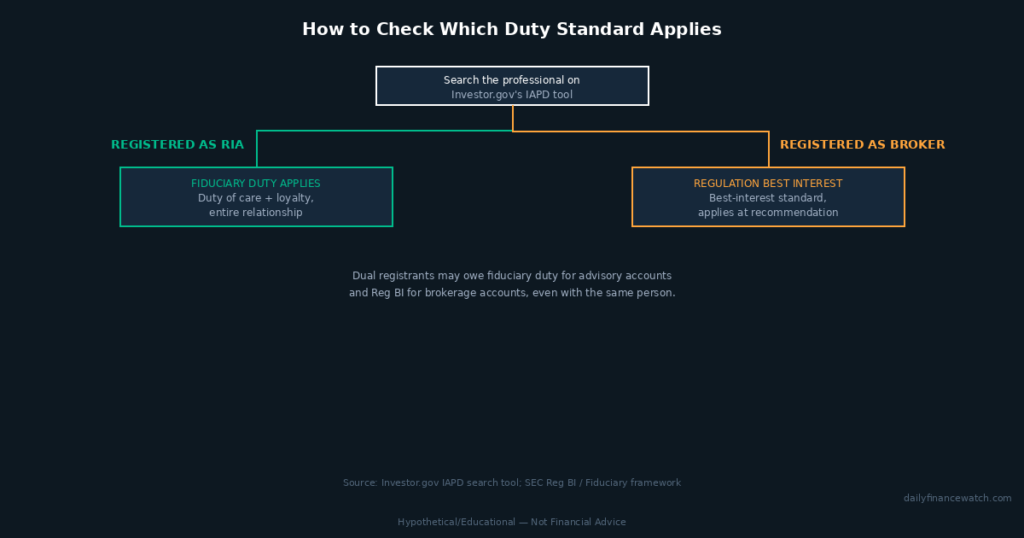
A decision tree showing how to check whether an advisor operates as a fiduciary or under Regulation Best Interest.
How to Actually Check Which Standard Applies
Investor.gov offers a free search tool specifically for this purpose. Typing a professional’s name redirects you to the Investment Adviser Public Disclosure database. Specifically, this tool shows whether someone holds registration as an investment adviser, a broker-dealer, or both. Otherwise, if they only hold broker registration, the tool redirects to FINRA’s BrokerCheck system instead. This entire check takes only a few minutes. Notably, it reveals which standard actually governs your relationship.
Dual Registrants Add Complexity
Notably, some professionals carry both broker-dealer and investment adviser registration. Regulators call this dual registration. Here, the applicable standard can depend on the specific account type or service involved. For instance, a fee-based advisory account might carry a fiduciary duty. Meanwhile, a separate brokerage account with that same person could fall under Reg BI instead.
Cost Structures Differ Independently of Duty Type
Also, beyond the duty question, robo-advisors and human advisors typically charge differently. Specifically, robo-advisors commonly charge a smaller percentage of assets under management annually. Human financial advisors, particularly those offering comprehensive planning, often charge more. This reflects the additional personalized service and complexity they handle. However, neither fee structure alone indicates which duty standard applies. Fees and regulatory classification get determined independently of each other.
The Anti-Advice Reminder
Several factors determine whether a robo-advisor or human advisor fits your situation. These include your need for personalized guidance, your financial complexity, and which duty standard actually applies. Notably, neither automated nor human advice guarantees a particular outcome. Also, a title alone never confirms a specific legal obligation. Before choosing any financial professional, take two steps. First, check their registration status through Investor.gov’s search tool. Then, ask them directly whether they operate as a fiduciary.
A human financial advisor does not automatically face a higher standard than a robo-advisor. Instead, the specific registration type determines whether fiduciary duty or Regulation Best Interest governs that relationship. Ultimately, understanding this distinction matters more than assuming either option is inherently safer.
This article is for educational purposes only. It does not constitute financial advice. Regulatory standards for financial professionals are subject to change.
© 2026 Daily Finance Watch. All rights reserved.