Last updated: July 5, 2026
A 60/40 portfolio left alone from mid-2019 through mid-2020 could have drifted far past its target. Vanguard’s December 2024 research found that monthly rebalancing let allocations swing up to 7% off target. Quarterly rebalancing let them swing 10%. Because of this, portfolio rebalancing exists to prevent that kind of drift. This article explains how it works, when to do it, and what the data actually shows about its benefit.
What Portfolio Rebalancing Actually Means
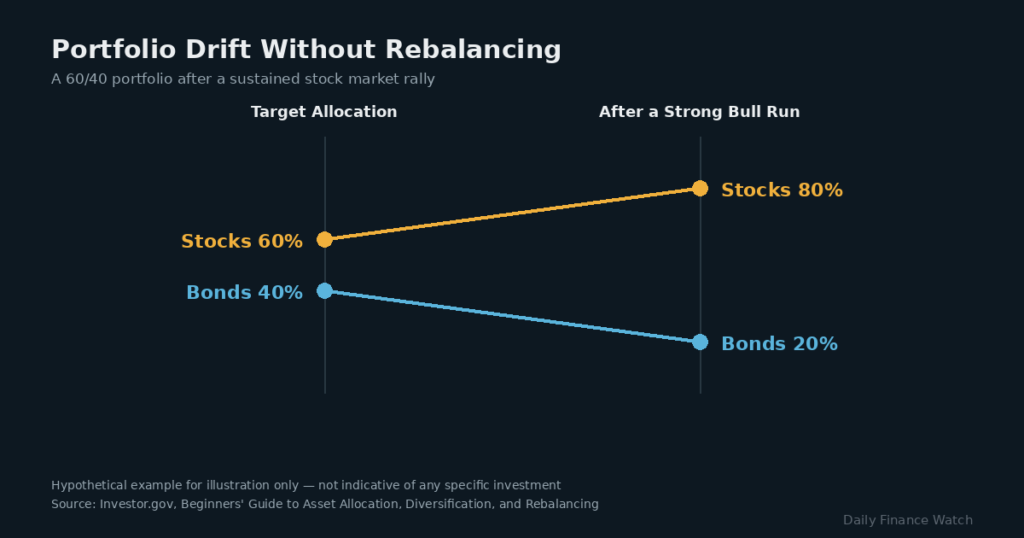
A hypothetical 60/40 portfolio drifts to 80% stocks after a sustained rally.
Portfolio rebalancing means returning your holdings to a chosen target mix, such as 60% stocks and 40% bonds. Markets rarely move in lockstep, so one asset class typically outgrows another. For example, stocks might climb faster than bonds during a bull run. As a result, that pushes your equity weight higher than intended. Therefore, rebalancing brings the mix back to your original plan. However, it does not chase performance or try to time a market top. Instead, it restores the risk level you chose before markets moved. That distinction matters, because rebalancing is fundamentally a discipline for risk control, not a return-maximizing tactic.
Why Portfolios Drift From Their Target Allocation
Every asset class carries a different long-term return, so unmanaged portfolios drift in a predictable direction. Stocks have historically outpaced bonds and cash over multi-year stretches, according to Investor.gov’s guide on asset allocation, diversification, and rebalancing. As a result, a portfolio that started at 60% stocks can quietly become an 80% stock portfolio after a strong run. That drift raises the account’s risk exposure without any deliberate decision by the investor. Consequently, the investor now carries more downside risk than originally intended. If a downturn hits at that moment, the loss lands on a heavier stock weighting than planned. Rebalancing exists specifically to catch this silent shift before it compounds.
Calendar-Based vs. Threshold-Based Approaches
Investors generally choose between two rebalancing methods: calendar-based and threshold-based. Calendar-based rebalancing resets the portfolio at fixed intervals, such as every quarter or year. It does this regardless of how far the portfolio has drifted. Threshold-based rebalancing works differently. It triggers a reset only when an asset class moves a set percentage away from target, such as five percentage points.
Vanguard’s Yu Zhang led a December 2024 study comparing these methods inside target-date funds. During the volatile stretch after COVID-19 began, a hypothetical 60/40 portfolio using threshold-based rebalancing stayed within 2% of target the entire time. Meanwhile, the same portfolio using monthly rebalancing drifted as much as 7% off target. Quarterly rebalancing drifted up to 10%. Specifically, threshold-based rebalancing responded to the market move instead of waiting for a fixed date.
What the Research Actually Shows
It is tempting to assume rebalancing boosts long-term returns, but the research tells a more modest story. Zhang’s team found that threshold-based rebalancing produced returns only 11 to 18 basis points higher per year than calendar-based approaches. A basis point equals one-hundredth of a percentage point. So this advantage is measured in fractions of a percent, not multiple points of outperformance.
The bigger benefit actually shows up in risk control, not returns. The threshold approach cut annual allocation deviation by 43 basis points compared with monthly rebalancing. Compared with quarterly rebalancing, the deviation dropped by 135 basis points. Additionally, transaction costs fell by roughly 13 to 17 basis points a year. Rebalancing’s primary job, in other words, is keeping risk where an investor wants it, not squeezing out extra return.
How Often Should You Check Your Allocation?
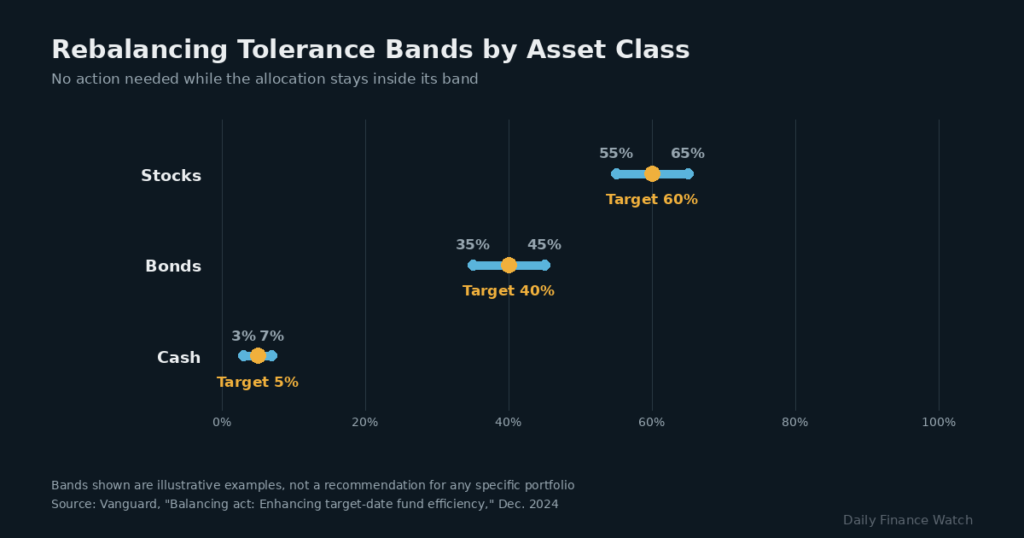
Tolerance bands let each asset class drift a set range before triggering action.
Most individual investors do not need daily monitoring to benefit from rebalancing. Instead, a common approach reviews the portfolio every six to twelve months. Adjustments happen only if an asset class has drifted meaningfully. Investor.gov describes both calendar-based and threshold-based approaches as reasonable. It also notes that rebalancing tends to work best when done infrequently rather than constantly.
A simple threshold rule offers a workable middle ground. For instance, rebalancing whenever an asset class moves five percentage points from target avoids both constant tinkering and years of unchecked drift.
Rebalancing Inside Target-Date Funds and Robo-Advisors
Many investors never rebalance manually at all. Target-date funds and robo-advisors handle the process automatically, using rules similar to Vanguard’s threshold-based approach. In many cases, a robo-advisor can automate this process for a standard taxable or retirement account, checking allocations daily and trading only when drift crosses a set band. As a result, this removes the emotional element entirely, since the account rebalances on a schedule the investor never has to remember. However, automation is not free. In contrast, target-date funds bundle rebalancing costs into the fund’s expense ratio, while a robo-advisor typically charges a separate management fee. Meanwhile, investors comfortable rebalancing manually can often replicate the same risk control without paying for automation, using a simple calendar or threshold rule.
Common Mistakes to Avoid
Three mistakes come up repeatedly. First, some investors rebalance too often, treating every small market move as a trigger and running up transaction costs for no measurable benefit. Second, others ignore taxes entirely, selling appreciated positions in a taxable account without checking the capital gains impact first. Third, many investors rebalance only after a crash, essentially locking in losses rather than restoring a plan set in calmer conditions. Generally, avoiding these mistakes comes down to picking one method, calendar or threshold, and applying it consistently rather than reacting to headlines.
Three Ways to Rebalance a Portfolio
There are three practical ways to rebalance a portfolio. First, sell a portion of an over-weighted asset and buy the under-weighted one with the proceeds. Second, direct new contributions toward whichever asset class has fallen behind, rather than selling anything. Third, if income is being withdrawn, take a larger share from the over-weighted asset. Generally, the second method works best inside a taxable brokerage account, since it avoids triggering capital gains. Retirement accounts such as IRAs and 401(k)s do not face that concern. So selling and buying within those accounts carries no immediate tax consequence.
This Is Not a Personalized Recommendation
This article explains rebalancing mechanics; it is not a recommendation for your specific portfolio. The right threshold, frequency, and target mix depend on your time horizon, risk tolerance, tax situation, and goals. None of those factors can be assessed by a general article. A robo-advisor can automate the process described above for a standard account. However, a taxable account with concentrated positions may call for a financial professional’s judgment instead.
Overall, portfolio rebalancing will not turn a mediocre portfolio into a great one. The research confirms that its return advantage is small. What it reliably does is keep an investor’s risk exposure aligned with the plan they set out to follow. That alignment is the entire point of choosing a target allocation in the first place. Ultimately, investors who pair a clear long-term investing strategy with a simple, consistent rebalancing rule give up very little for a meaningful reduction in unplanned risk.
This article is for educational purposes only and does not constitute financial, investment, or tax advice; consult a licensed financial professional before making decisions about your own portfolio.