Last updated: July 5, 2026
Your paycheck lands on Friday. By the next Thursday, you’re staring at your banking app, wondering where it all went. If that cycle feels familiar, you don’t need a complicated spreadsheet — you need a starting framework.
The 50/30/20 budgeting rule is that framework. It splits your after-tax income into three buckets: 50% for needs, 30% for wants, and 20% for savings and extra debt payments. After-tax income simply means the money that actually reaches your bank account. This guide explains how the budgeting rule works and what belongs in each bucket. You’ll also see the split in real dollars for a typical U.S. household.
Key Takeaways
- The 50/30/20 budgeting rule divides your after-tax (take-home) income into needs (50%), wants (30%), and savings plus extra debt payments (20%).
- The rule uses net income, not your gross salary. Net income is what remains after taxes come out.
- On the 2024 median post-tax U.S. household income of $72,330 (Census Bureau), the split is about $3,014 for needs, $1,808 for wants, and $1,206 for savings each month.
- Minimum debt payments count as needs. Anything you pay above the minimum counts toward the 20% bucket.
- The percentages are a starting point, not a law. High housing costs may mean adjusting the ratio.
What is the 50/30/20 budgeting rule?
The 50/30/20 rule is a percentage-based plan for dividing your take-home pay. It comes from the 2005 book “All Your Worth” by Elizabeth Warren and Amelia Warren Tyagi. Instead of tracking dozens of spending categories, you track three.
That simplicity is the whole appeal. The math fits on a sticky note, which is exactly the point. Detailed line-item budgets often fail because they’re exhausting to maintain. A three-bucket budgeting rule survives because it isn’t.
Think of the percentages as guardrails, not a GPS route. They keep your spending on the road while leaving you free to steer the details.
What counts as a need, a want, or savings?
Needs (50%)
Needs are expenses required to keep your household running and your obligations current. That includes rent or mortgage payments, utilities, groceries, insurance premiums, transportation to work, and the minimum payments on any debt. If skipping it would cause real harm within a month, it’s a need. If you’re unsure how much of your income debt already claims, your debt-to-income ratio is the number that tells you.
Wants (30%)
Wants are everything you enjoy but could postpone. Dining out, concerts, hobbies, travel, and new clothes beyond the basics all live here. So do your streaming subscriptions — yes, all seven of them.
Savings and extra debt payments (20%)
This bucket builds your future. It covers your emergency fund, retirement contributions, and any debt payment above the required minimum. A high-yield savings account is a common place to hold this money while it grows. It’s the bucket that quietly grows your net worth while the other two keep life running.
When an expense is hard to classify, use the postpone test. Ask yourself: could I reasonably skip this purchase this month without real consequences? If yes, it’s a want. If skipping it would threaten your housing, health, job, or credit, it’s a need.
What does the budgeting rule look like in real dollars?
Percentages feel abstract, so let’s use a real, current figure. U.S. Census Bureau reports that the median post-tax household income was $72,330 in 2024. Post-tax means money income after federal and state taxes, credits, and payroll taxes come out. In other words, it’s a close match for take-home pay.
That works out to roughly $6,028 a month. Under the 50/30/20 budgeting rule, that income splits three ways each month. Needs get about $3,014, wants get about $1,808, and savings and extra debt payments get about $1,206.
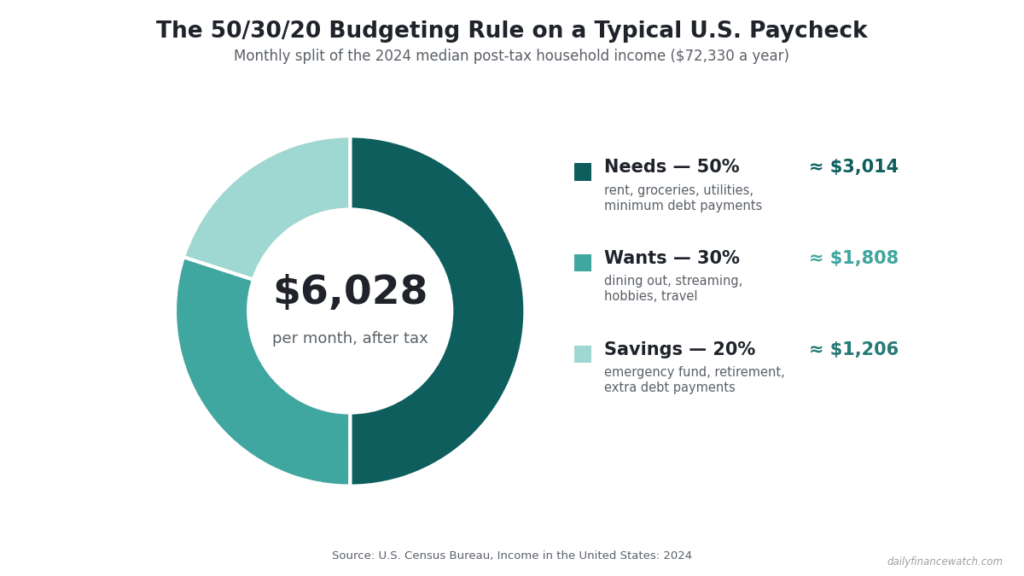
How the 50/30/20 rule splits a typical monthly after-tax income of about $6,028, based on the 2024 median post-tax household income (U.S. Census Bureau, 2024).
Notice what that last number does. “Save 20%” sounds vague, but $1,206 a month is concrete. Over a year, that’s more than $14,000 set aside by a household earning the national median. Your own numbers will differ, but the math stays the same. Find your monthly take-home pay, then multiply by 0.50, 0.30, and 0.20.
Where do people trip up with the 50/30/20 rule?
Two mistakes cause most of the confusion.
Mistake one: using gross income
Gross income is your salary before anything is taken out. Net income is what’s left after taxes. The budgeting rule runs on net income, because that’s the money you can actually spend. Build the split on your gross salary and every bucket will be inflated — and your plan will fail by design.
Mistake two: putting all debt payments in one bucket
Minimum required payments are obligations, so they belong in needs. Any payment above the minimum is a choice that builds your financial position, so it belongs in the 20% bucket. Mixing these up makes progress on debt invisible in your budget.
One more gentle note: spending the 30% is not a failure. The wants bucket exists on purpose. Budgets that allow zero enjoyment are usually abandoned within a few months.
What if your needs are more than 50%?
In many U.S. cities, housing alone can push the needs bucket past half of take-home pay. Add childcare, and the classic split may simply not fit right now. That’s frustrating, and it’s also common — it doesn’t mean you failed the test.
Treat the rule as a diagnostic instead of a verdict. If needs are consuming 65% of your income, you now know that precisely, which is more than most people can say. Some households shift to a 60/30/10 or 70/20/10 split temporarily while working on the big fixed costs. The habit that matters is making the split consciously rather than letting the month decide for you.
Irregular income makes this harder, but the rule still works. If your pay varies from month to month, build the split on the low end of your recent months. Good months then add to savings instead of quietly expanding your wants.
How do you put the budgeting rule to work this week?
You can set this up in under an hour.
- Find your real monthly take-home pay. Check your pay stub or bank deposits, not your offer letter.
- Sort last month’s spending into the three buckets. Your bank and card statements have everything you need. The Consumer Financial Protection Bureau offers free budgeting worksheets and a spending tracker that make this step easier.
- Compare your actual percentages to 50/30/20. Most people find one bucket badly oversized. That bucket is your first project.
- Automate the 20%. Set up an automatic transfer to savings on payday, before spending can happen. Building an emergency fund is a common first goal for this bucket, and automating your savings removes willpower from the equation.
- Recheck monthly. Ten minutes at the end of each month keeps the plan honest.
The bottom line
The 50/30/20 budgeting rule won’t optimize every dollar, and it isn’t meant to. More detailed methods exist, such as zero-based budgeting, where every single dollar gets an assigned job. Those systems offer more control but demand far more tracking. For most beginners, the three-bucket approach is the version that actually sticks.
The rule gives you a clear, memorable structure: cover your needs, enjoy some wants, and pay your future self every single month. Master the three buckets first — the fine-tuning can come later.
This article is for general educational purposes only and is not financial advice. The figures cited are national medians for 2024 and will not match every household’s situation. Budgeting methods that work well for one person may not suit another’s income, expenses, or goals. Before making significant financial decisions, consider consulting a qualified financial professional who can evaluate your individual circumstances.