Last updated: July 5, 2026
You check your bank account on the 28th of the month, and the number is smaller than you expected again. You didn’t buy anything unusual. The money just seemed to leave on its own.
Zero-based budgeting is built to end that mystery. Instead of watching money disappear and guessing where it went, you assign every single dollar a job before the month starts. Income minus every assigned dollar equals zero. That’s not because you spent carelessly — it’s because every dollar, including the ones going to savings, has a destination you chose in advance.
Key Takeaways
- Zero-based budgeting assigns every dollar of your monthly income to a specific category — bills, savings, debt payoff, or spending — until income minus assigned dollars equals zero.
- “Zero” refers to the math, not your bank balance. Savings and debt payments count as assigned dollars, just like rent.
- The average U.S. household spent $78,535 in 2024, or about $6,545 a month (Bureau of Labor Statistics). A zero-based budget means deciding in advance where every one of those dollars goes.
- Unlike the 50/30/20 rule, zero-based budgeting doesn’t use fixed percentages. Every category gets its own dollar amount based on your real life.
- It takes more upfront effort than percentage-based budgets, but it catches “lazy money” — the small, untracked spending that quietly drains an account.
What is zero-based budgeting?
Zero-based budgeting is a method where you plan your spending down to the last dollar before the month begins. You start with your income, then subtract categories one at a time — rent, groceries, debt payments, savings — until nothing is left unassigned.
Think of each dollar as an employee with one job. Rent money’s job is rent. Grocery money’s job is groceries, and savings money’s job is building your emergency fund. When every dollar has a job, none of them can quietly wander off to a coffee shop without you noticing.
The method dates back to corporate and government budgeting in the 1970s, long before it became a popular personal finance tool.
How is zero-based budgeting different from the 50/30/20 rule?
The 50/30/20 rule sorts spending into three big buckets using fixed percentages: needs, wants, and savings. It’s simple, but it doesn’t tell you exactly how much to spend on groceries versus streaming subscriptions within the “wants” bucket.
Zero-based budgeting skips the percentages entirely. You build categories from your actual bills and goals, then assign a real dollar figure to each one. This takes more time to set up, but it gives you precise control that a percentage split can’t.
If you’re just starting out, a percentage-based rule is often easier. If you already know your numbers and want tighter control, zero-based budgeting is the upgrade.
What does zero-based budgeting look like in real dollars?
Percentages and categories are easier to picture with real numbers attached. The Bureau of Labor Statistics tracks exactly what the average American household spends every year through its Consumer Expenditure Survey.
In 2024, average household spending totaled $78,535 a year, or about $6,545 a month. Building a zero-based budget around those national averages might assign roughly $2,186 to housing, $1,113 to transportation, and $847 to food. Insurance and retirement contributions would take about $818, and healthcare about $517. Everything else — entertainment, apparel, personal care, and more — would get the remaining $1,064.
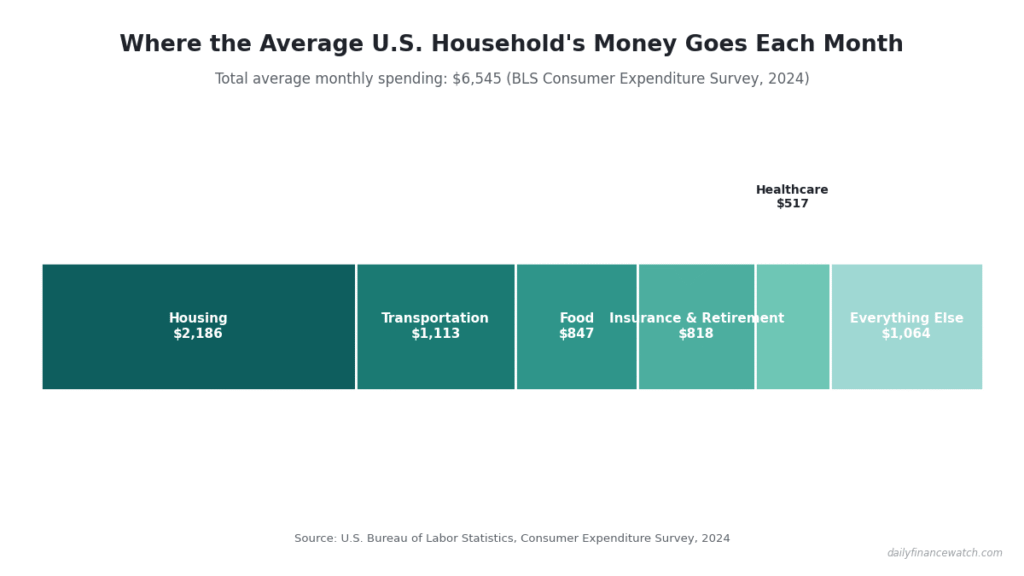
How the average U.S. household’s monthly spending breaks down by category, based on 2024 Consumer Expenditure Survey data (Bureau of Labor Statistics).
Notice that “insurance and retirement” is a category with its own dollar figure here, not an afterthought. That’s the entire point of zero-based budgeting. Retirement savings gets a job the same way rent does, instead of becoming whatever happens to be left over.
Where do people trip up with zero-based budgeting?
Mistake one: forgetting irregular expenses
Car registration, annual subscriptions, and holiday spending don’t show up every month, so they often get left out of the plan. Then they arrive and blow up the budget. The fix is a dedicated category for irregular costs. Fund it with a small amount every month, so the money is already there when the bill shows up.
Mistake two: treating zero as permission to spend everything
Zero-based budgeting means every dollar has a job, and one of those jobs can absolutely be savings or debt payoff. A completed zero-based budget with nothing assigned to your future isn’t a well-built budget — it’s just spending with extra steps.
Is zero-based budgeting right for you?
Zero-based budgeting works best for people with steady income and a genuine willingness to track spending closely. If you’ve tried looser budgets before and money still disappeared without explanation, the detail here is the feature, not the burden.
A budgeting app can lighten the manual work considerably, since most will sort transactions into categories automatically and flag when one runs over. But the app is a tool, not the method itself — you can build a zero-based budget on paper or in a spreadsheet just as effectively if you prefer fewer subscriptions.
It asks more of you upfront than a percentage-based rule. If your income is irregular, build your budget around your lowest recent month. Direct anything extra toward savings or debt, instead of letting it quietly expand your spending categories.
How do you build a zero-based budget this week?
You can set up your first month in under an hour.
- Calculate your real monthly income. Use your actual take-home pay, or your average from the last few months if it varies.
- List every expense category you actually have. Include fixed bills, variable spending like groceries, and irregular costs divided into monthly chunks.
- Assign a dollar amount to each category until income minus categories equals zero. The Consumer Financial Protection Bureau offers free budgeting worksheets and a spending tracker that make this step easier.
- Include savings and debt payoff as categories, not leftovers. Give them a dollar figure before you finalize anything else.
- Track spending against your categories all month, and move money between categories — never invent it — if one runs short.
- Rebuild the budget every month. Zero-based budgeting starts fresh each cycle instead of carrying last month’s plan forward.
The bottom line
Zero-based budgeting takes more work than a percentage-based rule, and it isn’t the right fit for everyone. But for anyone who wants to know exactly where every dollar is going, giving each one a job helps. Vague money anxiety turns into a plan you can actually see.
Start with one month. If assigning every dollar a job feels like too much, a simpler method like the 50/30/20 rule is a reasonable place to begin instead. The goal is a budget you’ll actually keep using, not the most detailed one on paper.
This article is for general educational purposes only and is not financial advice. The figures cited are national averages for 2024 and will not match every household’s situation. Budgeting methods that work well for one person may not suit another’s income, expenses, or goals. Before making significant financial decisions, consider consulting a qualified financial professional who can evaluate your individual circumstances.