Last updated: July 5, 2026
You open your banking app, look at the balance, and have no idea why it’s lower than you expected. You know money came in. You’re just not sure where it went. That gap between “money in” and “money out” is exactly what a budget closes.
Key Takeaways
- A budget is simply a written plan for your take-home pay, not a punishment for spending money.
- Start with your real take-home pay, then list every expense you already have before changing anything.
- The 2024 Consumer Expenditure Survey shows the typical U.S. household spends about $6,545 a month, with housing alone taking up a third of that.
- Pick one budgeting method — 50/30/20, zero-based, or envelope — and try it for one full month before judging it.
- Your first budget will not be perfect, and it doesn’t need to be. It only needs to be honest.
What a Budget Actually Is (and Why the First One Feels Hard)
A budget is a plan for your income before you spend it, not a record of spending after the fact. It feels hard the first time because you’re doing two things at once: learning your own numbers and learning a new habit.
Most guides skip the part where your first month probably won’t balance. That’s normal, and it doesn’t mean you did it wrong.
Step 1: Find Your Real Take-Home Pay
Take-home pay is the money that actually lands in your account after taxes, health insurance, and retirement contributions come out. It’s different from your salary, which is your pay before any of that.
Build your budget around take-home pay, not salary. Using your full salary makes your budget look roomier than your bank account really is.
If your pay changes month to month, use your lowest recent month as your planning number. You can always adjust upward later if a bigger paycheck arrives.
Step 2: List Every Expense You Already Have
Before you change anything, write down what you’re already spending. Pull up your last one to two months of bank and card statements and sort each expense into a category.
Fixed expenses
Fixed expenses stay the same each month. Rent or mortgage, insurance premiums, and loan payments are common examples. These are usually the easiest to list because the amount rarely moves.
Variable expenses
Variable expenses change from month to month. Groceries, gas, and dining out fall into this group. Estimate these using your recent statements, and round up slightly if you’re unsure.
Step 3: Choose a Budgeting Method That Fits You
There’s no single “correct” budgeting method. The right one is whichever you’ll actually keep using next month.
The 50/30/20 rule
The 50/30/20 rule splits your take-home pay into three buckets: 50% for needs, 30% for wants, and 20% for savings or debt payoff. It’s a good starting point if you want structure without tracking every category by hand.
Example: Turning $4,000 into a working budget
Say your take-home pay is $4,000 a month. Under the 50/30/20 split, that’s $2,000 for needs like rent, groceries, and utilities. Another $1,200 goes to wants, such as dining out and streaming subscriptions. The remaining $800 goes to savings or extra debt payments. You can adjust these percentages if your rent alone runs higher than 50% of your income — the split is a starting guide, not a hard rule.
Zero-based budgeting
Zero-based budgeting gives every dollar a job until your income minus your planned spending equals zero. It takes more setup than 50/30/20, but it catches small leaks that percentage-based budgets can miss.
The envelope method
The envelope method puts a set amount of cash (or a digital equivalent) into a labeled category for spending. Once that category’s envelope is empty, spending in it stops for the month. It works well if you tend to overspend on flexible categories like dining out.
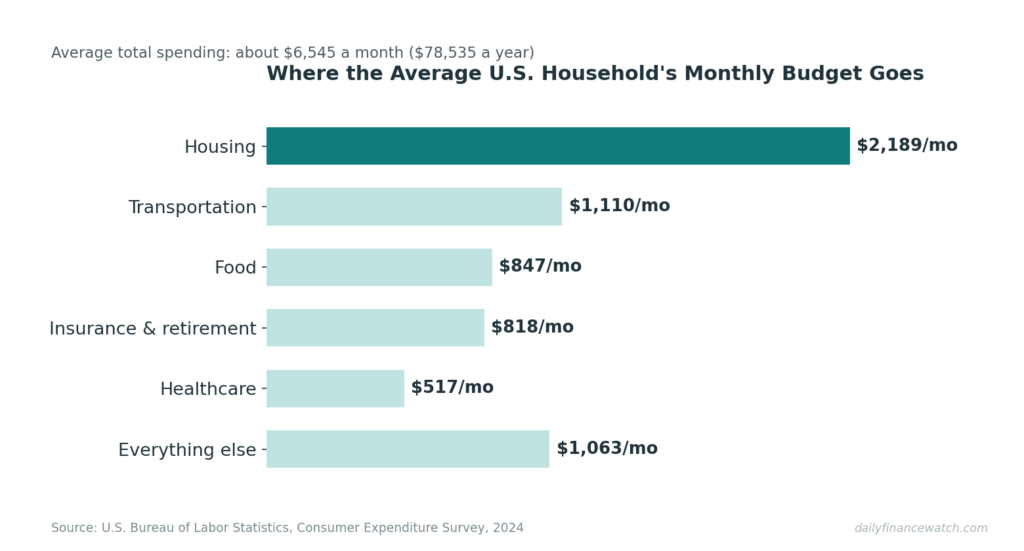
Average U.S. household spending broke down to about $6,545 a month in 2024, according to the Bureau of Labor Statistics.
Where the Average Household’s Money Actually Goes
Real numbers can make budgeting feel less abstract. In 2024, the average U.S. household spent about $78,535 for the year, or roughly $6,545 a month, according to the Bureau of Labor Statistics’ Consumer Expenditure Survey. Housing alone made up 33.4% of that total, or about $2,189 a month. Transportation came in at 17.0%, or roughly $1,110 a month.
Seeing how much of the average budget goes to just two categories explains why housing and transportation costs are usually the first place to check when your own numbers don’t balance.
Where People Trip Up When They Build Their First Budget
The most common mistake is budgeting from salary instead of take-home pay, which makes the whole plan too optimistic from day one. A close second is forgetting expenses that don’t happen every month, such as car repairs or annual subscriptions, which then show up as “surprise” costs later.
A 2025 Federal Reserve survey found that 51% of adults spent less than their income in the month surveyed, up from 48% the year before. That means nearly half of adults were still spending at or above their income, which is exactly the gap a first budget is meant to catch.
How to Stick With Your Budget After Week One
Pick one day each week to compare your plan against what actually happened. This short review catches problems while you can still adjust, instead of finding out at the end of the month. The FTC’s consumer finance guide recommends this same weekly check-in for anyone building their first budget.
Expect your first month to be off in a few categories. Adjust the numbers next month instead of abandoning the whole plan. A budget is a living document, not a one-time task.
The Bottom Line
Your first budget doesn’t need to be perfect, and it won’t be. It needs to be honest about what you actually earn and spend, so you can see where your money goes and make small changes on purpose instead of by accident.
This article is for financial education only. It doesn’t account for your personal income, debts, or goals, and it isn’t personalized financial advice. If you want help building a plan for your specific situation, a nonprofit credit counselor or a fee-only financial planner can look at your numbers directly.