Last updated: July 5, 2026
You get paid, pay the bills, and tell yourself you’ll be careful with the rest. Three weeks later the checking account is thin again, and you can’t point to any one purchase that caused it. It was just a lot of small swipes that added up.
The envelope budgeting method catches that kind of leak before it happens.
Key Takeaways
- Envelope budgeting means dividing your money into labeled categories — traditionally cash in physical envelopes — and only spending what’s in each one.
- Once an envelope is empty, spending in that category stops until the next pay period. That way, one category can’t quietly drain another.
- Paying with cash tends to make people spend less than paying with a card. Handing over physical money registers more like a real loss.
- The average U.S. household spent $519 a month on groceries and $329 a month on dining out in 2024 (BLS). That’s a realistic starting point for your own envelope amounts.
- Digital versions of the same idea, like apps or dedicated sub-accounts, work well if you don’t want to carry cash.
What Is the Envelope Budgeting Method?
Envelope budgeting is a way to manage money. You split your income into separate categories — groceries, gas, entertainment, and more. Then you put the exact amount for each category into its own envelope.
When you buy groceries, you pay from the groceries envelope. When it’s empty, you stop buying groceries for the month. Or you move money over from a category that still has cash left.
The method closely relates to zero-based budgeting. Zero-based budgeting assigns every dollar of income a job until none of it goes unaccounted for. Envelope budgeting applies that same idea using physical cash instead of a spreadsheet.
Why Does Paying With Cash Change How You Spend?
There’s a well-documented reason envelopes work better for a lot of people than a mental budget alone. Handing over physical cash creates a small, immediate sense of loss that a card swipe or a tap doesn’t. Researchers call this the “pain of paying.”
A card separates the moment you spend from the moment you feel the cost. That gap makes it easier to spend more without noticing.
Cash forces you to notice. You can see exactly how many bills remain in the envelope. Once it’s empty, there’s no invisible reserve to dip into.
The Consumer Financial Protection Bureau says tracking spending in real time is one of the most effective ways to stick to a budget. An envelope does that automatically.
How Do You Set Up an Envelope Budget?
- Total your monthly take-home pay. Use the amount that actually lands in your bank account, after taxes.
- List your variable spending categories. These are categories that change month to month. You control them day to day — groceries, dining out, gas, entertainment, personal spending. Fixed bills like rent usually stay on autopay instead of going into an envelope.
- Set a dollar amount for each envelope. Base it on your last two or three months of actual spending.
- Withdraw cash and fill each envelope at the start of the month or each payday.
- Spend only from the matching envelope. When one runs dry, either stop spending in that category or transfer cash from an envelope that still has room.
- Reset at the start of the next period.
Most people do fine starting with five to eight envelopes. Too few, and you lose the detail that makes the method work. Too many, and refilling them every month becomes its own chore.
Example: Groceries and Dining Out Envelopes
Here’s a real benchmark. In 2024, the average U.S. household spent about $519 a month on groceries. It spent about $329 a month on dining out, according to the Bureau of Labor Statistics Consumer Expenditure Survey.
Together, that’s about $848 a month. Food alone makes up roughly 12.9% of the average household’s total spending.
If your own habits land near those numbers, they’re a reasonable starting point. Adjust the amounts once you check your actual receipts.
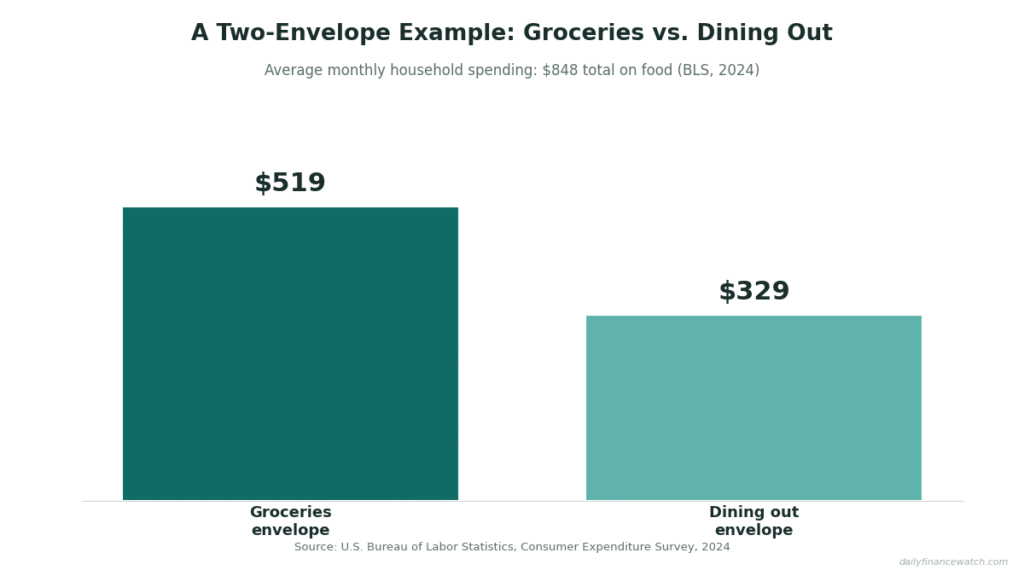
Average U.S. households spent $519 a month on groceries and $329 a month on dining out in 2024 — a real starting point for your own envelope amounts (BLS, 2024).
Cash Envelopes or Digital Envelopes?
The core idea doesn’t require actual paper: assign money to a category, stop spending once it’s gone.
The Cash-Only Method
This is the traditional version: real bills in real envelopes. It gives you the strongest version of the “pain of paying” effect, since you’re physically watching money disappear.
The tradeoffs are practical, though. A card protects you if it’s lost or stolen, but cash doesn’t. Most online shopping doesn’t accept cash at all. And frequent ATM trips add friction of their own.
Digital Envelope Apps
Budgeting apps and some banks’ sub-account features let you assign money to virtual categories. You see a running balance for each one, without carrying physical cash.
You get the visibility and the stop-spending trigger without the security downsides of cash. The tradeoff runs the other way, though. A card swipe doesn’t feel as costly in the moment as handing over bills, which makes the psychological brake weaker for some people.
Neither version is objectively better. It depends on what you respond to more: the physical cash cue, or the safety of an insured, card-protected account.
Where Do People Trip Up With Envelope Budgeting?
Mistake One: Setting Envelope Amounts From Hope Instead of History
Guessing a low number for dining out doesn’t change how much you actually spend. It just means you run out of cash by week two. Then you either stop cold or reach for a card anyway — which defeats the whole system.
Base each envelope on a few real months of past spending, then adjust gradually.
Mistake Two: Forgetting Irregular Expenses Entirely
Car repairs, gifts, and annual subscriptions don’t show up every month. People often leave them out of the envelope system entirely. Then they hit as a surprise.
Set aside a small “miscellaneous” envelope for exactly these irregular costs. It keeps one bad month from blowing up the whole budget.
Some people find a strict system easier to follow than a loose mental plan. For them, envelope budgeting can feel almost like a game. It’s like giving yourself a preloaded gift card for groceries or entertainment each month, instead of an open-ended account. Once it’s gone, it’s gone — and that’s exactly the point.
The Bottom Line
Envelope budgeting won’t fix every money problem. It also takes more manual upkeep than letting a paycheck flow straight into one account.
But for anyone whose spending disappears into small, hard-to-trace purchases, this method helps. Giving each category its own hard limit — cash or digital — creates a stop sign. A mental budget alone usually can’t do that.
This article is for general educational purposes only and is not personalized financial advice. Your own budget categories and amounts should reflect your actual income, expenses, and financial goals, not the averages cited here.