Last updated: July 7, 2026
Picture two credit cards and a personal loan sitting in a drawer. Each one has its own bill and its own interest rate. You’ve found an extra $150 a month to put toward debt. Now you just need to decide which balance to attack first. You’re also wondering whether the debt snowball method is the right place to start.
Two popular strategies answer that question in opposite ways: the debt snowball and the debt avalanche. This guide explains how each method works. It runs the real math on a sample payoff. Then it helps you match the method to your situation.
Key Takeaways
- The debt snowball method pays off your smallest balance first, then rolls that payment into your next-smallest debt.
- The debt avalanche method pays off your highest-interest-rate balance first, which usually costs less overall.
- In a sample $6,800 payoff across three debts, the avalanche method saved about $123 in interest. It finished in the same 29 months as the snowball.
- Both methods require you to keep paying the minimum on every other debt. You send extra cash to just one target at a time.
- The better fit for you depends on one thing: do you need quick wins to stay motivated, or are you optimizing purely for cost?
What are the debt snowball and debt avalanche methods?
The Consumer Financial Protection Bureau’s debt-reduction worksheet describes this same basic framework. It uses two names: the “highest interest rate method,” commonly called the avalanche method, and the “snowball method.” Start by listing every debt you owe. Keep paying at least the minimum on each one. Send any extra money toward one target debt until it’s gone. Once that debt disappears, its old minimum payment rolls into the next target. The two methods only disagree about which debt goes first.
The debt snowball method
The snowball method orders your debts from smallest balance to largest, no matter what interest rate each one charges. You pay off the smallest debt first, then move to the next-smallest, and so on. Each payoff feels like a real win, and that momentum is the whole point. People who use this method are betting on something specific. Visible progress keeps them going better than a perfectly optimized spreadsheet.
The debt avalanche method
The avalanche method orders your debts by interest rate instead, from highest annual percentage rate (APR) to lowest. APR is the yearly cost of carrying a balance, including interest. You send extra money to the priciest debt first. That balance drains the most money every month it sticks around.
The rate gap can be bigger than people expect. As of the first quarter of 2026, the average APR on credit card accounts carrying a balance was 21.52%. That’s according to the Federal Reserve’s G.19 Consumer Credit report. On a $4,500 balance, that rate alone adds up to about $968 a year in interest. That’s before a single dollar goes toward what you actually owe.
Debt snowball vs. debt avalanche: which saves more money?
Here’s the part a spreadsheet can’t measure: how you feel about the plan. A method you actually finish beats a “better” method you abandon in month four. Still, the dollar difference between the two methods is worth a look, and it’s usually smaller than people assume.
| Debt Snowball | Debt Avalanche | |
|---|---|---|
| What it prioritizes | Smallest balance first | Highest interest rate first |
| Extra payment goes to | The smallest balance, regardless of rate | The costliest balance, regardless of size |
| Sample $6,800 payoff — total interest | About $2,062 | About $1,939 |
| Sample $6,800 payoff — time to debt-free | 29 months | 29 months |
| Best fit for | People who need quick wins to stay motivated | People focused purely on minimizing cost |
Worked example: paying off $6,800 across three debts
Say you owe:
- $500 on a personal loan at 7% APR
- $1,800 on a store credit card at 29.99% APR
- $4,500 on a general credit card at 21.52% APR, the national average rate for balances that carry interest
You have $150 a month beyond your minimum payments to put toward one target debt.
Under the snowball method, you’d pay off the personal loan first, then the store card, then the credit card. Under the avalanche method, you’d pay off the store card first, then the credit card, then the personal loan.
Both paths take 29 months to reach zero. The snowball costs about $2,062 in total interest along the way. The avalanche costs about $1,939, a savings of roughly $123 for the exact same monthly payment.
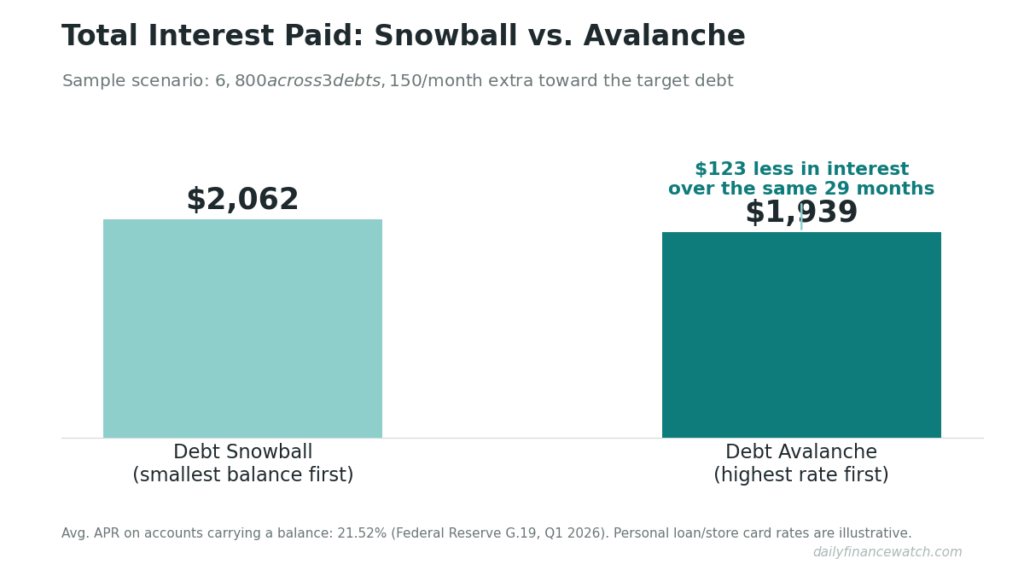
The avalanche method saves about $123 in interest on the same $6,800 payoff. Both plans finish in 29 months. (Sample scenario; average card APR from the Federal Reserve’s G.19 report, Q1 2026.)
Where people trip up with debt payoff methods
Mistake one: assuming the “wrong” method wastes a fortune
The gap between snowball and avalanche is usually small. Think tens or low hundreds of dollars, not thousands. That’s especially true when your balances and rates sit close together, like in the example above. The gap grows large in two cases. One: a single balance carries a much higher rate than the others. Two: the extra payment is small and the payoff stretches over many years.
Mistake two: skipping minimum payments on other debts
Both methods only change where your extra money goes. Every other debt still needs at least its minimum payment every single month. Skip one, and you risk late fees and a ding to your credit score. Some issuers even charge a penalty APR that erases whatever you were trying to save.
How to choose the right method for you
Choose the snowball if
You’ve stalled out on debt payoff before and need visible progress to stay motivated. Your smallest balances also carry meaningfully high rates, so going small first costs you little. You want the simplest possible rule to follow: smallest balance, every time.
Choose the avalanche if
You’re confident you’ll stick with the plan even without an early win. One of your debts carries a rate well above the rest. Paying it down first meaningfully cuts your total interest. Minimizing total cost matters more to you than a quick psychological win.
Getting started today
List every debt you owe, including the balance, the APR, and the minimum payment. Add up how much extra you can put toward debt each month, beyond the minimums. Pick your order: smallest balance first for the snowball, or highest rate first for the avalanche. Set up automatic minimum payments on every debt, so a missed due date never derails your plan. The moment one debt hits zero, redirect its old payment straight to the next one on your list.
The bottom line
Both methods get you to the same place: zero debt. The debt snowball method pays off your smallest balance first and banks on momentum to keep you going. The debt avalanche method pays off your highest-rate balance first and banks on math to save you money. Neither one is wrong, and you can switch between them at any point without penalty. Pick the one you’ll actually finish, run the real numbers on your own debts, and get to zero.
This article is for educational purposes only and isn’t personalized financial advice. Your results will vary based on your actual balances, interest rates, and payment amounts. A financial advisor or credit counselor can help you apply these methods to your specific situation.