Last updated: July 7, 2026
You open your credit card statement and see two numbers. One is the balance you owe. The other is a minimum payment that barely makes a dent. You’ve decided it’s time to start real debt payoff, not just manage the balance every month.
This guide covers the full toolkit for credit card debt payoff. It explains what minimum payments really cost you and how much extra to pay. It also covers common traps to avoid and other tools worth knowing about.
Key Takeaways
- Minimum payments are built to stretch out slowly. On a $5,000 balance at today’s average card rate, paying only the minimum takes about 16 years. That path costs about $7,371 in interest.
- Adding a fixed extra amount changes everything. The same balance paid at $175 a month is gone in about 3.5 years and costs about $2,072 in interest.
- Card issuers must show you this math. Federal law requires a “minimum payment warning” on every statement.
- Tools like balance transfers, consolidation loans, and nonprofit credit counseling can help, but none of them erase debt by themselves.
- The habit that matters most is simple: pay more than the minimum every month, and stop adding new charges.
Why minimum payments alone barely move the balance
Your minimum payment is usually a small slice of your balance plus that month’s interest. If that number is too low, a flat floor amount kicks in instead. Early on, most of that payment covers interest. Only a small piece chips away at what you actually owe.
What the law requires your statement to show
Federal regulations spell out exactly what your card issuer has to tell you. Every statement must carry a “minimum payment warning.” It must also show the months and total cost of paying the minimum only. And it must show the fixed payment needed to clear the balance in three years. A phone number for credit counseling information is required, too. Congress added this rule because so many people had no idea how long minimum-only payments would actually take.
How much extra speeds up debt payoff?
There’s no single right number. It depends on your budget and how fast you want to be done. What matters is picking a fixed amount above the minimum and sticking with it every month.
This guide focuses on a single balance. If you’re juggling more than one credit card or loan, the order you pay them off in matters for your overall debt payoff too. Our guide to the debt snowball and debt avalanche methods walks through how to pick.
Worked example: $5,000 at the average card rate
Say you have a $5,000 balance at 21.52% APR. That’s the average rate on credit card accounts carrying a balance, according to the Federal Reserve’s G.19 Consumer Credit report. Two paths from here look very different.
Pay only the minimum, and it takes about 194 months, or roughly 16 years, to reach zero. Total interest along the way comes to about $7,371, nearly one and a half times the original balance.
Pay a fixed $175 a month instead. The same balance is gone in about 41 months, a little under 3.5 years. Total interest drops to about $2,072.
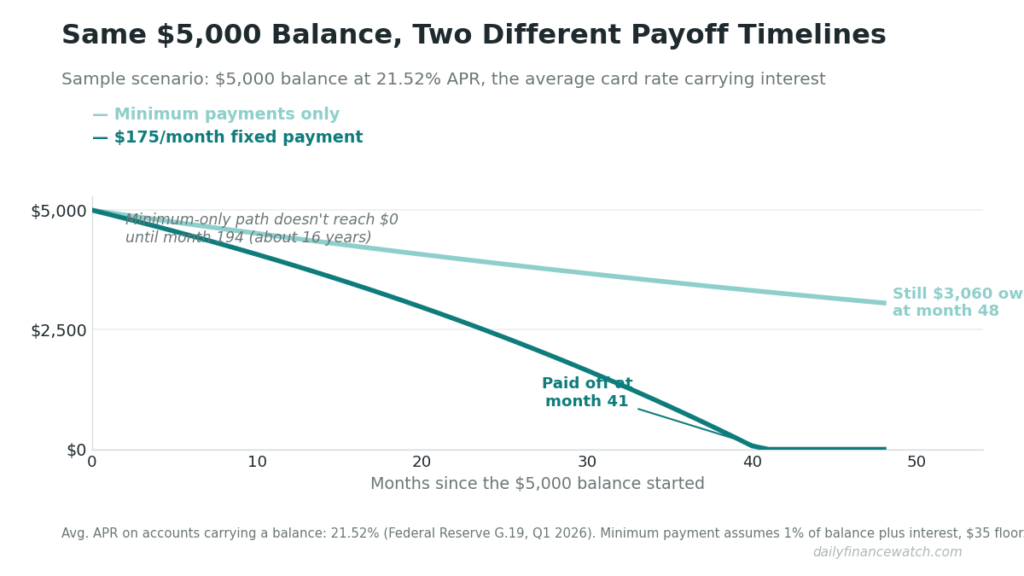
Paying only the minimum on a $5,000 balance still leaves about $3,060 owed after 4 years. A fixed $175 a month clears it in about 41 months (sample scenario; average card APR from the Federal Reserve’s G.19 report, Q1 2026).
Where people trip up paying off credit card debt
Mistake one: using the card while paying it down
New charges undo your progress before it happens. Say you’re putting $175 extra toward the balance. If you also add $100 in new charges that month, you’re really only making $75 of progress. Consider setting the card aside, physically or digitally, until it’s paid off.
Mistake two: closing the card the moment it hits zero
Closing a paid-off card can raise your credit utilization ratio. It can also shorten your average account age. Both effects can lower your credit score. It’s often better to keep the account open, especially if it has no annual fee, and simply stop using it.
Other tools worth knowing about
A few options can work alongside your payoff plan, though none replace it. A balance transfer card can move your balance to a lower promotional rate for a limited time. Most of these offers charge an upfront fee, often 3% to 5% of the amount moved. It’s worth running the math before assuming a transfer saves money. A debt consolidation loan combines several balances into one fixed payment, often at a lower rate than a credit card. Nonprofit credit counseling organizations can build you a debt management plan. They’ll often negotiate a lower rate with your creditors on your behalf. A counselor can help you compare options before you commit to one.
Getting started on your debt payoff plan
Find your exact APR and current balance on your latest statement to kick off your debt payoff plan. Decide on a fixed extra payment you can sustain every month, not just this month. Set up automatic payments so the amount goes out before you’re tempted to spend it elsewhere. Put the card away while your balance is above zero. Check your statement’s minimum payment warning box each month to track your progress.
Frequently Asked Questions
A few quick answers to common questions about paying down credit card debt.
How long does debt payoff take on $5,000 in credit card debt with minimum payments?
At the average card rate, debt payoff can take around 16 years with minimum payments alone. It can also cost thousands more in interest than the original balance. That’s because minimum payments are designed mainly to cover interest early on.
Does paying more than the minimum hurt my credit score?
No. Paying more than the minimum lowers your balance faster. That typically helps your credit utilization ratio and can improve your score over time.
Should I close a credit card once I pay it off?
Not necessarily. Closing a paid-off card can raise your utilization ratio. It can also shorten your average account age. Both effects can work against your credit score, especially if the card has no annual fee.
Is a balance transfer or a debt consolidation loan a better option?
It depends on the fees and rate you qualify for. Balance transfers usually charge an upfront fee and offer a temporary low rate. Consolidation loans offer a fixed rate over a set term instead. Run the numbers on both before you choose.
The bottom line
Minimum payments are designed to keep an account current, not to speed up debt payoff. A fixed extra payment, even a modest one, changes the entire timeline and cost. Pick an amount you can stick with every month. Avoid new charges while you pay it down. Use tools like balance transfers or credit counseling to support that plan, not replace it.
This article is for general educational purposes only and is not personalized financial advice. Your own budget categories and amounts should reflect your actual income, expenses, and financial goals, not the averages cited here.