Last updated: July 8, 2026
Marcus hasn’t missed a payment in eight years, yet his FICO Score sits at 690, lower than he expected. Payment history is only one of five FICO factors behind that score. The other four have been working against him the whole time.
A FICO Score never comes down to a single habit. The Consumer Financial Protection Bureau defines a credit score as a prediction of how likely you are to repay a loan on time.
That prediction comes from signals like payment history, debt levels, and account age. FICO turns those same signals into five weighted factors that each reward or penalize a different pattern. Those patterns include paying on time, carrying too much debt, letting accounts age, opening new credit too fast, and mixing account types. Knowing the weight behind each factor shows you exactly where your own score is leaking points.
Key Takeaways
- Payment history carries 35% of a FICO Score, and amounts owed carries another 30% — together, nearly two-thirds of the total (myFICO).
- Length of credit history counts for 15%, while new credit and credit mix each account for 10%.
- A hard inquiry stays on a credit report two years, but a FICO Score counts it for only 12 months (myFICO).
- Income, employer, and marital status never appear in a FICO Score, no matter how high or stable they are (myFICO).
- Closing your oldest card can hurt two factors at once: amounts owed and length of credit history.
The 5 FICO factors, ranked by weight
FICO publishes the exact weight behind each factor, and the gap between them is bigger than most people expect. The top two factors alone decide nearly two-thirds of the score.
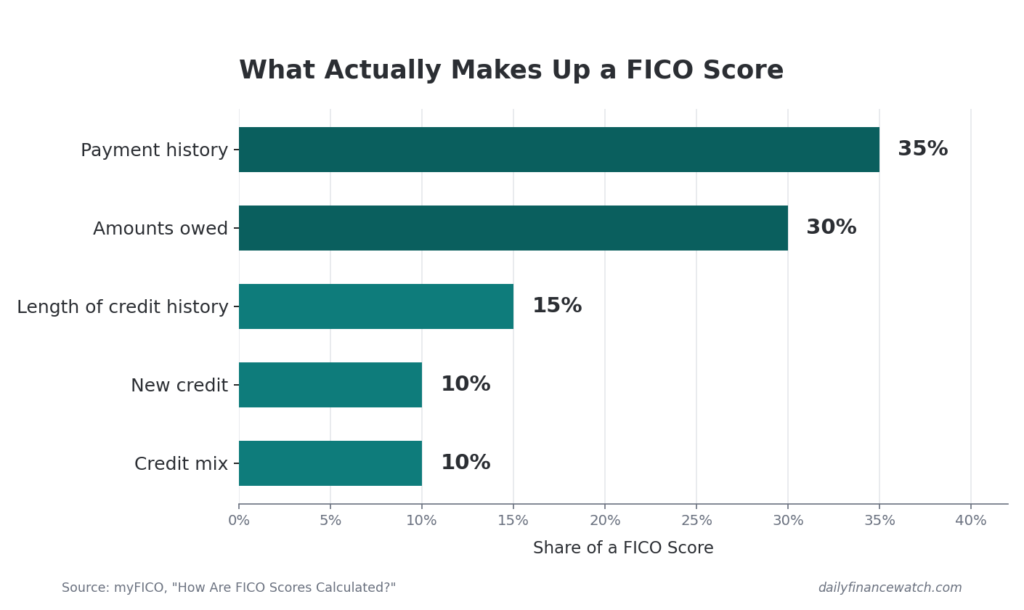
Payment history and amounts owed drive 65% of a FICO Score between them; the remaining three factors split the rest (myFICO).
Payment history: 35%
Payment history asks one question: did you pay on time? That single question outweighs every other factor, with amounts owed still a distant second. A payment 30 days late can stay on a credit report for up to seven years, even after the balance gets caught up.
Recent activity still carries more weight than something from years back. Consistent on-time payments starting today gradually build a stronger track record, even alongside an old late payment still on file.
Amounts owed: 30%
Amounts owed measures how much of your available credit you’re actually using, not just your raw balance. A card sitting near its limit signals risk to a lender, even if you pay it off in full every month before the statement closes.
This factor goes beyond a simple balance-to-limit ratio. It weighs multiple accounts, loan types, and how many carry a balance at once — math dense enough to deserve its own separate breakdown. The short version: keep balances well below each limit to protect this factor.
Length of credit history: 15%
Length of credit history looks at three timestamps. That includes your oldest account’s age, your newest account’s age, and the average age across everything you hold.
This is the factor most people damage by accident. Closing your oldest card doesn’t just remove an account — it can shorten your average account age the moment that account stops reporting.
New credit: 10%
New credit tracks how many accounts you’ve opened recently, along with how many hard inquiries show up on your file. myFICO notes that a hard inquiry lingers on a credit report for up to two years. It only affects the score during the first 12 months, though.
Opening several accounts in a short window reads as risk, even when each application gets approved. Spacing out new applications keeps this factor from dragging down the rest of the score.
Credit mix: 10%
Credit mix rewards variety: revolving accounts like credit cards, and installment accounts like an auto loan, student loan, or mortgage. FICO considers whether you can manage both types responsibly, not just one.
This is the smallest factor on the list, and rightly so. A mortgage taken out specifically to improve credit mix would cost far more in interest than it’s worth. The handful of points it might add rarely justifies that expense.
Where people trip up with FICO factors
Mistake one: assuming income affects your score
Income feels like it should matter, but a FICO Score never sees it. myFICO explicitly excludes salary, occupation, employer, and marital status from the calculation, along with age, race, and where you live.
A high earner with maxed-out cards can carry a lower score than someone earning far less who pays on time and keeps balances low. Lenders often check income separately, through pay stubs or tax returns, because a credit score can’t tell them that part of the story.
Mistake two: closing a card without checking the fallout
Closing an old, unused card feels tidy, but it can hit two factors at once. Amounts owed can rise immediately if the closed card carried a chunk of your available credit. Length of credit history can shorten too, once that account stops reporting.
Keep old accounts open when there’s no annual fee working against you, even ones you rarely use. A small, occasional charge keeps the account active without changing your spending habits.
Which FICO factor should you focus on first?
Payment history and amounts owed combine for 65% of a FICO Score, more than the other three factors put together. Someone still building a credit history from scratch should start there too, since payment history is the first thing on file. Anyone chasing a higher score gets the most out of fixing those two factors first. Pay every bill on time, and keep balances well below each limit.
Length of credit history, new credit, and credit mix improve mostly through patience. Time takes care of average account age on its own. There’s rarely a reason to force a new account or loan type just to nudge those smaller factors.
Frequently Asked Questions
Which FICO factor matters most?
Payment history matters most, at 35% of a FICO Score. Amounts owed follows closely behind at 30%, so the two together account for nearly two-thirds of the total.
Does income affect your FICO score?
No. A FICO Score never factors in income, salary, employer, or job title. Lenders often check income through a separate application step, not through the score itself.
How long do hard inquiries affect a FICO score?
A hard inquiry stays on a credit report for up to two years. It only affects a FICO Score for the first 12 months, though.
Can closing a credit card hurt your score?
Yes, closing a card can hurt two FICO factors at once. It can raise your amounts-owed ratio if that card carried available credit, and it can shorten your average account age over time.
The bottom line
A FICO Score isn’t one measurement; it’s five, stacked with different weights. Payment history and amounts owed do most of the heavy lifting, while length of credit history, new credit, and credit mix round out the rest.
Once you know which factor carries the most weight, the fixes get simpler. Pay on time, keep balances low, and let the smaller factors take care of themselves over time.
This article is for general educational purposes only and is not personalized financial advice. Your own budget categories and amounts should reflect your actual income, expenses, and financial goals, not the averages cited here.