Last updated: July 4, 2026
Selling a losing investment to reduce your tax bill sounds like it makes the loss disappear. Actually, in most cases, it does not. It usually just moves the tax liability into the future.
What Tax-Loss Harvesting Actually Does
Tax-loss harvesting means selling an investment at a loss to offset capital gains realized elsewhere in your portfolio. According to IRS Topic 409, losses from capital asset sales are first netted against capital gains before any other treatment applies. If your losses exceed your gains, you can deduct up to $3,000 of the excess against ordinary income each year.
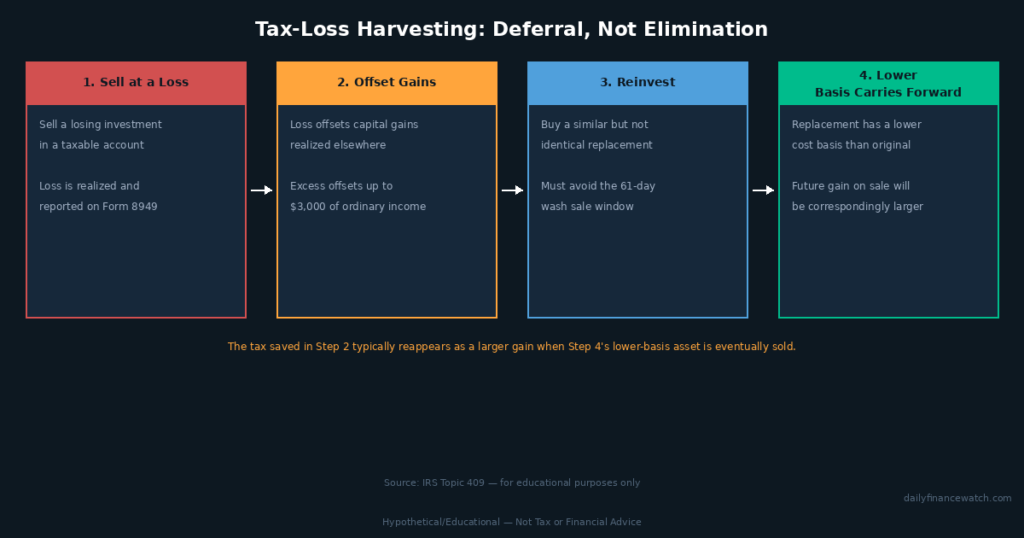
A diagram showing the four-step tax-loss harvesting mechanism: sell at a loss, offset gains, reinvest in a similar asset, and carry the lower cost basis forward.
You can review the full rule directly at irs.gov. Any loss beyond that annual $3,000 limit does not disappear. Instead, it carries forward indefinitely to future tax years, where the same $3,000 annual cap applies again.
Why This Is Deferral, Not Elimination
Here is the thesis of this article. When you harvest a loss, you typically reinvest the proceeds into a similar but not identical investment to stay in the market. That replacement investment carries a cost basis equal to what you paid for it, which is lower than the original investment’s basis before the loss. Consequently, when you eventually sell the replacement, your taxable gain will be larger than it otherwise would have been. The tax you avoided today gets added back later, assuming the replacement investment recovers in value.
This does not mean harvesting has no value. Deferring a tax bill has real financial worth, since money not paid to the IRS today can keep growing in your portfolio. However, framing tax-loss harvesting as making a tax bill vanish overstates what actually happens for most investors.
The Wash Sale Rule Constraint
The IRS wash sale rule disallows a harvested loss if you buy the same or a “substantially identical” security within 30 days before or after the sale. This 61-day window forces investors to choose a genuinely different replacement, not simply the same holding under a different ticker. Our guide on the wash sale rule covers this constraint in detail, including a real regulatory example from the IRS.
The Experience Anchor: A Limit Frozen Since 1978
The $3,000 ordinary-income offset limit did not always sit at that figure. Under prior law, the offset was capped at $1,000. The Tax Reform Act of 1976 (P.L. 94-455) raised that cap to $2,000 for 1977, then to $3,000 for tax years beginning after 1977. Congress has not adjusted this figure since. A Congressional Research Service report updated September 30, 2022, calculated that adjusting the $3,000 limit for inflation since 1978 would bring it to approximately $13,000 in 2022 dollars.
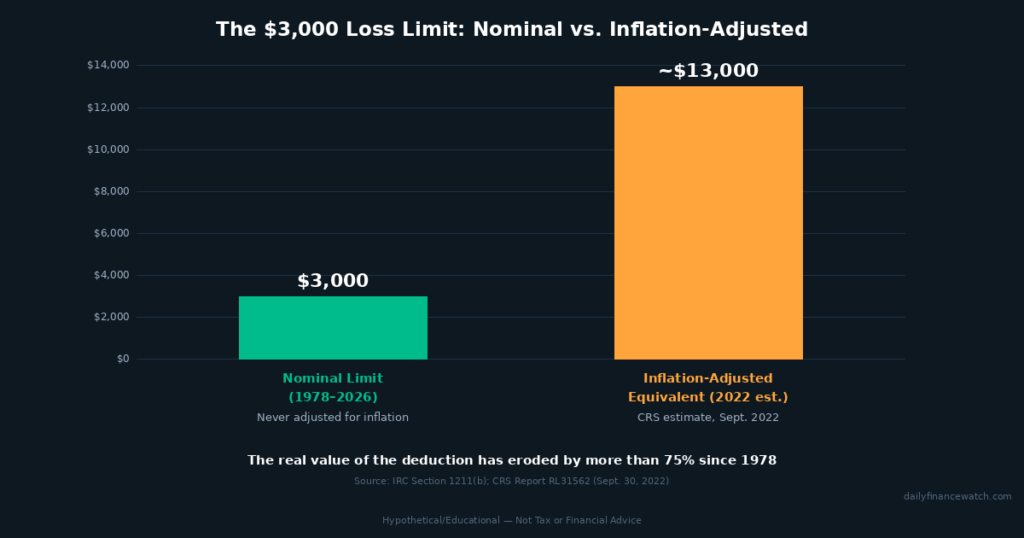
A chart comparing the $3,000 ordinary-income offset limit’s nominal value since 1978 against its inflation-adjusted equivalent.
You can review the full CRS analysis at everycrsreport.com. This means the real value of the annual offset has shrunk substantially over 48 years, even though the nominal dollar figure has not changed. An investor deducting $3,000 today receives meaningfully less relief, in real purchasing power, than an investor deducting the same $3,000 figure in 1978.
Why the Limit Matters More for Large Losses
Consider an investor with a $20,000 net capital loss and no offsetting gains. At the current $3,000 annual limit, fully using that loss against ordinary income would take roughly seven years. If the limit tracked inflation and stood closer to $13,000, the same loss could be absorbed in under two years. This gap directly affects how quickly investors regain the value of a tax deduction, particularly during years with significant portfolio losses.
Retirement Accounts Are Not Eligible
Tax-loss harvesting only applies to taxable brokerage accounts. Losses realized inside a traditional IRA, Roth IRA, or 401(k) do not generate a deductible capital loss, since these accounts already receive different tax treatment. Our guide on traditional IRA vs Roth IRA explains how those accounts handle gains and losses differently from a standard brokerage account.
When Deferral Becomes Permanent
There is one scenario where tax-loss harvesting’s deferral can effectively become permanent: holding the replacement investment until death. Under current law, many inherited assets receive a step-up in cost basis to fair market value at the date of death, which can eliminate the deferred gain entirely for heirs. This interaction between harvesting and estate planning is a more advanced strategy that depends heavily on individual circumstances.
The Anti-Advice Reminder
Tax-loss harvesting can improve after-tax returns over time, but it is not a guaranteed win in every situation. Trading costs, the risk of missing a market rebound during the wash sale window, and the eventual higher-basis gain all factor into whether harvesting makes sense for a specific portfolio. The strategy tends to matter most for investors in higher tax brackets with meaningful realized gains to offset. Before harvesting losses as a year-end strategy, reviewing your full tax situation with a qualified tax professional helps confirm the approach fits your circumstances.
Selling at a loss to reduce this year’s tax bill often just relocates that tax bill to a future year, carried by a lower cost basis in whatever you buy next. Understanding that distinction changes how much credit tax-loss harvesting deserves as a wealth-building strategy, versus a timing tool that works best alongside a clear long-term plan.
This article is for educational purposes only and does not constitute tax or financial advice. Tax-loss harvesting rules and limits are subject to change by Congress and the IRS.
© 2026 Daily Finance Watch. All rights reserved.