Every morning at 9:30 a.m. Eastern Time, a bell rings at the New York Stock Exchange and millions of buy and sell orders begin matching automatically. The process behind that moment is what most investors never fully learn. Understanding how does the stock market work means following a single trade from the moment you click “buy” all the way through to legal ownership. Each step involves a regulated system designed to keep prices fair and transactions reliable. However, gaps in this knowledge lead to common mistakes — and those mistakes cost money.
How Does the Stock Market Work Step by Step
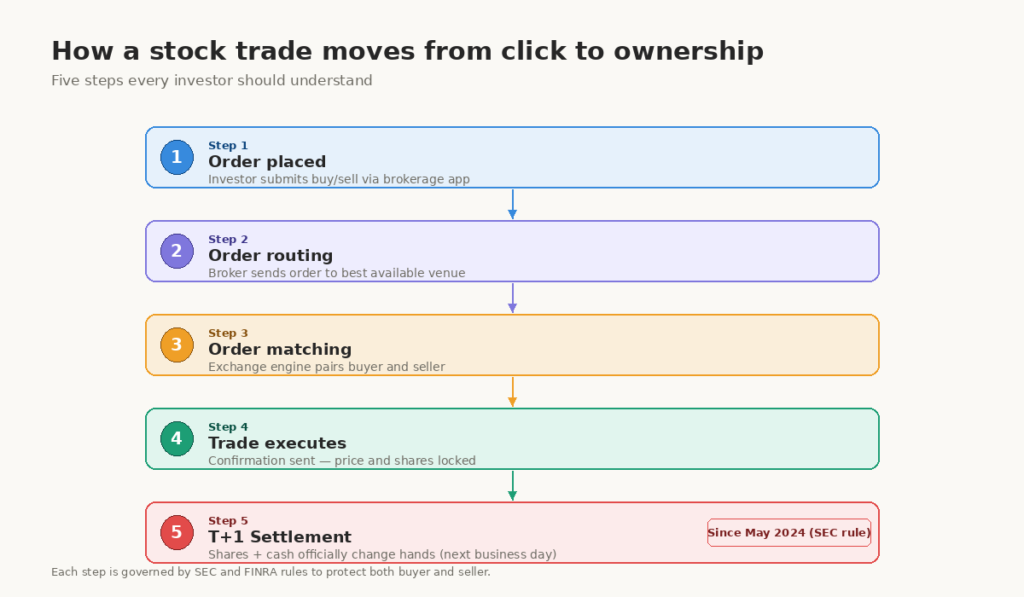
A stock market transaction follows a precise sequence. First, an investor places an order through a brokerage account. The brokerage then routes that order to an exchange or electronic trading venue. Next, an order-matching engine compares all incoming buy and sell orders. When a buyer’s price and a seller’s price agree, the exchange executes the trade.
The table below shows the full lifecycle of one stock trade.
| Step | What happens | Who is involved |
|---|---|---|
| 1. Order placed | Investor submits buy or sell order | Investor, broker |
| 2. Order routing | Broker sends order to best venue | Broker, exchange |
| 3. Order matching | Engine pairs buyer and seller at agreed price | Exchange |
| 4. Trade execution | Confirmation sent to both parties | Exchange, broker |
| 5. Settlement (T+1) | Shares and cash change hands officially | Clearinghouse, broker |
Settlement deserves special attention. Since May 2024, most U.S. stocks, bonds, and other securities moved from T+2 to T+1 settlement, meaning trades settle one business day after execution. This means if you buy shares on Monday, you legally own them on Tuesday. According to FINRA, under the T+1 settlement cycle, your brokerage firm must receive payment no later than one business day after the trade is executed. Charles SchwabFINRA
Market Hours, Order Types, and Price Discovery
Regular trading hours for stocks traded on exchanges are from 9:30 a.m. to 4:00 p.m. Eastern Time. Outside these hours, extended-hours trading is available through many brokerages. However, the SEC warns that during extended-hours trading there is generally less trading interest and therefore less price competition for most stocks, which may raise trading costs or increase uncertainty with respect to prevailing prices. Investor.govInvestor.gov
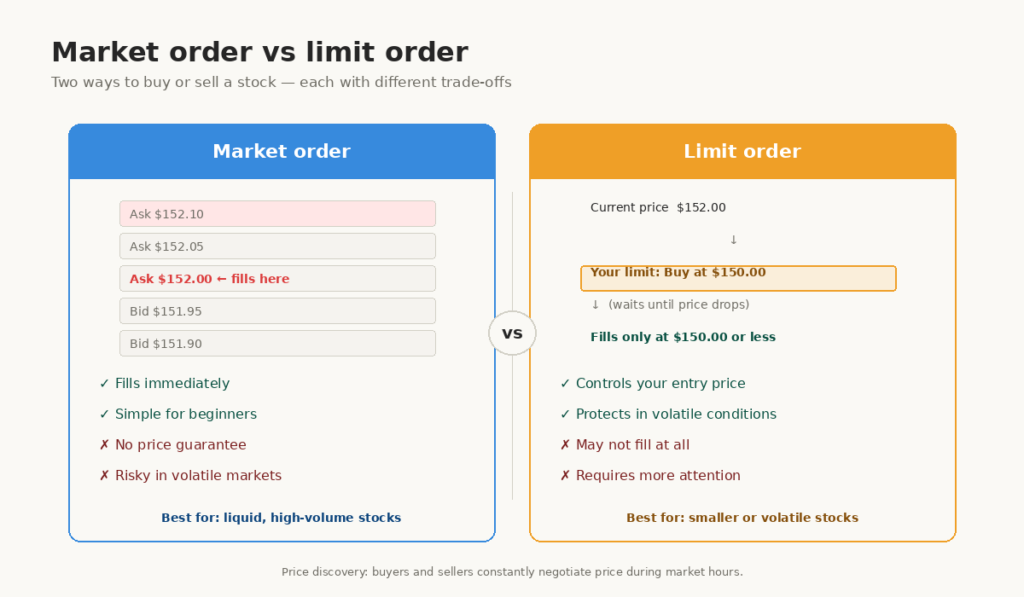
Within regular hours, two order types matter most for beginners. A market order executes immediately at the best available price. A limit order executes only at your chosen price or better. Because limit orders give you direct control over execution price, many disciplined investors use them instead of market orders — particularly during fast-moving markets.
Price discovery is the process by which buyers and sellers together decide what a share is worth at any given moment. Supply and demand drive this continuously during trading hours. Furthermore, institutional investors — large funds moving significant capital — can push prices during periods of heavy buying or selling. Investors often watch volume spikes as a possible indicator of institutional activity, though this does not predict future returns.
You can review the SEC’s guide on how stock markets work for further explanation of exchange structure and order routing.
What Moves Stock Prices During the Trading Day
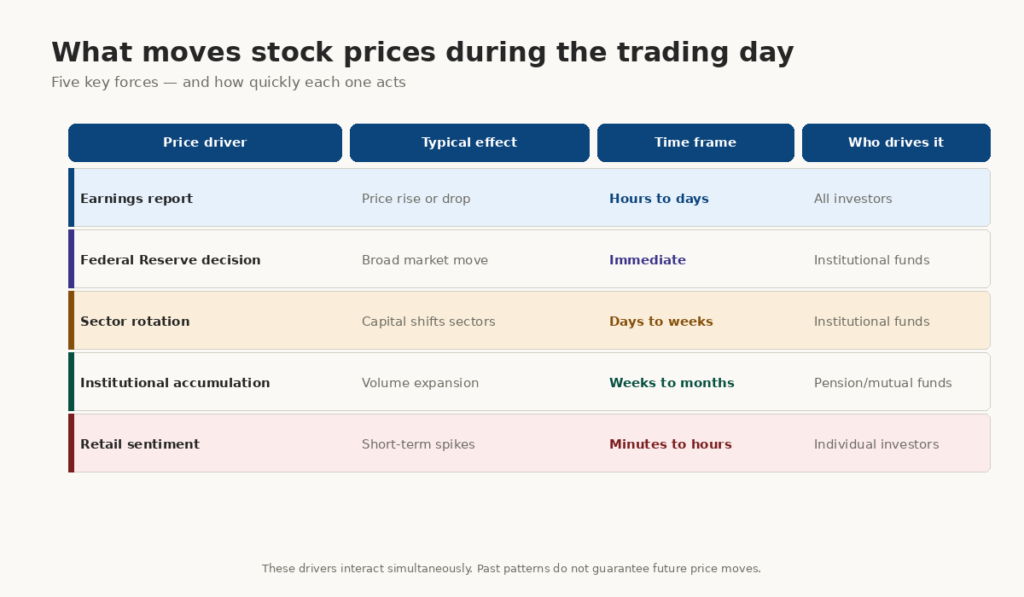
Many beginners assume a stock price moves because of company news alone. In reality, prices respond to a wider set of forces simultaneously. Earnings reports, Federal Reserve statements, economic data releases, and sector rotation all shift prices within minutes.
Consider a realistic example. Suppose Apple reports stronger-than-expected quarterly earnings before the market opens. Pre-market trading may push the price higher immediately. However, when regular hours begin at 9:30 a.m., large institutional funds reassess their positions. Sometimes the price gives back early gains as profit-taking volume increases. This pattern — good news followed by selling — surprises many beginners.
| Price driver | Typical effect | Time frame |
|---|---|---|
| Earnings beat | Initial price rise | Hours to days |
| Federal Reserve rate decision | Broad market move | Immediate |
| Sector rotation | Capital shifts between sectors | Days to weeks |
| Institutional accumulation | Steady volume expansion | Weeks to months |
| Retail investor sentiment | Short-term volatility | Minutes to hours |
Investor psychology amplifies every one of these forces. Recency bias — giving too much weight to the most recent price move — causes many investors to buy near peaks and sell near lows. Furthermore, herd behavior, which means following the crowd without independent analysis, pushes prices beyond what fundamentals justify in both directions. Awareness of these tendencies does not eliminate them, but it helps investors make calmer decisions.
Our guide on what is a stock explains how individual shares connect to a company’s underlying value.
What Disciplined Investors Actually Watch
Smart money flow tracking goes far beyond watching whether the S&P 500 is up or down on a given day. Experienced investors monitor several signals before acting. Relative strength measures how a specific stock performs against a market index. Rising relative strength on expanding volume may suggest institutional accumulation, though past patterns do not guarantee future returns. Free cash flow quality — the actual cash a business generates after expenses — often matters more than reported earnings.
A disciplined investor may also compare a stock’s valuation against its earnings growth rate. The price-to-earnings ratio, or P/E ratio, expresses how much investors currently pay for each dollar of a company’s earnings. When this ratio runs far above its historical average without clear earnings acceleration, experienced investors often reduce exposure rather than chase price. This approach reflects valuation discipline rather than market timing.
Market structure itself matters too. Megatrends in artificial intelligence, cloud computing, and semiconductor demand have driven prolonged institutional interest in specific sectors. However, disciplined investors consider whether current prices already reflect that growth before committing capital. Because a well-understood trend is often already priced in, timing and price paid still determine long-term returns.
For further reading, explore these related guides:
- What Is the Stock Market? Buyers, Sellers, and Exchanges Explained
- NYSE vs Nasdaq: Key Differences for Investors
What is the role of a market maker in the stock market?
A market maker is a firm that continuously quotes buy and sell prices for a specific stock, providing liquidity to the market. By standing ready to buy or sell at posted prices, market makers ensure that other investors can trade quickly without waiting for a matching counterparty. In return, they earn the spread between the buy price and the sell price. Nasdaq relies heavily on competing market makers, while the NYSE uses designated market makers on its trading floor.
How does a stock trade actually settle after execution?
When a trade executes, the exchange sends a confirmation to both the buyer’s and seller’s broker. A clearinghouse then processes the transaction. Since May 2024, most U.S. stock trades settle on a T+1 basis, meaning shares transfer to the buyer and cash transfers to the seller on the next business day. FINRA notes that your brokerage must have your payment by that settlement date. Most modern brokerage accounts handle this automatically.
Should beginners use market orders or limit orders?
Beginners should understand both before placing any trade. A market order is simpler and fills immediately, but you accept whatever price the market offers at that moment. A limit order gives you price control, but the trade may not fill if the stock never reaches your target price. For stocks with high daily trading volume, the difference between a market and limit order is often small. For smaller or more volatile stocks, a limit order can protect you from unexpected price gaps.