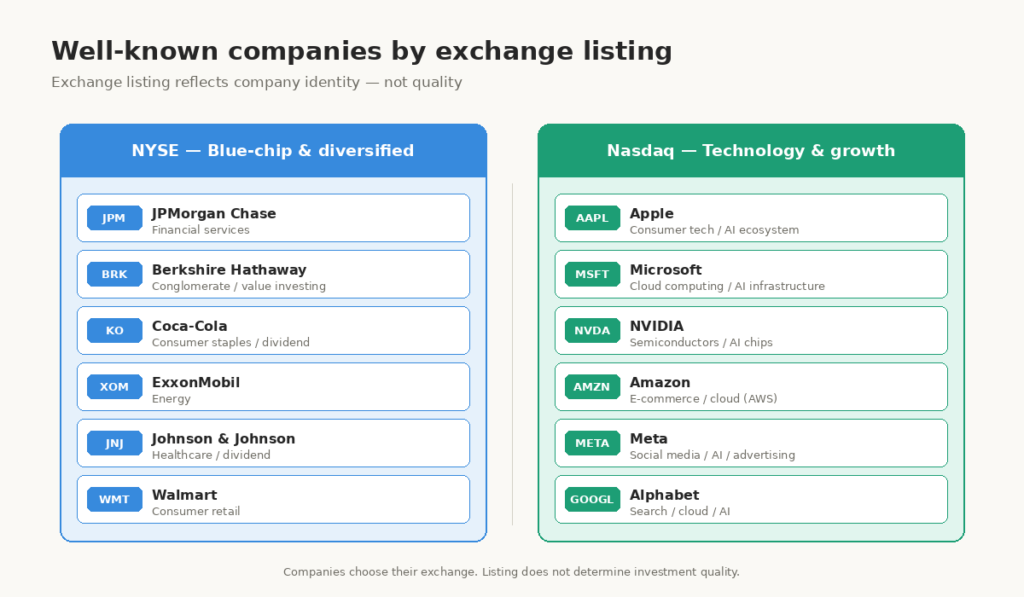
When Apple reports earnings, its stock trades on Nasdaq. When JPMorgan Chase reports earnings, its stock trades on the NYSE. Both companies are among the most followed in the world, yet they list on different exchanges for different reasons. Understanding NYSE vs Nasdaq begins with recognizing that these two markets operate differently in structure, history, and the types of companies they attract. For a beginning investor, knowing these differences helps explain why a stock behaves the way it does during high-volume trading days.
NYSE vs Nasdaq: History and Market Structure
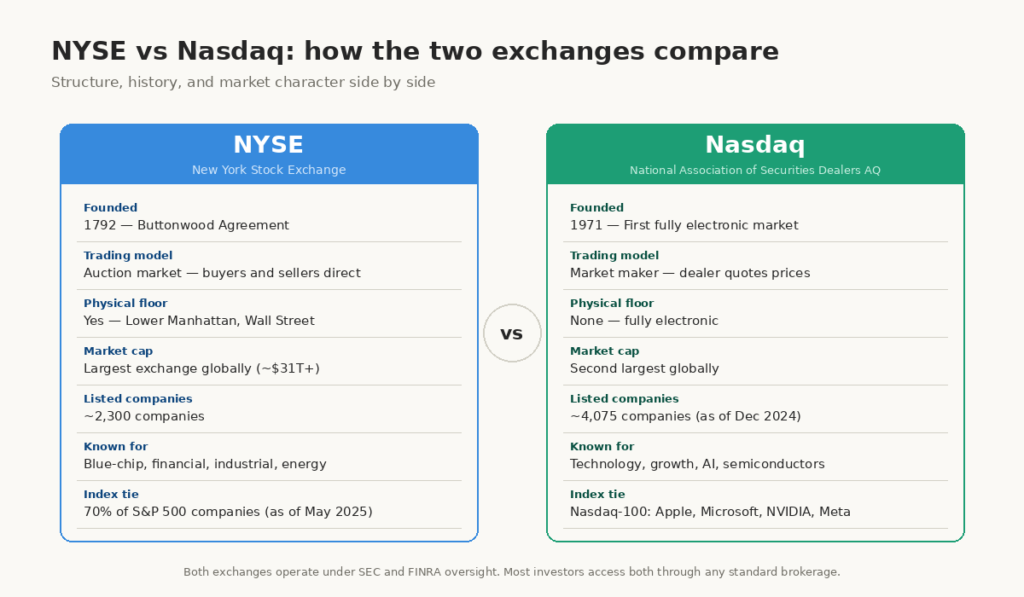
The NYSE traces its origins to the Buttonwood Agreement of May 17, 1792, when 24 brokers signed an agreement that set commission rates and bound signers to give preference to each other in securities sales. It remains the largest stock exchange in the world by market capitalization. The NYSE is currently owned by Intercontinental Exchange, a Fortune 500 holding company that trades on the NYSE itself under the ticker symbol ICE. WikipediaWikipedia
Nasdaq began in 1971 as the world’s first fully electronic stock market, initially displaying bid and ask prices from competing market makers on electronic terminals. The name is an acronym for National Association of Securities Dealers Automated Quotations. As of December 31, 2024, 4,075 companies listed securities on Nasdaq. WikipediaWikipedia
The most important structural difference is how trades actually execute. The NYSE functions as an auction market in which participants transact directly with each other, whereas market participants on the Nasdaq make purchases and sales via a market maker. A market maker is a firm that continuously quotes buy and sell prices and stands ready to trade, providing liquidity. In contrast, the NYSE auction model matches buyers and sellers directly at the best available price. Bassberrysecuritieslawexchange
| Feature | NYSE | Nasdaq |
|---|---|---|
| Founded | 1792 | 1971 |
| Trading model | Auction market (direct) | Market maker (dealer) |
| Physical floor | Yes, Lower Manhattan | Fully electronic |
| Market cap rank | Largest globally | Second largest globally |
| Known for | Blue-chip, industrial, financial | Technology, growth, innovation |
Which Companies List on Each Exchange
The two exchanges attract very different company profiles, and this shapes the character of each market. The NYSE, founded in 1792, is a storied exchange known for listing blue-chip and industrial companies. By contrast, the Nasdaq, founded in 1971, has a reputation for attracting companies focused on technology and innovation. Bassberrysecuritieslawexchange
You can see this split clearly in major index membership. As of May 2025, 70% of the companies included in the S&P 500 were listed on the NYSE. Meanwhile, the Nasdaq hosts Apple, Microsoft, NVIDIA, Amazon, and Meta — the five largest technology companies by market capitalization. Furthermore, most artificial intelligence and semiconductor companies have chosen Nasdaq as their primary listing venue. Bassberrysecuritieslawexchange
Companies sometimes switch exchanges as their business evolves. During the first half of 2025, ten companies with a combined market value of $271 billion switched to Nasdaq from the NYSE, compared to five companies moving to the NYSE from Nasdaq over the same period. Shopify moved to Nasdaq in early 2025, stating it wanted to be listed among the most innovative technology companies in the world. On the other hand, companies that move from Nasdaq to NYSE have cited the exchange’s size, prestige, and liquidity for institutional investors as key reasons. Bassberrysecuritieslawexchange
You can review the SEC’s investor resources on stock exchanges to understand how both markets operate under federal oversight.
How Each Exchange Affects Your Investment
For most individual investors, the exchange a stock trades on does not change how you buy or sell it. You place an order through your brokerage and the system routes it correctly regardless of whether the stock is on the NYSE or Nasdaq. However, the exchange structure creates real differences in trading behavior that disciplined investors notice.
The NYSE’s designated market maker system means a human specialist is responsible for maintaining orderly trading in specific stocks during extreme volatility. This can slow the pace of price swings in some situations. In contrast, Nasdaq’s competing market maker model means multiple firms simultaneously quote prices, which historically produces very tight bid-ask spreads for heavily traded technology names. The bid-ask spread is the difference between the highest price a buyer will pay and the lowest price a seller will accept.
Consider a realistic comparison. During a broad market selloff, a heavily traded NYSE blue-chip stock like Coca-Cola may see its designated market maker absorb some of the selling pressure to prevent a disorderly market. Meanwhile, a Nasdaq-listed semiconductor stock may move faster because price discovery depends on competing electronic market makers responding to real-time order flow. Neither outcome is better by definition — each reflects the exchange’s design.
Our guide on how the stock market works covers order matching and settlement in more detail.
What Smart Investors Consider When Comparing Exchanges
Experienced investors do not simply assume Nasdaq stocks are riskier or that NYSE stocks are safer. Instead, they evaluate the underlying business regardless of which exchange it lists on. However, exchange identity can serve as a useful initial signal. A company listing on the NYSE Global Select tier, for example, has met stricter financial requirements than one listing on Nasdaq’s Capital Market tier.
The NYSE lists more than 2,000 companies spanning industries including energy, finance, healthcare, and consumer goods. This diversification across sectors means many NYSE-listed stocks respond to different economic forces than the technology-heavy Nasdaq. Therefore, investors watching sector rotation often track which exchange leads on high-volume days. When institutional funds rotate from growth to value, NYSE-listed financial and industrial stocks may benefit while Nasdaq names underperform. FOREX.com
Investor psychology plays a role here too. During periods of enthusiasm around megatrends like artificial intelligence, Nasdaq-listed semiconductor and cloud companies attract heavy retail participation. This herd behavior — following the crowd without checking valuation — can push prices far beyond what earnings growth justifies. A disciplined investor may compare price-to-earnings ratios across both exchanges before shifting capital, rather than simply chasing whichever exchange gained more that week.
For further reading, explore these related guides:
- What Is the Stock Market? Buyers, Sellers, and Exchanges Explained
- S&P 500, Dow Jones, and Nasdaq Index Explained
Does it matter which exchange a stock trades on for a long-term investor?
For long-term investors, the exchange matters less than the quality of the underlying business. Both NYSE and Nasdaq require companies to meet SEC reporting standards and operate under FINRA oversight. The trading model differences — auction versus market maker — affect intraday price behavior but rarely influence long-term returns. What matters more is the company’s earnings growth, free cash flow, competitive position, and the price you pay for those future earnings.
Why do most major technology companies list on Nasdaq instead of NYSE?
Nasdaq built its reputation as the first electronic exchange by attracting early technology companies like Intel and Microsoft in the 1970s and 1980s. That reputation compounded over decades. Today, technology companies listing on Nasdaq gain immediate association with the world’s most recognized innovation brands. Furthermore, inclusion in the Nasdaq-100 index is a major draw because it generates automatic buying by the hundreds of ETFs and index funds that track it.
Can a company move from one exchange to the other?
Yes, companies can and do switch exchanges. The process requires meeting the new exchange’s listing standards and paying applicable fees. Recent examples include Shopify moving from NYSE to Nasdaq in 2025. Companies move to Nasdaq primarily for technology brand association, access to the Nasdaq-100 index, and cost savings. Companies move to NYSE primarily for the exchange’s global prestige, broader institutional investor base, and the designated market maker liquidity model.