Last updated: June 30, 2026
Two investors adopt the same strategy on the same day. One holds for twenty years and builds real wealth. The other abandons it after eighteen months of flat returns. The gap between them has nothing to do with the strategy itself. When beginners compare investment strategies, they treat the decision like picking the fastest car — find the optimal one and win. The real deciding factor is behavioral: the best strategy is the one you can stick with through a market decline, not the one with the highest theoretical return.
What Investment Strategies Actually Are
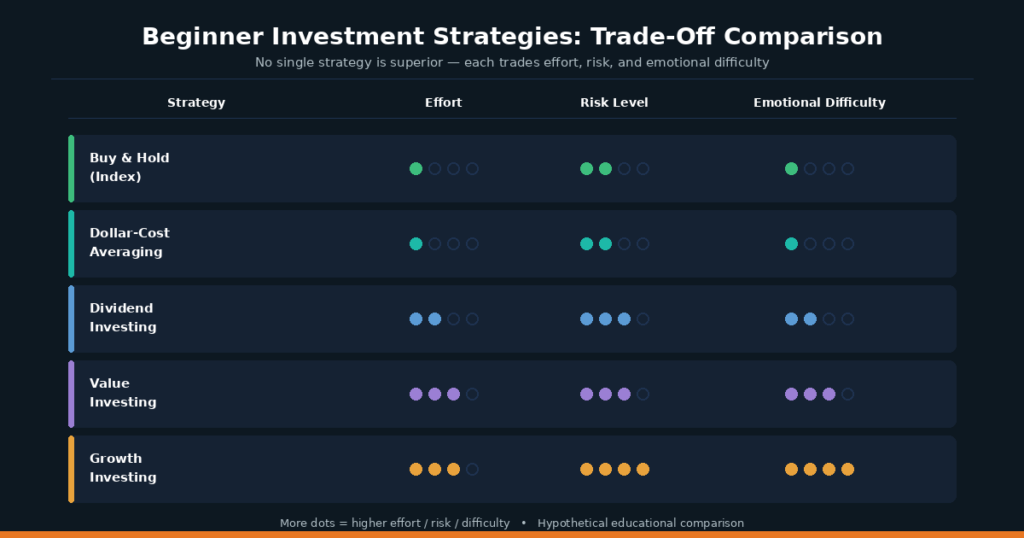
Caption: Each strategy trades off effort, risk, and emotional difficulty — no single approach is superior for every investor.
An investment strategy is a consistent set of rules for deciding what to buy, how much to hold, and when to act. The rules matter less than the consistency. A strategy removes moment-to-moment emotion from decisions, which is where most beginner damage actually happens.
Strategies fall into a few broad families. Passive investing aims to match the market by holding broad index funds. Active investing tries to beat the market through stock selection or timing. Between these sit hybrid approaches that combine a passive core with smaller active positions. Each carries different demands on time, knowledge, and emotional discipline.
Why “Best Strategy” Is the Wrong Question
Most beginner guides rank strategies as if one is objectively superior. This framing creates a hidden problem. A strategy that delivers strong returns on a spreadsheet is worthless if the investor sells in a panic during the first serious drawdown. Professional advisors call this the behavior gap — the measurable difference between what investments return and what investors actually earn. Therefore, the practical question is not “which strategy performs best” but “which strategy will I follow without quitting.”
| Strategy | Effort Required | Main Risk | Behavioral Difficulty |
|---|---|---|---|
| Buy and Hold (Index) | Very low | Market-wide declines | Low — requires patience |
| Dollar-Cost Averaging | Low | Slower in rising markets | Low — automatic |
| Dividend Investing | Moderate | Concentration, dividend cuts | Moderate |
| Value Investing | High | Value traps, long waits | High — requires conviction |
| Growth Investing | High | Valuation compression | High — high volatility |
The Behavior Gap: Evidence That Execution Beats Selection
The research firm DALBAR has studied investor returns versus market returns for over three decades through its Quantitative Analysis of Investor Behavior. Its findings consistently show that the average equity fund investor underperforms the S&P 500 by a meaningful margin over long periods — not because the funds failed, but because investors bought and sold at the wrong times. The gap stems from chasing performance after gains and selling after losses.
This pattern proves the thesis directly. If strategy selection were the deciding factor, investors holding S&P 500 index funds would earn the S&P 500 return. Many do not, because they abandon the strategy at the worst moment. The strategy did its job; the behavior undid it.
A Simple Illustration With Real Index History
Consider the S&P 500’s actual behavior in recent memory. The index fell roughly 19% across calendar year 2022, according to widely reported market data, then recovered substantially in the following two years. An investor who held a low-cost S&P 500 index fund through 2022 participated in the recovery. An investor who sold during the 2022 decline — locking in the loss — missed it. Same strategy, same fund, opposite outcomes. The difference was execution under stress, not the strategy on paper.
Tracking index drawdowns across multiple market cycles shows this pattern repeats. Declines feel permanent while they happen, which is exactly when the behavior gap opens widest.
Matching a Strategy to Your Actual Temperament
Because execution is the deciding variable, choosing a strategy starts with honest self-assessment rather than return projections. An investor who checks prices daily and feels anxious during declines should avoid high-volatility growth strategies, even if those strategies show higher historical returns. The volatility that looks acceptable on a chart feels very different when it is your own capital falling 30%.
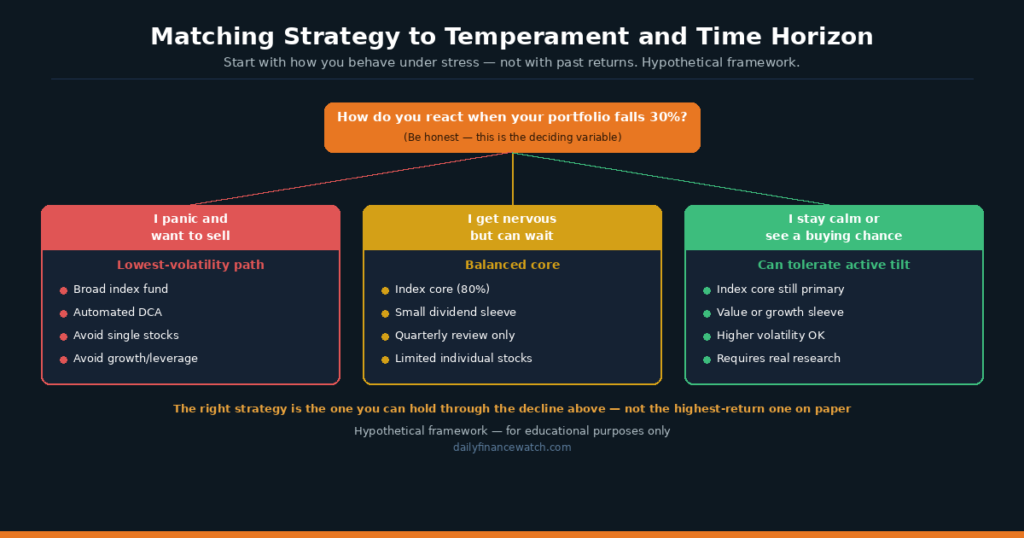
Caption: Strategy selection should start with time horizon and emotional tolerance, not with which approach posted the highest past return.
Most guides describe diversification as simply “owning many stocks to reduce risk.” This framing leaves out the behavioral function that matters most for beginners. Diversification also reduces the emotional intensity of any single position’s decline, which makes the overall strategy easier to hold. Institutional investors think about diversification partly as a tool for managing their own decision-making under stress, not only as mathematical risk reduction. A portfolio you can hold calmly is one you are less likely to abandon.
Common Mistakes That Break Strategies
Strategy switching is the most damaging beginner error. An investor adopts buy-and-hold, watches a different approach outperform for a few months, then switches — usually right before the original strategy would have recovered. This reflects recency bias, the tendency to assume recent performance will continue. Each switch typically locks in a loss and buys into a peak.
Overconfidence drives a related mistake. After early success in a rising market, beginners often abandon a simple index strategy for active stock picking, mistaking a bull market for personal skill. The test of skill only arrives during a full market cycle that includes a serious decline.
For investors building a foundation, how to start investing in stocks covers the account and first-purchase steps, and what is dollar-cost averaging explains the single most execution-friendly strategy in detail.
What Disciplined Investors Do Differently
Smart money behavior centers on removing emotion from execution rather than finding a secret strategy. Disciplined investors automate contributions so that buying happens on schedule regardless of market mood. This converts a behavioral challenge into a mechanical process. The SEC’s investor education resource at Investor.gov emphasizes consistent long-term investing over attempts to time entries and exits.
A disciplined investor also defines rules in advance for when to act and, more importantly, when not to. Deciding ahead of time to hold through declines removes the in-the-moment emotional decision that destroys returns. This does not guarantee future performance, but it closes the behavior gap that undermines most beginner outcomes.
What you should take from this is a reversal of the usual question. Stop asking which investment strategy is best. Start asking which one you can hold through a 30% decline without selling. For most beginners, that answer points toward a simple, automated, broadly diversified approach — not because it wins on paper, but because it is the one they will actually still be following when the recovery arrives.
FAQ
What is the best investment strategy for a complete beginner?
There is no single best strategy, because the deciding factor is execution rather than theoretical return. For most beginners, a low-cost broad index fund held consistently through market cycles works well — not because it produces the highest returns on paper, but because it is simple, automated, and easy to maintain during downturns. The strategy you can follow without abandoning it during a decline will outperform a “better” strategy you quit.
Why do most beginners underperform the market?
Most beginners underperform not because they pick bad investments, but because of poor timing driven by emotion. Research on investor behavior consistently shows that average investors buy after prices rise and sell after they fall, which is the opposite of what builds wealth. This behavior gap means many investors earn less than the funds they own returned. Consistent, automated investing through market declines closes most of this gap.
How often should a beginner change their investment strategy?
Rarely. Frequent strategy switching is one of the most damaging beginner mistakes, because it typically locks in losses and buys into recent winners just before they cool. A strategy needs to be held through at least one full market cycle, including a significant decline, before its real value becomes clear. Switching based on a few months of underperformance usually reflects recency bias rather than a genuine flaw in the strategy.
This content is for educational purposes only and does not constitute personalized financial advice. All investing involves risk, including the possible loss of principal.