Last updated: June 30, 2026
An investor receives a $12,000 bonus and freezes. Investing it all today feels reckless — what if the market drops next week? So they wait for a “better moment” that never clearly arrives, and the cash sits idle for a year. Dollar-cost averaging solves this paralysis by replacing one frightening decision with a simple schedule. Yet most beginner guides sell it as a way to earn higher returns, which is misleading. The evidence shows dollar-cost averaging usually trails lump-sum investing on returns. Its real value is behavioral: it removes the timing decision that makes investors freeze or panic.
What Dollar-Cost Averaging Actually Is
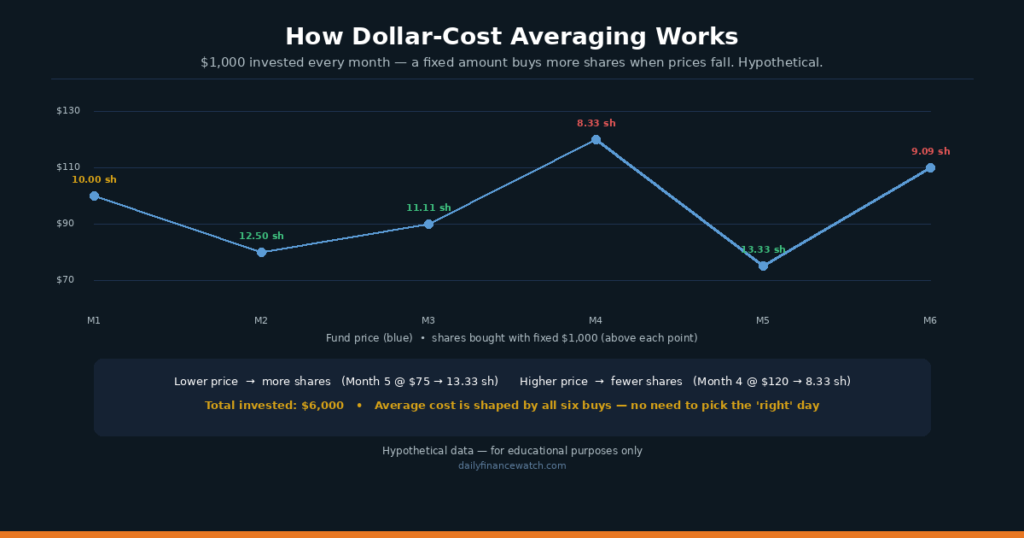
Caption: Dollar-cost averaging invests a fixed amount on a set schedule, buying more shares when prices fall and fewer when they rise.
Dollar-cost averaging is the practice of investing a fixed dollar amount at regular intervals, regardless of price. An investor might put $500 into an index fund on the first of every month, whether the market is up, down, or flat. The schedule, not the price, decides when to buy.
Because the dollar amount stays constant while prices move, the strategy automatically buys more shares when prices are low and fewer when prices are high. Over time, this produces an average purchase price across many buying points. The mechanism is simple and requires no forecasting, which is precisely its appeal for beginners.
Why DCA Is Sold Wrong
Most beginner guides claim dollar-cost averaging “lowers your average cost” or “boosts returns.” This framing is misleading in a specific way. Multiple studies, including widely cited research from Vanguard, have found that investing a lump sum immediately has historically outperformed spreading it out, roughly two-thirds of the time. The reason is straightforward: markets rise more often than they fall, so money invested sooner spends more time growing. Therefore, presenting DCA as a return-boosting tactic sets a false expectation. The honest case for DCA is not mathematical superiority — it is behavioral reliability.
| Claim About DCA | Reality |
|---|---|
| “It boosts your returns” | Usually trails lump-sum investing on average |
| “It lowers your average cost” | Only versus the worst-timed lump sum, not on average |
| “It removes risk” | It reduces timing risk, not market risk |
| “It prevents losses” | It does not; all investing can still lose value |
| Its true strength | Removes the timing decision and emotional paralysis |
The Behavioral Case That Actually Matters
The genuine value of dollar-cost averaging is psychological, and for most beginners that matters more than the modest return difference. Investing a large sum at once triggers a specific fear: what if I buy right before a crash? This fear causes two damaging behaviors — sitting in cash indefinitely, or investing and then panic-selling at the first decline because the entire position moved at once.
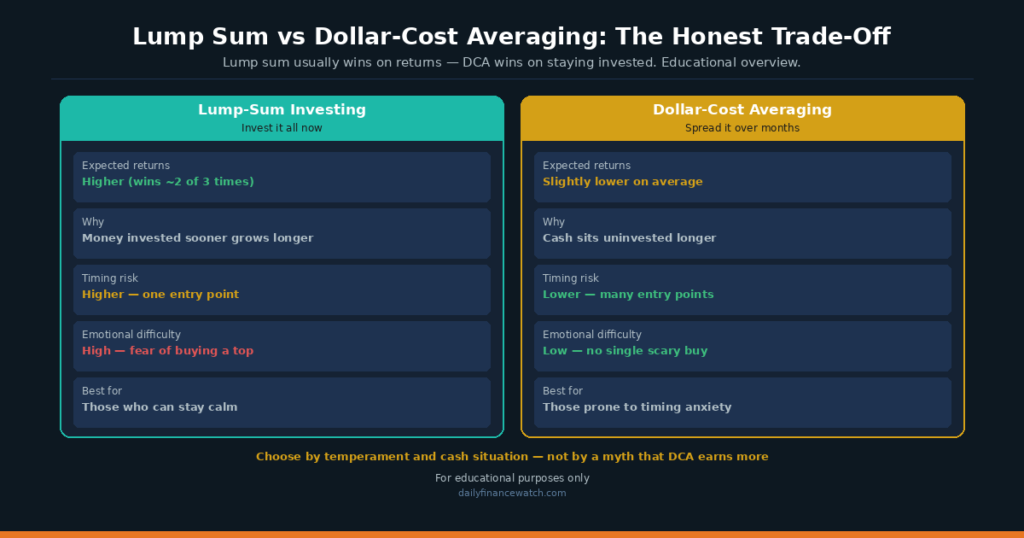
Caption: Lump-sum investing usually wins on returns, but dollar-cost averaging wins on emotional consistency — the factor that keeps beginners invested.
Dollar-cost averaging defuses both. By spreading purchases across time, no single buy point can feel like a catastrophic mistake. This makes the strategy far easier to start and to maintain through volatility. A return advantage on a spreadsheet is worthless if the investor never invests, or abandons the plan during a decline. For someone prone to timing anxiety, DCA’s behavioral reliability can produce a better real-world outcome than a theoretically superior lump-sum plan they cannot emotionally execute.
A Realistic Hypothetical Illustration
Consider a hypothetical investor with $6,000 investing $1,000 monthly into an index fund over six months. In a month when the fund trades at $100, the $1,000 buys 10 shares. In a month it drops to $80, the same $1,000 buys 12.5 shares. When it rises to $120, the $1,000 buys only 8.33 shares. The fixed dollar amount mechanically buys more when cheaper and less when pricier. The result is an average cost shaped by all six purchase points — not a guarantee of a lower price, but a removal of the pressure to pick the single right entry day.
How Beginners Should Use Dollar-Cost Averaging
For most beginners, dollar-cost averaging is best understood as the default method for investing regular income, not as a tactic to beat lump-sum investing. Anyone investing a portion of each paycheck is already dollar-cost averaging by nature — money arrives on a schedule and gets invested on a schedule. This is the strategy working as intended: automatic, consistent, emotion-free participation.
The distinction matters when an investor receives a windfall, such as a bonus or inheritance. Here the evidence favors lump-sum investing on average, but the behavioral reality may favor DCA. An investor who would invest a lump sum and then panic at the first 10% drop may be better served spreading it over several months — accepting a small expected return cost in exchange for a higher chance of staying invested. The SEC’s investor education resource at Investor.gov emphasizes consistent, long-term investing over attempts to time the market.
For investors building this foundation, how to start investing in stocks covers account setup and automation, and why time in the market beats timing the market explains the broader principle behind consistent investing.
Common Mistakes With Dollar-Cost Averaging
Stopping during declines is the most damaging error and the exact opposite of how DCA is meant to work. When prices fall, the fixed contribution buys more shares — the strategy’s most valuable moments. An investor who halts contributions during a downturn out of fear abandons the discounted buying that drives long-term results. This reflects loss aversion, the tendency to fear losses more intensely than equivalent gains.
Treating DCA as a market-timing tool is a second mistake. Some investors deliberately hold cash to “dollar-cost average in later,” believing they are being prudent. In a rising market, this is simply delayed investing that historically costs returns. DCA is a method for investing money you have on a schedule, not a reason to keep money out of the market waiting for clarity.
What Disciplined Investors Understand About DCA
Smart money practice treats dollar-cost averaging as an automation and discipline tool rather than a performance edge. Disciplined investors set up automatic recurring investments so that buying happens without a decision, on schedule, regardless of headlines or market mood. This converts the hardest part of investing — acting consistently through fear and greed — into a mechanical process that runs itself.
A disciplined investor also understands the honest trade-off. They do not expect DCA to beat lump-sum investing on average, and they choose between the two based on their own temperament and cash situation rather than on a myth about higher returns. For regular income, they let automatic DCA run. For a windfall, they weigh the small expected return cost of spreading it against the behavioral safety it provides. This does not guarantee performance, but it matches the method to the real decision.
What you should now understand differently is what dollar-cost averaging is for. It is not a clever way to earn more than investing all at once — usually it earns slightly less. It is a way to keep investing when fear would otherwise stop you. For a beginner whose biggest risk is freezing or panicking, a strategy that guarantees consistent participation can quietly outperform a “better” strategy that never gets followed. The value was never in the math; it was always in the behavior.
FAQ
Does dollar-cost averaging actually increase returns?
Usually not. Research, including widely cited Vanguard studies, has found that investing a lump sum immediately outperforms dollar-cost averaging roughly two-thirds of the time, because markets rise more often than they fall and money invested sooner grows longer. Dollar-cost averaging’s real value is behavioral, not mathematical. It removes the timing decision and emotional paralysis that cause investors to freeze or panic, which helps beginners stay invested consistently.
When should I use dollar-cost averaging instead of investing all at once?
Dollar-cost averaging is the natural method for investing regular income, since paychecks arrive on a schedule. For a windfall like a bonus or inheritance, the evidence favors investing the lump sum on average, but spreading it out may suit investors prone to timing anxiety. If you would invest a lump sum and then panic-sell at the first decline, dollar-cost averaging trades a small expected return cost for a higher chance of staying invested.
Why should I keep investing when the market is falling?
Falling prices are when dollar-cost averaging works hardest. Because you invest a fixed dollar amount, a lower price means your contribution buys more shares, lowering your average cost over time. Stopping contributions during a decline abandons the discounted buying that drives long-term results, and reflects loss aversion rather than sound strategy. Continuing to invest on schedule through downturns is the core discipline that makes dollar-cost averaging effective for long-term investors.
This content is for educational purposes only and does not constitute personalized financial advice. All investing involves risk, including the possible loss of principal.