Last updated: July 8, 2026
A beginner ready to start investing opens a brokerage app and immediately searches for a stock to buy. The purchase takes ninety seconds. The decisions that actually shape the outcome — why they are investing, in what account, and in what mix — were skipped entirely. This is the central error in how most people start investing: they begin with the last step. The order of the decisions matters more than the first stock, and getting that sequence right is what separates investors who build wealth from those who stall, churn, or quit.
What “Starting to Invest” Actually Requires
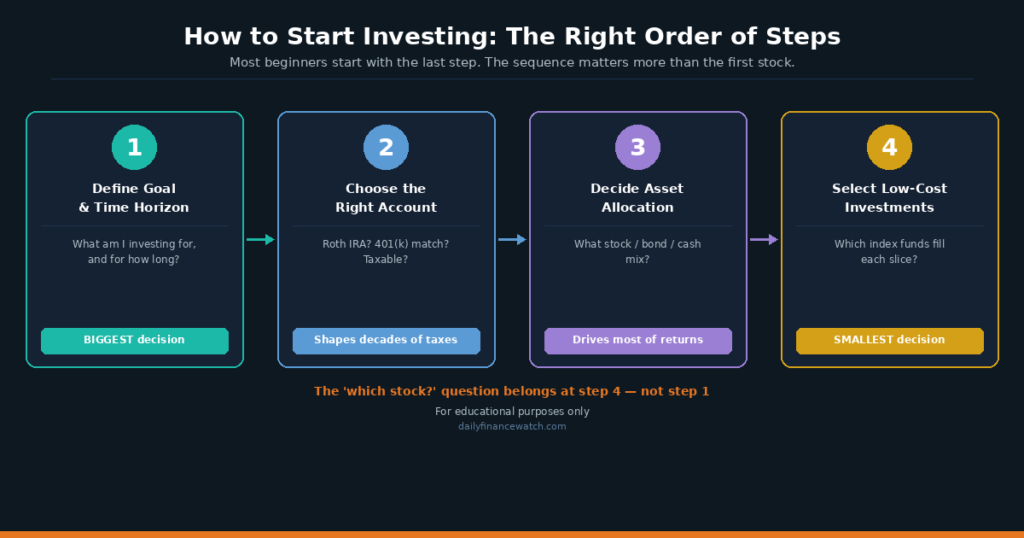
Caption: Starting to invest is a sequence — goals and accounts come before security selection, not after.
Starting to invest is not a single action. It is a short sequence of decisions, each of which constrains the next. Skipping ahead to stock selection means making the smallest decision first while leaving the largest ones unexamined. The result is often a portfolio that does not match the investor’s actual goals or risk tolerance.
The correct sequence runs in a specific order: define the goal and time horizon, choose the right account, decide an asset allocation, then select low-cost investments to fill it. Each step answers a question the next step depends on. You cannot sensibly choose investments before knowing your time horizon, just as you cannot choose an account before knowing your goal. The first stock is the final, smallest step — not the first.
Why the Order Matters More Than the First Stock
Most beginner guides open with “how to pick your first stock,” which reverses the sequence that determines results. Research into portfolio behavior has consistently found that asset allocation — the mix of stocks, bonds, and cash — drives far more of long-term outcomes than individual security selection. A beginner who picks a great stock inside a portfolio that ignores goals, taxes, and allocation has optimized the least important variable. Therefore, the disciplined starting point is the question that feels least urgent: what am I investing for, and over what timeframe?
| Step | Decision | Why It Comes First |
|---|---|---|
| 1 | Define goal and time horizon | Determines how much risk is appropriate |
| 2 | Choose the right account | Tax treatment shapes long-term results |
| 3 | Decide asset allocation | Drives most of long-term return variation |
| 4 | Select low-cost investments | The final, smallest decision |
Step One and Two: Goals and Accounts
The first decision is purpose and time horizon — how long until you need the money. A goal thirty years away (retirement) allows a very different approach than one three years away (a home down payment). Time horizon sets the appropriate risk level before any product enters the picture, because a longer horizon can absorb the volatility that comes with higher expected growth.
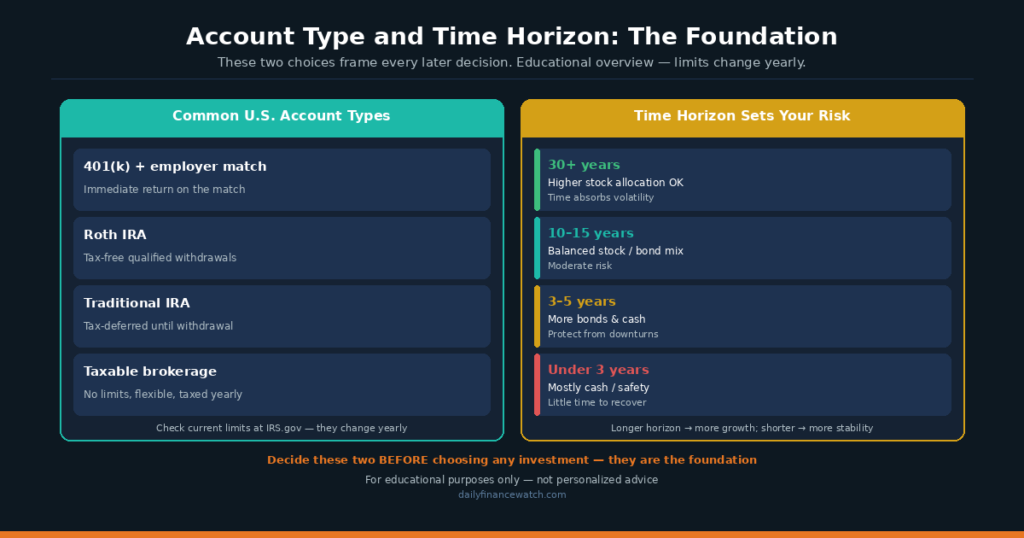
Caption: The account you choose and your time horizon frame every later decision — they are the foundation, not an afterthought.
The second decision is the account. For U.S. investors, the choice between a taxable brokerage account and tax-advantaged retirement accounts shapes decades of after-tax results. A 401(k) with an employer match offers an immediate return on contributions before any market growth. A Roth IRA grows tax-free for qualified withdrawals, a powerful advantage for younger investors with long horizons. The IRS guidance on retirement accounts provides current contribution limits and eligibility rules, which change periodically. Choosing the account before buying anything ensures every later dollar lands in the right tax structure.
Why Beginners Skip These Steps
The early steps feel abstract and slow, while buying a stock feels like real progress. This is a behavioral trap. The visible, exciting action — the purchase — produces a feeling of momentum, while the invisible foundational decisions do the actual work. Overconfidence accelerates the error: a beginner eager to “get started” mistakes activity for progress and skips the planning that would make the activity worthwhile.
Step Three and Four: Allocation, Then Investments
Once goal and account are set, the third decision is asset allocation — the split among stocks, bonds, and cash that matches the time horizon and emotional tolerance for volatility. This single decision shapes the portfolio’s risk and return more than any individual holding will. A longer horizon supports a higher stock allocation; a shorter one calls for more stability.
Only after allocation comes the fourth and final step: selecting the investments that fill each slice. For most beginners, broad low-cost index funds fill these slices efficiently, providing instant diversification without requiring stock-by-stock analysis. This is where the much-debated “first stock” question finally belongs — and by this point, it is the smallest decision, constrained by everything decided before it.
Most guides describe starting to invest as “open an account and buy your first investment.” This compresses four distinct decisions into one and hides the sequence. The accurate mental model is a dependency chain: goal sets horizon, horizon sets risk, risk sets allocation, allocation sets what you buy. Institutional and financial-planning frameworks formalize exactly this order through an investment policy that fixes goals and allocation before any security is chosen. The sequence is not bureaucracy — it prevents the most common beginner mistakes before they happen.
Common Mistakes When Starting Out
Starting with stock selection is the foundational error this guide corrects, and it cascades into others. A beginner who buys before deciding allocation often ends up overconcentrated in a single exciting stock or sector, reintroducing the company-specific risk that proper structure manages. The thrill of the purchase masks the absence of a plan.
Waiting too long is the opposite mistake. Some beginners, aware they should plan, delay starting for months while researching endlessly. Because time in the market compounds, this delay carries a real cost. The goal is to move through the sequence deliberately but promptly — planning is fast once you know the order, and the earliest contributions are the most valuable.
Putting the Sequence Into Practice
Smart money behavior treats starting to invest as executing a sequence, not making a single pick. Disciplined investors define the goal, choose the account, set the allocation, and only then select simple diversified investments — usually automating contributions so participation begins immediately and continues without interruption. They resist the urge to lead with stock selection, understanding it is the least consequential decision in the chain.
This pillar connects to the specific skills each step requires. To understand the strategies that fit different temperaments, see top investment strategies for beginners. To master the allocation decision that drives most results, see how to build your first portfolio. For the single most execution-friendly method of investing regular income, see what is dollar-cost averaging. And for the principle that makes starting early so powerful, see the power of compound interest in investing.
What you should now understand differently is where investing actually begins. It does not begin with a stock. It begins with a goal, which sets a horizon, which sets your risk level, which sets your allocation — and only then, finally, the investments that fill it. Get the order right and the first stock becomes the simple last step it should be. Start with the sequence, not the purchase, and you have already avoided the mistake that stalls most beginners before they truly begin.
FAQ
What is the very first step to start investing in stocks?
The first step is not picking a stock — it is defining your goal and time horizon. How long until you need the money determines how much risk is appropriate, which shapes every later decision. A thirty-year retirement goal allows a different approach than a three-year goal. Only after setting the goal should you choose an account, decide your asset allocation, and finally select investments. Starting with the goal prevents building a portfolio that does not match your actual needs.
Do I need a lot of money to start investing?
No. Most major U.S. brokerages have eliminated account minimums, and fractional shares let beginners start with very small amounts. The specific dollar figure matters far less than starting early and contributing consistently, because time in the market compounds. A modest amount invested now, inside the right account and allocation, often outperforms a larger amount invested years later. The priority is beginning the sequence promptly, not waiting until you have a large sum.
Should beginners pick individual stocks or use index funds to start?
For most beginners, broad low-cost index funds are the more reliable starting point. A single index fund provides instant diversification across hundreds of companies, removing the company-specific risk of individual stocks and the need for stock-by-stock analysis. Individual stock selection is the final and smallest decision in the investing sequence, and it requires skills that develop with experience. Building a diversified index-fund foundation first lets beginners participate immediately while learning.
This content is for educational purposes only and does not constitute personalized financial advice. All investing involves risk, including the possible loss of principal.