Last updated: June 30, 2026
An investor owns thirty different technology stocks and believes the portfolio is well diversified. In the 2022 selloff, nearly all thirty fell together, some by more than 50%. The holdings were many, but the protection was minimal. This is the gap most beginners miss. Portfolio diversification is not measured by how many stocks you own — it works through how differently those holdings behave when markets move, and thirty stocks that rise and fall in unison barely diversify at all.
What Portfolio Diversification Actually Means
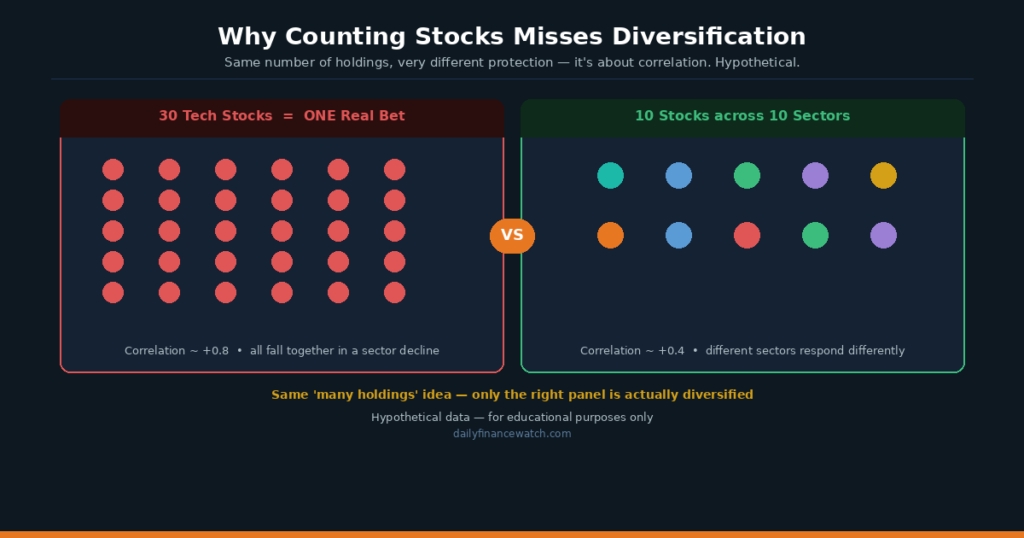
Caption: True diversification depends on correlation — how differently assets move — not simply on the number of holdings.
Diversification is the practice of spreading capital across investments that respond differently to the same events. The goal is to reduce the impact of any single holding, sector, or risk on the overall portfolio. When one part falls, another may hold steady or rise, smoothing the total result.
The key concept is correlation, which measures how closely two assets move together. Correlation runs from +1 to -1. Two assets with a correlation near +1 move almost identically. Two assets near -1 move in opposite directions. Diversification only works when holdings have low or negative correlation to each other. This is the mechanism beginners overlook when they simply count how many tickers they own.
Why Counting Stocks Misses the Point
A portfolio of thirty semiconductor stocks contains thirty holdings but only one real bet. Because these companies share the same industry, customers, and economic sensitivities, their prices tend to move together. Their correlation is high. As a result, a sector-wide decline hits all of them at once. The number thirty creates an illusion of safety that the correlation data does not support.
Professional portfolio managers measure diversification through correlation and risk contribution, not through a simple count of positions. This is why institutional frameworks treat “I own twenty stocks” as an incomplete statement. The relevant question is whether those twenty holdings respond differently to interest rates, economic cycles, and sector shocks.
| Portfolio | Number of Holdings | Correlation | Actual Diversification |
|---|---|---|---|
| 30 tech stocks | High (30) | Very high (~+0.8) | Low — one concentrated bet |
| 10 stocks across 10 sectors | Moderate (10) | Lower (~+0.4) | Moderate |
| Broad index fund (S&P 500) | Very high (500) | Spread across sectors | High |
| Stocks + bonds + index funds | Moderate | Mixed / some low | High |
How Diversification Reduces Risk — and the Risk It Cannot Touch
Diversification addresses one specific type of risk: unsystematic risk, also called company-specific or sector-specific risk. This is the danger tied to a single company’s management, a product failure, or one industry’s downturn. Spreading holdings across unrelated companies and sectors reduces this risk because no single failure can sink the whole portfolio.
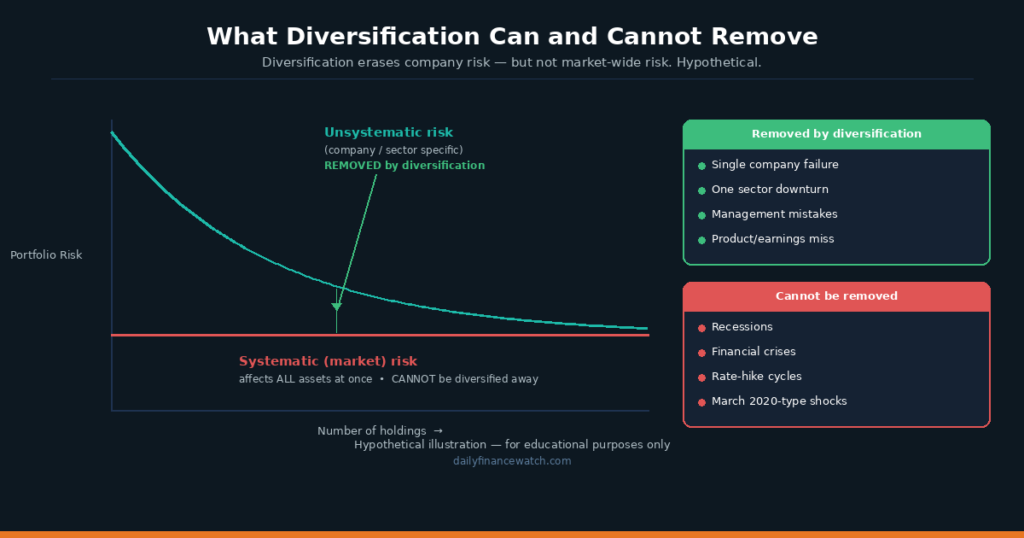
Caption: Diversification removes company-specific risk but cannot eliminate market-wide risk that affects all assets at once.
However, diversification cannot remove systematic risk — the market-wide risk that affects nearly all assets simultaneously. A broad recession, a financial crisis, or an aggressive interest-rate cycle pushes most stocks down together, regardless of how many you hold. This is the hidden limit most beginner guides omit. During the March 2020 market shock, correlations across asset classes spiked toward +1 as investors sold everything at once, which is precisely when diversification offers the least protection.
The Realistic Limits of Spreading Risk
Understanding this limit changes how a disciplined investor uses diversification. It is a tool for surviving company-specific and sector-specific shocks, not a shield against broad market declines. An investor who expects diversification to prevent losses during a systemic crisis has misunderstood the mechanism. The correct expectation is that diversification reduces the severity and frequency of damage from isolated events, while market-wide declines still require time horizon and patience to weather.
Most guides describe diversification as simply “don’t put all your eggs in one basket.” This framing is memorable but incomplete. It leaves out that eggs in the same basket-type — all stocks, all one sector — still break together. Institutional investors think in terms of correlation and risk factors precisely because the basket metaphor hides the systematic risk that no amount of stock-counting can diversify away.
How Beginners Build Diversification in Practice
For most beginners, a single broad index fund delivers more genuine diversification than a hand-picked basket of individual stocks. An S&P 500 index fund spreads capital across 500 companies in eleven sectors, weighted by size. This provides instant low-cost diversification across the U.S. large-cap market without requiring the investor to analyze correlation manually. Adding international funds and bonds extends diversification further, because those assets often respond differently to U.S.-specific events.
The SEC’s investor education resource at Investor.gov explains that diversification can help reduce risk and smooth returns, while noting it does not guarantee against loss. This official framing matches the mechanism: diversification manages risk, it does not erase it.
Common Diversification Mistakes Beginners Make
The most frequent error is owning many funds that hold the same underlying stocks. An investor might buy three different technology ETFs and believe they are diversified, when in fact all three hold the same large companies. This overlap, called holdings concentration, recreates the single-bet problem behind a diversified-looking surface.
Overconfidence drives a second mistake. After a single sector performs well, beginners often concentrate further into it, mistaking recent strength for durable safety. This reverses diversification at the worst time. Recency bias — the tendency to expect recent performance to continue — reinforces the error.
For investors building this foundation, how to start investing in stocks covers the practical first steps, and what is an index fund explains the single most efficient diversification tool available to beginners.
What Disciplined Investors Watch in a Diversified Portfolio
Smart money analysis of diversification focuses on correlation and exposure rather than the raw number of holdings. Disciplined investors periodically check whether their holdings have drifted into overlapping bets — for example, whether a portfolio has quietly become concentrated in a single megatrend like artificial intelligence across multiple funds. This may indicate hidden concentration risk that the holding count conceals.
A disciplined investor may also review how a portfolio behaved during the last significant decline. If everything fell together, the diversification was weaker than the position count suggested. This does not guarantee future protection, but it reveals whether the portfolio is genuinely spread across different risks or merely spread across different names carrying the same risk.
What you should now understand differently is the standard for judging your own portfolio. Stop counting how many stocks or funds you hold. Start asking whether they would fall together in the same downturn. A portfolio of twenty holdings that all move as one is concentrated; a smaller portfolio spread across genuinely different risks is diversified. The number was never the measure — correlation always was.
FAQ
How many stocks do I need for a diversified portfolio?
The number matters less than the correlation between holdings. A common reference point is that 20 to 30 stocks across different sectors can reduce most company-specific risk, but only if those stocks respond differently to economic events. Thirty stocks in one industry provide far less diversification than a single broad index fund holding 500 companies across eleven sectors. For most beginners, a low-cost index fund is the simpler and more reliable path to genuine diversification.
Can diversification protect me from a market crash?
Not fully. Diversification reduces company-specific and sector-specific risk, but it cannot remove systematic risk — the market-wide risk that affects nearly all assets at once. During broad crises like March 2020, correlations spike and most assets fall together, which is when diversification helps least. Diversification smooths returns and limits damage from isolated events, but surviving a market-wide decline still depends on a long time horizon and patience rather than diversification alone.
Why is owning many funds not always diversified?
Many funds hold the same underlying companies, especially large-cap technology names that appear across numerous index and sector funds. Owning three funds that each hold the same top stocks creates holdings overlap, which recreates concentrated risk behind a diversified-looking surface. True diversification requires holdings that respond differently to the same events. Checking what your funds actually own — not just how many funds you hold — reveals whether you are genuinely diversified or simply duplicated.
This content is for educational purposes only and does not constitute personalized financial advice. All investing involves risk, including the possible loss of principal.