Last updated: June 30, 2026
A beginner reads that fundamental analysis is for “serious investors” and technical analysis is for “gamblers,” picks a side, and ignores the other entirely. Then they buy a fundamentally strong stock the day before it drops 15% on a chart pattern every trader saw coming. The framing they inherited — that you must choose one camp — set up the mistake. Technical analysis and fundamental analysis are not rival philosophies competing for the same job. They answer different questions on different timeframes, and the real error is using one to make a decision the other was built to handle.
What Each Approach Actually Answers
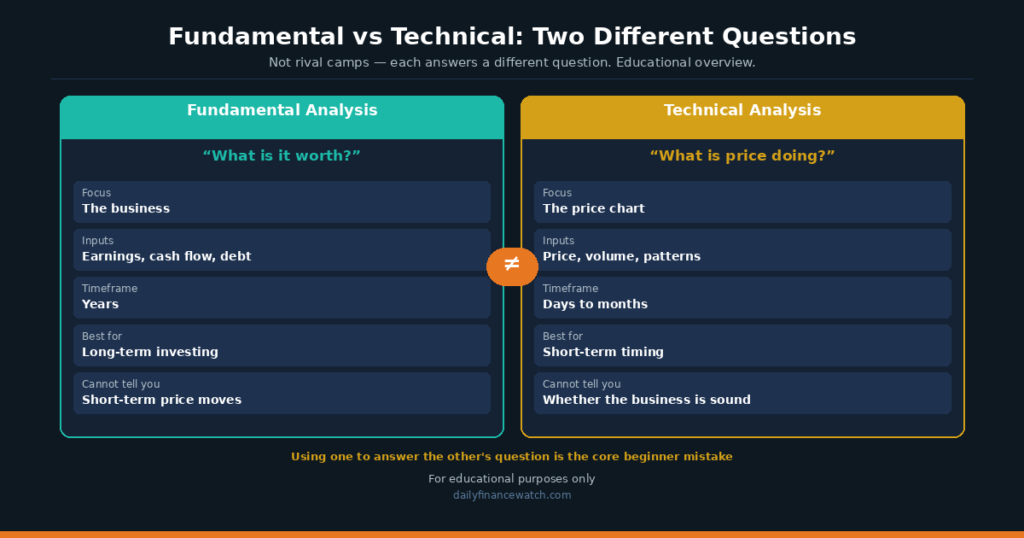
Caption: Fundamental analysis asks what a company is worth; technical analysis asks what price is doing now — two different questions.
Fundamental analysis evaluates the underlying business. It examines revenue, earnings, debt, cash flow, and competitive position to estimate what a company is worth. Its core question is value: is this stock worth its price? Fundamental analysis operates on long timeframes, because business value changes slowly.
Technical analysis studies price and volume history instead of the business. It looks at chart patterns, trends, and trading activity to judge market behavior and timing. Its core question is not value but momentum and sentiment: what is the price doing, and what might it do next? Technical analysis operates on shorter timeframes, because price and sentiment shift quickly.
Different Questions, Not Competing Answers
The mistake most beginner guides encourage is framing these as opposing teams. In reality, they sit at different points in a decision. Fundamental analysis helps decide what to own and whether a price is reasonable. Technical analysis helps some traders decide when to enter or exit. Asking technical analysis whether a company is a good long-term investment is like asking a speedometer for directions — it measures the wrong thing. The reverse fails too: fundamental analysis says little about whether a stock might fall 20% next month even when the business is sound.
| Question | Fundamental Analysis | Technical Analysis |
|---|---|---|
| Primary focus | The business | The price chart |
| Core question | What is it worth? | What is price doing? |
| Timeframe | Years | Days to months |
| Main inputs | Earnings, cash flow, debt | Price, volume, patterns |
| Best suited for | Long-term investing | Short-term timing |
| Cannot tell you | Short-term price moves | Whether the business is sound |
Why the Timeframe Decides Which Tool Fits
The single most useful idea for a beginner is that the right tool depends on the time horizon of the decision. A long-term investor holding for ten years gains little from short-term chart patterns, because a decade of business performance overwhelms any weekly price wiggle. For that investor, fundamental analysis does the heavy lifting. A short-term trader holding for days cares intensely about entry and exit points, so technical signals carry more weight.
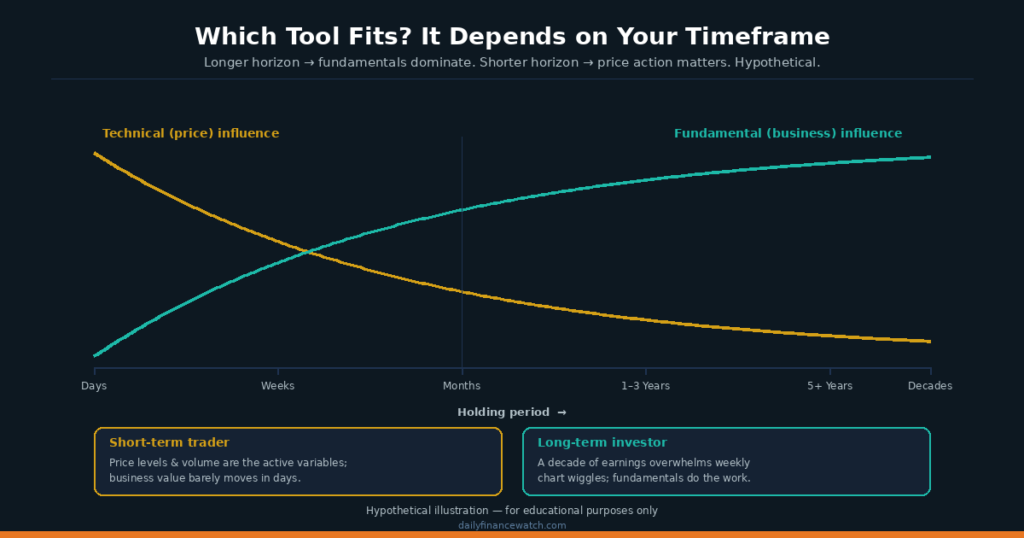
Caption: The longer the holding period, the more business fundamentals dominate; the shorter the horizon, the more price action matters.
This is why the “which is better” debate is misframed. Neither is better in the abstract. Over multi-year horizons, fundamentals have historically driven returns, because a stock’s price eventually reflects the underlying business performance. Over days and weeks, sentiment and price momentum dominate, and fundamentals barely move. The tools are matched to timeframes, not ranked against each other.
A Practical Illustration
Consider a hypothetical long-term investor evaluating a broad market index fund for a retirement account thirty years away. Technical chart patterns offer almost nothing useful, because the decision rests on decades of expected economic growth. Fundamental factors — valuations, earnings trends, costs — matter far more. Now consider a hypothetical short-term trader buying a stock to hold for three days around an earnings event. For that trader, fundamental value is largely fixed over three days, while price levels and volume patterns are the active variables. Same two tools, opposite relevance, decided entirely by timeframe.
How Beginners Should Actually Use Both
Most guides tell beginners to “choose fundamental analysis for investing.” This advice is mostly right but incomplete in a specific way. It implies technical analysis is useless for long-term investors, when a limited use remains. Even a long-term investor buying a position can glance at recent price action to avoid buying into an obvious short-term spike, then let fundamentals govern the hold. Institutional investors often separate the two functions cleanly: fundamentals decide what and whether, a light technical check informs when to execute. The error is not using both — it is letting the short-term tool override a long-term decision.
For a beginner, the practical hierarchy is clear. Long-term investors should anchor decisions in fundamental analysis and treat charts as, at most, a minor timing input. They should never let a chart pattern talk them out of a sound long-term holding, or into a poor one.
Common Mistakes in Mixing the Two
The most damaging error is timeframe confusion: making a long-term decision with short-term tools. A beginner sees a scary chart pattern and sells a fundamentally strong holding meant to be held for years, converting a long-term investment into a losing short-term trade. This often reflects panic selling driven by fear rather than analysis.
Overconfidence drives a second mistake. After a few technical predictions appear to work in a trending market, beginners conclude they can time the market reliably. Trends make almost any timing approach look skillful temporarily. The illusion fades when the trend breaks. Confirmation bias also creeps in, as investors find a chart pattern that supports what they already wanted to do.
For investors building this foundation, how to analyze a stock covers the fundamental side in depth, and how to start investing in stocks explains the practical setup for long-term investors.
What Disciplined Investors Take From Each
Smart money practice treats the two approaches as complementary inputs serving distinct purposes rather than competing forecasts. Disciplined long-term investors rely on fundamental analysis to judge value and business quality, the factors that drive returns over years. They may use a light technical read only to avoid obviously poor entry timing, never to override the core thesis. The FINRA investor education resources note that long-term investing success depends more on consistent participation and sound company selection than on short-term timing.
A disciplined investor also recognizes which question they are actually asking before reaching for a tool. If the question is “should I own this for a decade,” that is fundamental. If the question is “is this a reasonable week to buy,” a limited technical glance may help. Matching the tool to the question prevents the most common analytical errors.
What you should now understand differently is that the choice was never fundamental versus technical. The real decision is which question you are answering and over what timeframe. Pick the tool that fits the question, not the camp that fits your identity. A long-term investor who uses fundamentals to decide what to own, and resists letting a chart override that decision, has already avoided the mistake that the two-camps framing creates.
FAQ
Which is better for beginners, fundamental or technical analysis?
Neither is universally better, because they answer different questions. For most beginners, who invest for the long term, fundamental analysis matters more, since business performance drives returns over years. Technical analysis suits short-term trading, which carries higher risk and demands more time and skill. The better question is what timeframe you are investing on. Long-term investors should anchor decisions in fundamentals and treat short-term price patterns as, at most, a minor consideration.
Can you use fundamental and technical analysis together?
Yes, but for different purposes rather than as competing forecasts. A long-term investor can use fundamental analysis to decide what to own and whether the price is reasonable, then use a light technical check to avoid buying into an obvious short-term price spike. The key is hierarchy: fundamentals govern the long-term decision, while technical signals inform only execution timing. Problems arise when a short-term chart pattern overrides a sound long-term investment decision.
Why do long-term investors pay less attention to charts?
Over long horizons, a company’s business performance overwhelms short-term price movements. A decade of earnings growth or decline matters far more than any weekly chart pattern. Because of this, fundamental factors like valuation, earnings, and cash flow drive long-term returns, while short-term price action becomes noise. Long-term investors focus on charts minimally, mainly to avoid poor entry timing, and rely on fundamentals to judge what is genuinely worth holding.
This content is for educational purposes only and does not constitute personalized financial advice. All investing involves risk, including the possible loss of principal.