Last updated: June 30, 2026
A beginner opens a brokerage account and immediately asks the wrong first question: which stocks should I buy? They spend hours comparing companies while skipping the decision that will actually shape their results. The mix between stocks, bonds, and cash — called asset allocation — drives the majority of a portfolio’s long-term behavior, far more than which specific stocks fill the stock portion. Building your first investment portfolio starts not with picking winners, but with deciding that mix first.
What an Investment Portfolio Actually Is
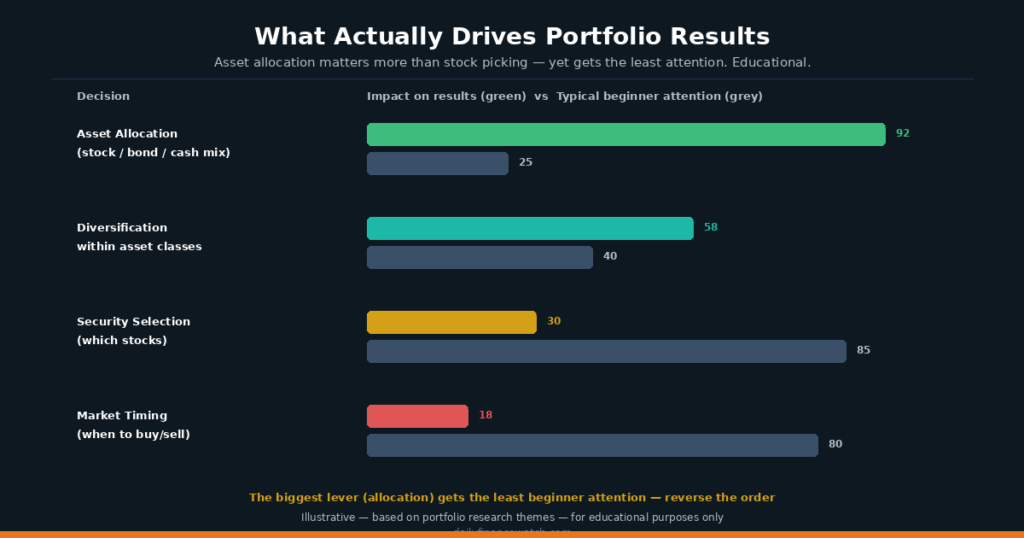
Caption: A portfolio is defined first by its allocation across asset classes — the stock-bond-cash mix shapes risk and return more than individual picks.
An investment portfolio is the complete collection of assets a person owns to pursue financial goals. It includes stocks, bonds, funds, cash, and sometimes other holdings. A portfolio is not a random pile of investments. It is a structured allocation designed to match a specific goal, time horizon, and risk tolerance.
The most important structural decision is asset allocation — how capital is divided among major asset classes. Stocks offer higher long-term growth with higher volatility. Bonds offer lower growth with more stability. Cash provides safety and liquidity but loses purchasing power to inflation over time. The proportions you choose define the portfolio’s character before any individual investment is selected.
Why Allocation Comes Before Stock Picking
Most beginner guides open with stock selection, which reverses the order that actually matters. Decades of research into portfolio behavior — beginning with a landmark 1986 study by Brinson, Hood, and Beebower published in the Financial Analysts Journal — found that asset allocation explained the large majority of the variation in portfolio returns over time, far more than security selection or market timing. The finding has been debated and refined since, but the core lesson holds: the stock-bond mix matters more than which stocks you own. Therefore, a beginner who agonizes over individual companies while ignoring allocation is optimizing the smaller decision.
| Decision | Relative Impact on Results | Beginner Attention (typical) |
|---|---|---|
| Asset allocation (stock/bond/cash mix) | Largest driver of variation | Often skipped |
| Diversification within asset classes | Significant | Sometimes considered |
| Individual security selection | Smaller than commonly assumed | Most attention |
| Market timing | Smaller and unreliable | High attention |
How to Choose Your Asset Allocation
Asset allocation should flow from two factors: time horizon and risk tolerance. Time horizon is how long until you need the money. A longer horizon allows a higher stock allocation, because there is more time to recover from declines. Risk tolerance is how much volatility you can withstand emotionally without selling at the wrong moment — a behavioral limit, not just a financial one.
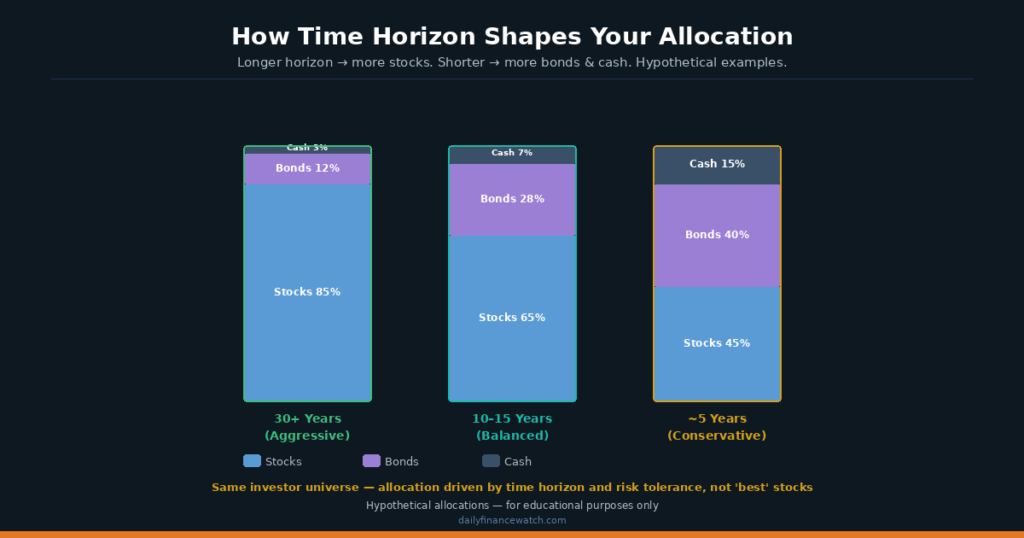
Caption: Longer time horizons generally support higher stock allocations; shorter horizons call for more stability from bonds and cash.
A common starting framework ties stock allocation loosely to time horizon. An investor decades from needing the money can hold a stock-heavy portfolio, accepting volatility in exchange for growth. An investor needing funds within a few years shifts toward bonds and cash to protect against a poorly timed decline. These are illustrative starting points, not rules — individual circumstances, income stability, and emotional tolerance all adjust the right mix.
A Realistic Hypothetical Allocation
Consider a hypothetical investor thirty years from retirement with a high tolerance for volatility. A growth-oriented allocation might place roughly 80–90% in diversified stock index funds and 10–20% in bonds. Now consider a hypothetical investor five years from a major expense. A more conservative allocation might hold 40–50% in bonds and cash to reduce the chance of a forced sale during a downturn. Same investor universe, very different allocations — driven entirely by time horizon and risk tolerance, not by which stocks are “best” right now.
Building the Portfolio With Simple Components
Once allocation is set, filling it is straightforward for beginners. Broad index funds can fill each slice efficiently. A total stock market or S&P 500 index fund covers the stock allocation with instant diversification. A bond index fund covers the bond allocation. This keeps the portfolio diversified, low-cost, and simple to maintain, while honoring the allocation decided first.
Most guides describe portfolio building as “choosing the right investments.” This framing buries the real sequence. The accurate mental model is allocate first, then fill — decide the stock-bond-cash proportions, then select low-cost funds to populate each slice. Institutional investors formalize this through an investment policy that fixes allocation before any security is chosen. The order protects the investor from letting exciting individual stocks distort a sound structure.
For deeper foundations, what is diversification explains how to spread risk within each asset class, and how to start investing in stocks covers account setup and first purchases.
Common Mistakes When Building a First Portfolio
Overconcentration is the most frequent error. A beginner places most of the portfolio in one stock, one sector, or one theme they feel confident about, abandoning allocation discipline. A single position dominating a portfolio reintroduces the company-specific risk that structure is meant to manage. This often reflects overconfidence after a stock has already risen.
Neglecting rebalancing is a quieter mistake. Over time, strong-performing assets grow to occupy a larger share than intended, quietly raising the portfolio’s risk. An allocation that started at 70% stocks can drift to 85% after a strong market, leaving the investor more exposed than they chose to be. Periodic rebalancing restores the intended mix.
What Disciplined Investors Do When Constructing Portfolios
Smart money practice fixes allocation as a deliberate decision and treats security selection as secondary execution. Disciplined investors write down a target allocation, then build toward it with diversified, low-cost funds rather than reacting to individual stock tips. They revisit the allocation only when goals or time horizons change, not in response to short-term market moves. The SEC’s investor education resource at Investor.gov emphasizes asset allocation as a foundational decision for managing risk and return.
A disciplined investor also rebalances on a schedule rather than on emotion — for example, reviewing the mix at set intervals and trimming what has grown beyond target. This enforces the discipline of selling some of what rose and buying some of what lagged, the opposite of the herd behavior that damages returns. This does not guarantee performance, but it keeps the portfolio aligned with the risk level the investor actually chose.
What you should now understand differently is the first move in building a portfolio. The opening question is not “which stocks should I buy” but “what mix of stocks, bonds, and cash fits my time horizon and temperament.” Get the allocation right, fill it with simple diversified funds, and individual stock selection becomes the small final step it should be — not the first and largest worry it appears to be.
FAQ
What should a beginner’s first investment portfolio look like?
A beginner’s first portfolio should start with an asset allocation — a deliberate split between stocks, bonds, and cash based on time horizon and risk tolerance. For long horizons, a stock-heavy mix using broad index funds is common; for shorter horizons, more bonds and cash add stability. The specific investments matter less than the allocation. A simple portfolio of one or two diversified index funds matching a chosen allocation is often more effective than a complex collection of individual stocks.
Why is asset allocation more important than picking stocks?
Research into portfolio behavior has found that the mix between asset classes explains far more of a portfolio’s long-term variation than individual security selection or market timing. Stocks, bonds, and cash behave differently, so their proportions largely determine a portfolio’s risk and return. Choosing strong individual stocks within a poorly designed allocation has limited effect, while a sound allocation works even with simple index funds. This is why disciplined investors decide allocation before selecting any specific investment.
How often should I rebalance my portfolio?
Most long-term investors rebalance on a set schedule, such as once or twice a year, or when an asset class drifts meaningfully from its target. Rebalancing restores the intended allocation by trimming what has grown and adding to what has lagged. This matters because strong-performing assets quietly increase a portfolio’s risk over time. Rebalancing on a schedule rather than on emotion prevents the portfolio from becoming riskier than the investor originally chose.
This content is for educational purposes only and does not constitute personalized financial advice. All investing involves risk, including the possible loss of principal.