Last updated: July 1, 2026
In 2022, U.S. stocks fell hard. The S&P 500 lost about 18% that year. Yet a broad index of U.S. real estate investment trusts fell nearly 25% over the same twelve months — a steeper drop than the broader market, in a supposedly defensive asset class. The mechanism behind that gap is the single most useful thing a beginner can learn about REIT investing.
REIT investing appeals for a straightforward reason. It offers a way to earn rental income from commercial real estate without buying a building. However, the trade-off is that REITs behave like stocks day to day and react to interest rates the way bonds do. Understanding this dual nature separates informed REIT investors from those chasing the headline dividend yield.
What REIT Investing Actually Involves
A real estate investment trust, or REIT, is a company that owns or finances income-producing real estate. Examples include apartment buildings, office towers, shopping centers, warehouses, data centers, and cell towers. According to the U.S. Securities and Exchange Commission’s investor bulletin on REITs, the company must have most of its assets and income tied to real estate and must distribute at least 90% of its taxable income to shareholders each year as dividends.
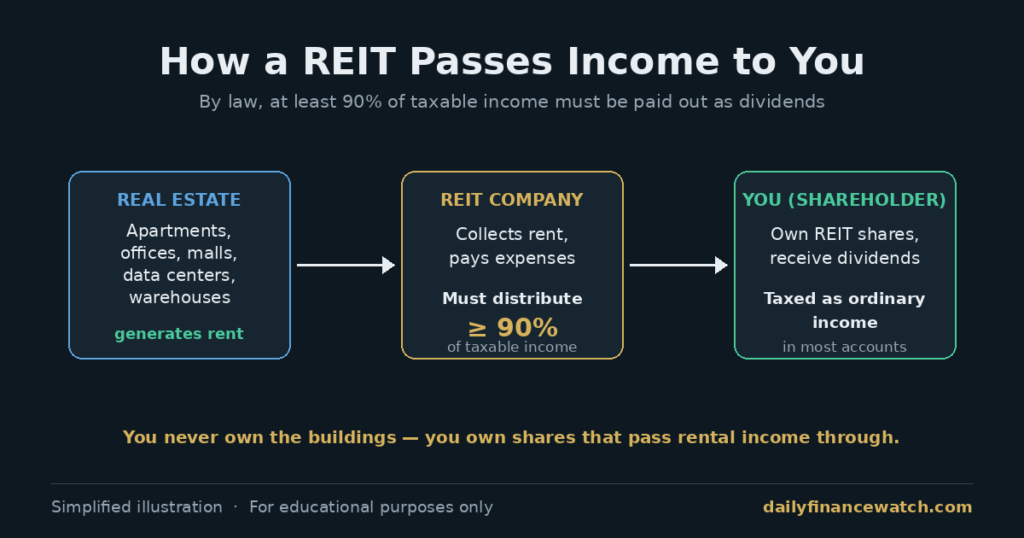
You never own the buildings — you own shares that pass rental income through.
That 90% rule is the single most important structural fact. In exchange for meeting it, a qualifying REIT pays no corporate income tax on the distributed earnings. As a result, more of the rental income reaches shareholders. This is also why REIT yields often look high compared with regular stocks — the yield reflects a legal distribution requirement, not superior business performance.
Most publicly traded REITs fall into two categories. Equity REITs own and operate physical properties, collecting rent as their primary income source. In contrast, mortgage REITs lend money to property owners and earn interest, which makes them more sensitive to short-term interest rates. Beginner guides often treat “REIT” as one asset, but these two behave very differently in a rate cycle.
Why “REITs Are Just Real Estate” Misleads Beginners
Most guides describe REITs as a simple way to own real estate for passive income. That framing is technically accurate and practically misleading. Institutional allocators think about REITs as a hybrid asset — equity-like in trading behavior, bond-like in rate sensitivity. This distinction rarely appears in beginner content, and it matters most exactly when investors need it.
Two mechanisms create this dual nature. First, publicly traded REITs are listed on stock exchanges and trade minute by minute like any other stock. Therefore, their prices reflect broad market sentiment, not just underlying property values. Second, REITs rely heavily on borrowed money to finance property purchases. When rates rise, borrowing costs climb, dividend yields on new bonds compete for income-seeking investors, and REIT prices often fall. This is the same interest rate risk that hit bond investors in 2022, applied to a different asset class.
The 2022 REIT Selloff in Context
The FTSE Nareit All Equity REITs Index posted a total return of \u221224.95% in 2022, according to Nareit’s official return data. By comparison, the S&P 500 fell 18.11% that year, meaning REITs underperformed the broader stock market by nearly 7 percentage points. The cause was the Federal Reserve’s rapid rate-hike cycle, which raised borrowing costs and made bond yields more competitive with REIT dividends. As with bonds, the mechanism was interest rates, not property fundamentals.
| Year | FTSE Nareit All Equity REITs | S&P 500 (Total Return) |
|---|---|---|
| 2021 | +41.30% | +28.71% |
| 2022 | \u221224.95% | \u221218.11% |
| 2023 | +11.36% | +26.29% |
| 2024 | +4.92% | +25.02% |
Sources: Nareit (FTSE Nareit All Equity REITs) and S&P Dow Jones Indices. Past performance never guarantees future results.
The pattern in the table matters. In 2021, low rates lifted REITs sharply. Then the 2022 rate shock reversed that gain. Meanwhile, in 2023 and 2024, REITs recovered modestly while the S&P 500 surged, held back by the same rate environment that had already hurt them. By comparison, this is closer to the sensitivity pattern of bonds than of the broader stock market.
How REIT Investing Fits in a Portfolio
Because REITs offer income and diversification from the broader stock market, they often appear as a small allocation in balanced portfolios. Historically, REITs have had a lower correlation with the S&P 500 than most other equity sectors, which can smooth portfolio returns. Nevertheless, that diversification benefit weakens sharply during rate shocks, when REITs and stocks can fall together.
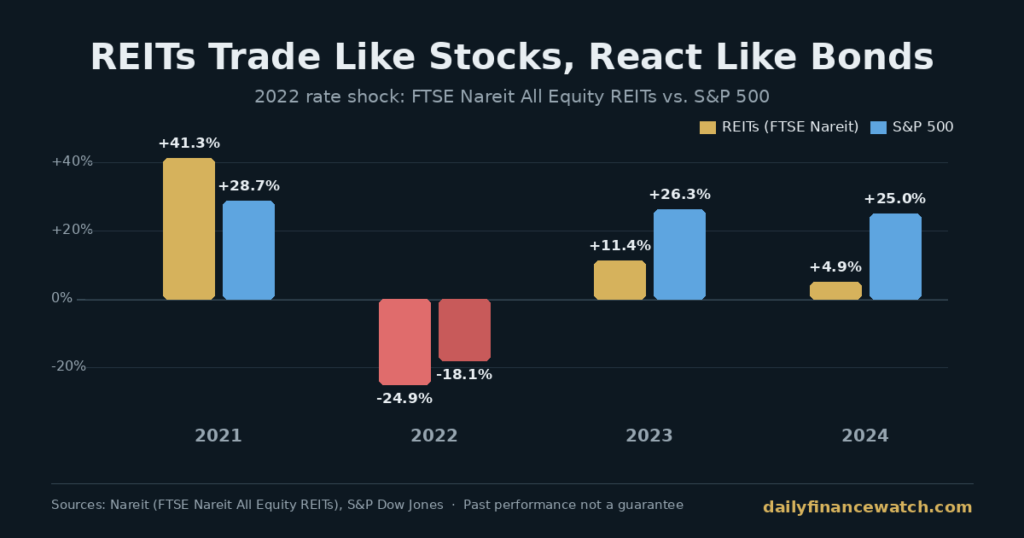
Same year, same rate cycle — REITs behaved like an equity-bond hybrid, not pure real estate.
Tax treatment adds another layer worth understanding. Most REIT dividends are taxed as ordinary income, not at the lower qualified-dividend rate that applies to most regular stocks. This means REIT investing works best in tax-advantaged accounts like IRAs or 401(k)s, where the higher tax on ordinary income does not apply annually. In a taxable account, that tax drag can erode a meaningful part of the headline yield.
Investors often watch a few signals before adding REITs. Fund flows, sector composition, and the shape of the yield curve all inform how much rate sensitivity a REIT position carries. Furthermore, disciplined investors compare REIT dividend yields against 10-year Treasury yields. As of June 30, 2026, the 10-year Treasury yielded about 4.44%, according to the U.S. Department of the Treasury. When Treasury yields rise close to REIT yields, the relative appeal of REIT income narrows.
Common Beginner Mistakes with REIT Investing
Three mistakes appear repeatedly. First, some chase the highest yield without checking whether it comes from a distressed sector like office REITs during a work-from-home shift. Meanwhile, others assume REITs are a stable income source and are shocked when prices fall 20% or more in a single year. In addition, many hold REITs in taxable accounts and lose a large portion of the yield to ordinary income tax.
Investor psychology plays a role here too. Anchoring — the tendency to fix on the first number seen — pushes beginners toward whichever REIT advertises the highest current yield. A steadier approach studies the property type, the debt level, and the interest rate environment first. To build the foundation, review how ETFs differ from mutual funds and what an index fund is, because most beginners access REITs through a low-cost REIT index fund rather than individual REIT stocks.
REIT investing should now read as something different than “owning real estate for passive income.” A REIT is a specific legal structure that distributes at least 90% of taxable income by rule, trades on stock exchanges like any equity, and responds to interest rate cycles the way bonds do. The high headline yield reflects that distribution requirement, not superior returns, and the price behavior can surprise investors who expected the calm of physical real estate. This content is educational, not personalized advice, and all investing carries risk, including possible loss of principal.
What is the difference between an equity REIT and a mortgage REIT?
An equity REIT owns and operates physical properties, earning rent as its main income. A mortgage REIT does not own buildings; it lends money to property owners or buys mortgage-backed securities, earning interest instead. Because mortgage REITs depend on the gap between short-term borrowing costs and long-term lending rates, they can move sharply when the Federal Reserve changes rates, often more than equity REITs.
Why do REITs pay such high dividend yields?
The high yield comes from a legal requirement, not superior performance. To keep their special tax status, REITs must distribute at least 90% of their taxable income to shareholders each year. This forces most of the rental or interest income out as dividends rather than retained inside the company. As a result, headline yields often exceed those of regular stocks, though the underlying business is not necessarily more profitable.
Should beginners hold REITs in a taxable account?
Most REIT dividends are taxed as ordinary income rather than at the lower qualified-dividend rate that applies to typical stocks. Because of this, holding REITs in a taxable account can reduce net returns for investors in higher tax brackets. Many beginners choose to hold REITs inside tax-advantaged accounts like traditional IRAs or Roth IRAs, where the ordinary income tax on dividends does not apply each year.
This content is for educational purposes only and is not personalized financial advice. Investing involves risk, including possible loss of principal.