Last updated: July 1, 2026
In 2022, U.S. investors watched something that had not happened in decades. A broad basket of investment-grade U.S. bonds fell more than 13% in a single year — the worst annual loss for the Bloomberg U.S. Aggregate Bond Index in its five-decade history. Bonds were supposed to be the calm side of a portfolio. That year, they were not.
Understanding bond investing starts with letting go of the “safe savings” framing. A bond is a loan, and its market price changes daily. When the Federal Reserve raises interest rates aggressively, newly issued bonds pay more, which makes older, lower-paying bonds worth less. That mechanism is the single most important thing beginners tend to miss.
What Bond Investing Actually Involves
A bond is a loan from you to a borrower — usually the U.S. government, a state, or a corporation. In return, the borrower agrees to pay you interest at set intervals and to return your original amount, called the principal, on a specific date known as the maturity. According to the U.S. Securities and Exchange Commission’s investor bulletin on bonds, this basic structure applies to nearly every type of bond, from Treasuries to corporate debt.
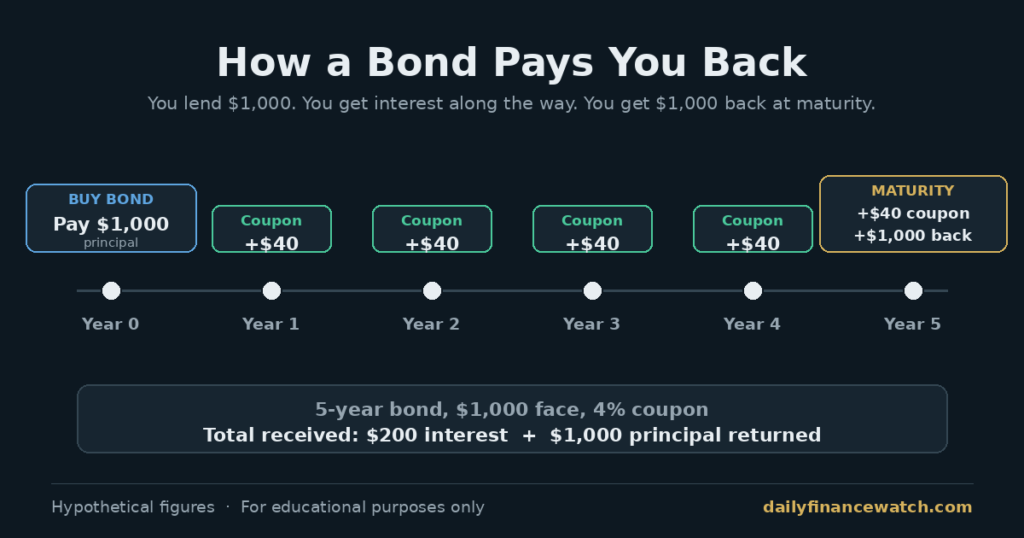
Interest along the way, principal returned at the end — the classic loan structure.
For example, a five-year U.S. Treasury bond with a $1,000 face value and a 4% coupon would pay $40 in interest each year, then return the full $1,000 at maturity. In total, the investor collects $200 in interest plus the original $1,000 back. Hold it to maturity, and the outcome is predictable, assuming the borrower does not default.
However, most bonds do not stay in one hand forever. They trade on markets, and their prices move constantly. This means the return you actually earn depends on both the coupon and any price change while you hold the bond. Therefore, understanding what moves those prices matters as much as knowing the coupon rate.
Why “Bonds Are Safe” Misleads Beginners
Most beginner guides describe bonds as the safe counterweight to stocks. This framing is not wrong, but it is incomplete in a specific way. Institutional allocators separate two distinct risks: default risk (the borrower fails to pay) and interest rate risk (rates move, and prices move against them). A U.S. Treasury bond has almost no default risk. It still carries significant interest rate risk, which the “safe” label quietly hides.
The mechanism is straightforward. Bond prices and interest rates move in opposite directions. When new bonds offer higher rates, older bonds paying less become less attractive, so their prices fall to compensate. In contrast, when rates decline, existing higher-rate bonds become more valuable. Longer-maturity bonds move more than shorter ones for the same rate change.
The 2022 Bond Market Shock
The Bloomberg U.S. Aggregate Bond Index lost roughly 13% in 2022, its worst calendar-year return since the index began in 1976. Before then, the worst year on record was a 2.9% decline in 1994, according to data compiled by Prudential’s PGIM Fixed Income. Longer-dated Treasuries fared worse; an index of long-term zero-coupon bonds fell about 39% that year. The cause was straightforward: the Federal Reserve raised its policy rate from near zero to above 4% inside twelve months, and existing bonds repriced downward.
| Year | Bloomberg U.S. Aggregate Return | Context |
|---|---|---|
| 2020 | +7.51% | Pandemic-era rate cuts |
| 2021 | \u22121.54% | Rates beginning to rise |
| 2022 | \u221213.01% | Worst year on record |
| 2023 | +5.53% | Partial recovery |
| 2024 | +1.25% | Continued recovery |
Source: YCharts, Bloomberg U.S. Aggregate Total Return Index, calendar-year returns as of mid-2026.
By comparison, the same broad bond index posted positive returns in 42 of 46 calendar years from 1976 through 2021. Losses were rare and small. The 2022 shock did not make bonds “risky” in a new way; it exposed a risk that had been quietly present all along.
How Bond Investing Works in a Portfolio
Because bonds pay predictable income and typically fall less than stocks in a downturn, investors often hold them alongside stocks. The classic mix has been 60% stocks and 40% bonds. In most years, when stocks drop, bonds either hold steady or rise — a pattern that smooths overall portfolio swings. Nevertheless, 2022 broke that pattern, as both stocks and bonds fell together during the rate shock.
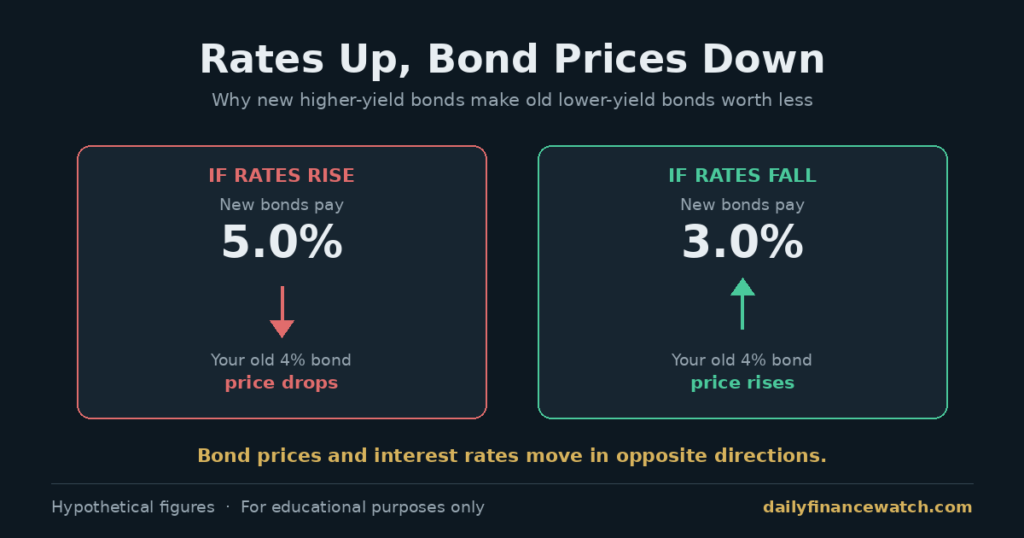
Bond prices and interest rates move in opposite directions — the core mechanism to remember.
The specific type of bond matters. Investors often watch a few distinctions. U.S. Treasuries carry the lowest default risk but full interest rate risk. Corporate bonds pay more, though the extra yield reflects added default risk. Municipal bonds offer federal tax advantages. Short-term bonds move less with rate changes than long-term bonds. A disciplined investor may compare these categories rather than treat “bonds” as a single asset.
Current U.S. Treasury yields provide a snapshot of what bonds pay today. As of June 30, 2026, the 10-year U.S. Treasury yielded roughly 4.44%, according to U.S. Department of the Treasury data. That is meaningfully higher than the near-zero yields of 2020 and 2021. This can indicate why some investors returned to bonds after the 2022 selloff — the income has become more competitive.
Common Beginner Mistakes with Bond Investing
Three mistakes recur. First, some assume that “bond” means “no risk,” then panic when a bond fund drops during a rate cycle. Meanwhile, others chase the highest yield without checking credit quality — junk bonds pay more precisely because default risk is higher. In addition, many treat all bond funds as interchangeable, ignoring that long-duration funds swing far more than short-duration ones for the same rate move.
Investor psychology plays a role here. Recency bias — the tendency to expect the recent past to continue — pushed many investors to hold long-duration bonds when yields were near zero, because they had been quiet for years. Consequently, the 2022 rate shock felt shocking, though the mechanism itself was ordinary. To build the foundation, review how bonds differ from stocks and mutual funds and what an index fund is — bond index funds work on the same principle.
Bond investing should now feel less like a savings account and more like what it actually is: a loan that trades on a market. The income is predictable if you hold to maturity, but the market price along the way responds to interest rate changes. Understanding that distinction is the difference between panicking when a bond fund shows a red number and recognizing why it moved — and whether it matters for your actual holding period. This content is educational, not personalized advice, and all investing carries risk, including possible loss of principal.
What is the difference between a bond and a bond fund?
A single bond has a fixed maturity date and, if held to that date, returns the principal assuming no default. A bond fund holds hundreds of bonds and continuously buys new ones as older ones mature, so it has no single maturity date. As a result, a bond fund’s price reflects daily market movements more visibly, though its diversification reduces the impact of any one bond defaulting.
Why did bonds lose money in 2022 if they are supposed to be safe?
The “safe” label describes low default risk, not price stability. When the Federal Reserve raised interest rates rapidly, newly issued bonds began paying higher rates, which made existing lower-rate bonds worth less on the market. This is called interest rate risk. It applies to every bond, including U.S. Treasuries. Longer-maturity bonds fell most because their locked-in low rates lasted longest.
Should beginners buy individual bonds or a bond fund?
Both have trade-offs. Individual bonds give a known maturity and a predictable payout if held to the end, which some investors prefer for planned expenses. Bond funds offer instant diversification across many issuers and are easier to buy in small amounts, but their prices move daily and never mature. Beginners often choose a low-cost, broad bond index fund for simplicity, though preferences vary.
This content is for educational purposes only and is not personalized financial advice. Investing involves risk, including possible loss of principal.